 PraxiLabs A virtual world of science


Last Updated on December 4, 2025 by Muhamed Elmesery
In today’s fast-evolving world, the use of technology in science education is no longer a luxury—it has become essential. With scientific knowledge expanding rapidly and classrooms shifting toward more interactive learning models.
technology tools for teaching science now play a critical role in helping students understand complex concepts, visualize abstract ideas, and safely explore experiments that may be difficult to conduct in traditional labs.
From virtual simulations to AI-powered learning platforms, technology is transforming science education into an experience that is more engaging, accessible, and aligned with the skills students need for the future.
Table of Contents
What are the uses of technology in science?
Use of technology in science education can be used for several purposes such as solving problems, enhancing experimentation processes, visualizing scientific concepts, making new discoveries, collecting important data easily, creating simulations that mimic real-world situations, and more!
Importance of the use of technology in science education
Importance of technology in teaching science
Use of technology in science education is important because:
- It improves thinking and critical thinking skills.
- It helps students imagine and visualize scientific concepts.
- It makes learning more interactive, immersive, and engaging.
- It provides flexibility and accessibility in learning.
- It enhances conceptual understanding through science simulations, data visualizations, and multimedia tools.
- It offers simulations that mimic real laboratory experiments in science. Students can perform their experiments at their own peace anytime and anywhere by using their computers.
- It prepares students well for a future workforce that is increasingly reliant on digital skills.

How to utilize technology to enhance teaching science?
Utilizing technology in teaching science revolutionizes the ways of education. Let’s explore some of these digital tools:
3D interactive simulations virtual labs
They are virtual environments that simulate real physical labs to help students conduct their experiments in several branches of science (ex: physics, chemistry, biology) in a safe environment away from any risks with features such as flexibility in learning, and cost effectiveness.
These simulations proved their efficiency in enhancing the students’ learning outcomes and retention.
Explore The Virtual Chemistry Lab of PraxiLabs
Gamification by using educational games
Using educational games in learning can motivate and encourage students to participate in the learning process and thus improve their learning outcomes and also enhance their engagement and motivation in learning.
Online e-learning app
An online e-learning app can enhance how science is taught by combining interactive technology, real-time feedback, and flexible access to learning resources. Instead of relying only on textbooks or limited lab sessions, students can explore scientific concepts anytime, anywhere—using tools that make learning more immersive, accurate, and engaging.
How does technology help students visualize abstract concepts?
By mimicking or replicating real physical lab conditions and experiments in a virtual learning environment. They allow students to conduct experiments, manipulate variables, and observe results just as they would in a physical lab.
Simulation labs use software and computer models to replicate the equipment, procedures, and experiments that would typically be conducted in a physical lab.
What is the value of digital tools in science classes?
According to the results of the study, they indicate a significant difference in student engagement and academic performance between traditional and technology-enhanced teaching methods.
Quantitative analysis revealed that students in the technology-enhanced group demonstrated a considerable improvement in their understanding of complex scientific concepts. Specifically, the average post-test scores for the technology-enhanced group were 85%, compared to 65% for the traditional group, indicating a statistically significant difference.
In surveys, 90% of students indicated that digital tools made learning more enjoyable and interactive.
Explore: Importance of Virtual Learning Websites for Academic Institutions
Virtual labs as a use of technology in science education
- Just imagine that your students can conduct difficult experiments remotely from their own home or classroom, without feeling pressured and with no need to go to the real lab or provide expensive materials and equipment.
- Virtual labs are now vital in science education. Students can do experiments easily anytime and anywhere by using simulations in an interactive virtual environment without the need for real laboratory tools.
- They provide students with tools, materials, and techniques set up on computers to do experiments or on websites. This improves the student’s learning outcomes by creating a more immersive learning experience for students and enhancing their engagement.
- Educational institutes can benefit from the power of virtual laboratories in science education by integrating them with immersive digital lab environments that support STEM education.
- By using virtual labs, tasks like grading assignments and monitoring student progress can be done automatically, allowing teachers to spend more time interacting with students and focusing on their individual educational needs.
Explore: Advantages of simulation based learning in classrooms
What are the challenges of integrating technology in science education?
One of the big challenges of technology integration in science education is that it negatively affects the direct interaction among students and educators, and it also reduces the interaction between students and teachers because communication between them is not direct most of the time.
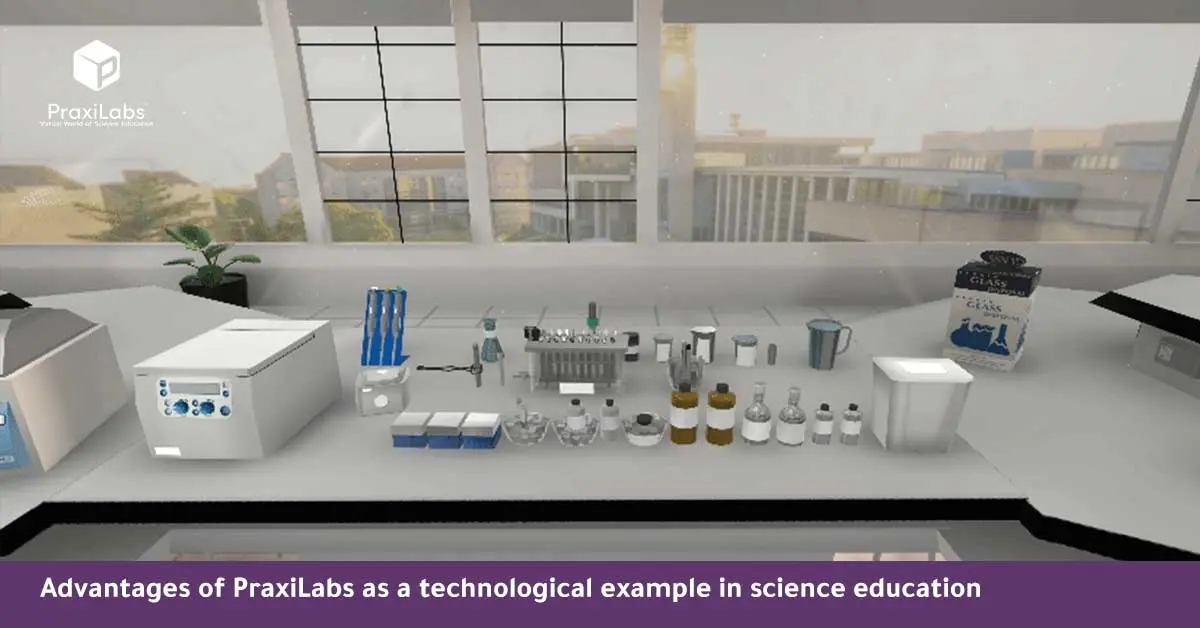
Advantages of PraxiLabs as a technological example in science education
PraxiLabs stands out as one of the most effective technological innovations transforming science education today. By offering fully interactive, 3D virtual science labs, PraxiLabs gives students the freedom to conduct experiments anytime and anywhere—without the limitations, risks, or costs of traditional physical labs.
Its simulations replicate real-world laboratory conditions with high accuracy, allowing learners to practice procedures, make mistakes safely, and repeat experiments as many times as needed to master scientific concepts. With built-in guidance, instant feedback, and rich multimedia explanations, PraxiLabs enhances understanding and boosts student confidence.
The platform also empowers educators through detailed analytics, customizable lessons, and seamless integration into learning management systems.
As a result, PraxiLabs not only enriches teaching and learning but also makes high-quality science education accessible, flexible, and scalable for schools and universities worldwide.
Frequently Asked Questions
What role does technology play in STEM education?
The role of technology in science education is that the technological tools can enhance students’ engagement, develop their critical thinking, and improve their learning outcomes.
What are the advantages of technology for students?
There are several advantages of technology for students such as allowing students to do experiments easily anytime and anywhere by using simulations in an interactive virtual environment without the need for real laboratory tools.
How does the use of technology affect teaching profession?
By enhancing instruction through personalized learning and interactive tools, automating administrative tasks to free up time, and expanding professional development opportunities