 PraxiLabs A virtual world of science

Last Updated on December 18, 2025 by Muhamed Elmesery
Remember those days hunched over a microscope, or carefully mixing chemicals in a beaker? Science education has always been deeply rooted in hands-on experience.
But what happens when the classroom moves online? Far from being a limitation, the rise of virtual teaching techniques has unleashed a powerful transformation in how we teach—and learn—science.
From immersive simulations that bring complex concepts to life, to collaborative virtual labs that connect students across continents, digital tools are breaking down barriers, making science more accessible, engaging, and relevant than ever before.
Let’s explore how these innovative approaches are not just adapting science education, but fundamentally transforming it.
Table of Contents
What are virtual teaching techniques?
Virtual teaching techniques are methods and strategies educators use to deliver instruction, facilitate learning, and engage students in an online environment. The most effective techniques focus on active learning, building community, and leveraging virtual teaching technology to create a dynamic and accessible educational experience.
Importance of tech-based education
- Tech-based education improves the quality of learning and education and its outcomes through flexibility and customization, increased accessibility, and enhanced student engagement and collaboration.
- It also allows students to learn at their own pace and provides content specifically designed to meet individual needs, while also expanding access to educational resources and creating new opportunities for interaction between students and teachers.
- Studies show a positive impact on student performance and engagement, although success depends on factors such as digital literacy and effective platform design.
- The impact of online learning on student performance has been documented in many studies. These studies show a positive effect on student performance and engagement, although success depends on factors such as digital literacy and effective platform design.
What makes virtual learning more interactive?
Virtual learning techniques becomes more interactive through tools like:
- 3D virtual simulations.
- Multimedia.
- Tutorial videos.
- Gamification methods.
- collaboration activities.
- Virtual teaching and learning platforms.
- E-learning apps.
- Online quizzes.
- Virtual student teaching.
Promising practices for effective virtual teaching
Effective virtual teaching techniques and practices include:
- Building a strong online community.
- Share feedback.
- Foster community through collaborative tools.
- Give learners control.
- Personalized learning.
- Promote active learning.
- Analyzing student data.
- Ask your pupils for feedback.
- Be Accessible.
Explore: Major Advantages of Virtual Education in Universities
Benefits of using simulations as a curriculum technique
Virtual simulation as curriculum virtual teaching techniques contribute by providing educational simulations and virtual teaching programs for learning sciences, offering virtual science labs that closely mimic real labs, but in a digital environment that gives students additional benefits such as the ability to conduct various experiments at any time and from anywhere.
Let’s explore the main features of virtual science labs for students and institutions:
Interactive Environment:
Virtual science simulations provide an immersive and hands-on interactive experience that simulates the real lab environment, giving students the opportunity for practical learning in a realistic manner.
Scalability:
For institutions that need to train a large number of students at the same time, virtual labs are the ideal choice. They can accommodate hundreds of users simultaneously, making them highly scalable without the need for additional infrastructure.
Enhanced Knowledge Retention:
Virtual labs offer scenario-based interactive learning, which enhances learners’ retention of information and increases their engagement. They are also easily accessible to large numbers of students.
Navigation:
Virtual labs work with any device connected to the internet. Whether students use a desktop computer, a laptop, a smartphone, or a tablet, virtual labs are compatible with all devices and common operating systems, with minimal system requirements and browser capabilities.
Data Analysis and Tracking:
Virtual labs allow precise tracking of learners’ progress, enabling teachers to know each student’s current status, the steps they have completed, and areas that need improvement, while providing multimedia reports that help develop the educational process.
Enhancing Safety:
Using a virtual lab ensures that learners are protected from any hazards they might encounter during training in real labs. It is an effective way to prevent lab accidents by completely eliminating the handling of hazardous materials. Therefore, virtual labs provide a safe environment for learners and ensure their full safety.
Why does ed-tech become a necessity in universities?
Because ed-tech has a great advantage which is flexibility. Universities that offer a distance ed-tech system are considered a flexible and ideal way for students with other responsibilities and jobs to obtain university degrees.
Other advantages of ed-tech in distance learning colleges include:
- Lower overall costs (more affordability).
- A wide variety of programs and online courses.
- Location independence, which helps students find the right online college that suits their situation and goals, regardless of their geographical location.
Explore: Why the Use of Technology in Science Education Is Becoming Essential?
How does PraxiLabs support virtual teaching techniques?
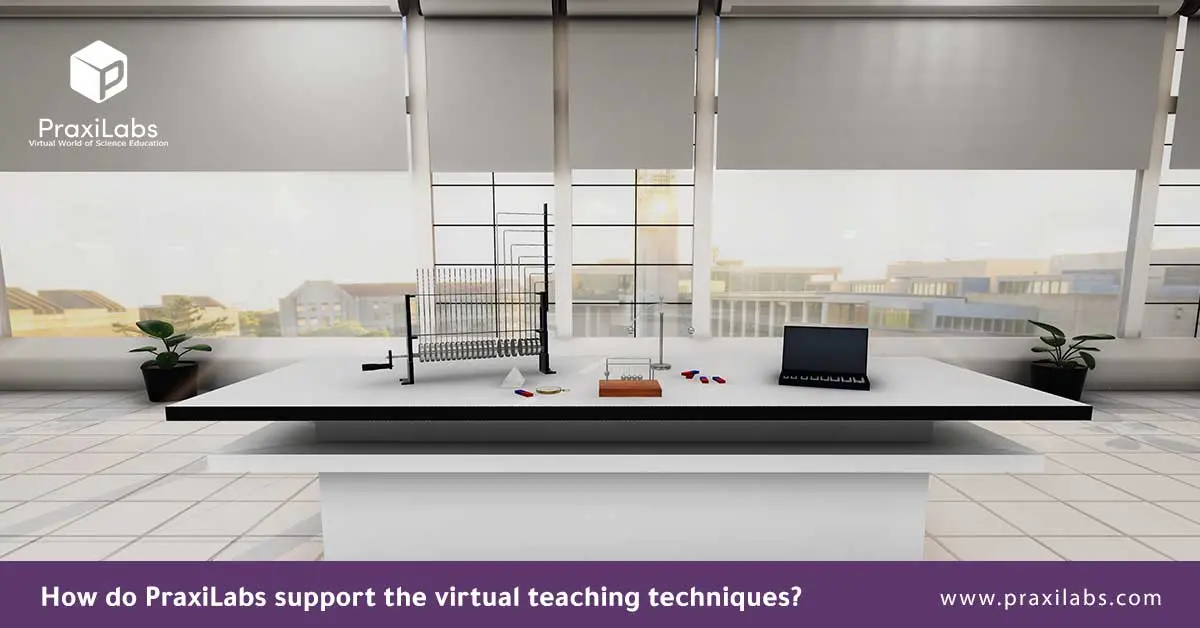
In response to the challenges posed by virtual teaching, universities have increasingly partnered with institutions like PraxiLabs to provide virtual lab simulations across their colleges. These interactive virtual labs have been shown to increase student engagement and retention of learning.
With PraxiLabs, students can learn actively while conducting their experiments.
- 65% of learners are visual: Praxilabs provides various forms of multimedia.
- 30% are auditory: Praxilabs uses voice guidance.
- 5% are kinesthetic: Praxilabs offers a more “hands-on” virtual experience.
In addition to the main virtual labs we offer, PraxiLabs also provides custom virtual labs and simulation solutions specifically designed to meet the needs of organizations.
Whether your organization needs simulations for various science experiments or, for example, a virtual mechanical workshop, PraxiLabs can design these labs and help you save costs on expensive equipment and space.
Frequently Asked Questions
What is the virtual method of teaching?
There are several methods of virtual teaching techniques such as multimedia, tutorial videos, gamification methods, collaboration activities, E- learning apps and platforms, online quizzes and more!
Could virtual teaching become the global standard?
While virtual teaching methods are rapidly growing and becoming a key part of the global educational landscape, it is unlikely to entirely replace traditional, in-person instruction and become the sole global standard
What are the different teaching approaches in interactive classrooms?
interactive classroom teaching uses student-centered approaches like project-based learning, and inquiry-based learning.