 PraxiLabs A virtual world of science

Last Updated on January 2, 2026 by Muhamed Elmesery
Understanding optics concepts like reflection, refraction, and image formation by lens system simulation can be challenging when students rely only on static diagrams or equations.
Optics simulations transform these abstract ideas into interactive visual experiences, allowing learners to trace light rays, adjust angles, and instantly observe how images form and change.
By experimenting in a virtual environment, students gain clearer intuition, stronger conceptual understanding, and the confidence to apply optical laws to real-world scenarios—before ever stepping into a physical lab.
Table of Contents
What is optics simulation?
Optics simulation online is a computer-based environment that mimics how light behaves in different optical system simulations such as interactive lens simulation, mirrors, optical fibers, sensors, and displays, to predict performance like reflection, refraction, and diffraction (reflection and refraction simulation).
Optics simulations have several benefits such as saving money, flexibility, safety, a game-like experience, and more.
Benefits of optics simulation in education
Using online optics simulations in education offers numerous benefits for both students and educational institutions. Here are its key advantages
Visualizing Invisible Concepts
With a virtual optics lab, abstract optics concepts such as reflection, refraction, and diffraction can be visualized, helping to bridge the gap between theory and practice and providing students with a deeper understanding of the subject.
Safe and Cost-Effective
There is no need for expensive laboratory equipment—students can perform optical simulation experiments using their own devices. There is also no need to worry about potential hazards (such as electrical, thermal, or laser risks).
Interactive Learning and Skill Development
Students learn optics concepts in an immersive and interactive environment, where they can modify variables and see the results immediately.
Virtual labs enhance critical thinking and active learning skills, rather than merely engaging in passive observation.
Explore: Modern Physics Simulations for High School and University
Optics concepts that can be best visualized by simulation
Optics simulation software is especially powerful in optics because many phenomena involve invisible rays, wave behavior, or dynamic changes that are hard to capture with static diagrams or real lab setups.
| Optics Topic | Key Concepts | Why Simulation Works Best |
| Reflection & Refraction | Laws of reflection, Snell’s law, critical angle, total internal reflection | Shows ray bending and angle changes dynamically |
| Mirrors | Concave & convex mirrors, real vs virtual images, focal length | Visualizes image formation as object position changes |
| Lenses | Convex & concave lenses, magnification, image properties | Instant ray tracing and live image updates |
| Wave Optics | Interference, diffraction, Young’s double-slit experiment | Makes invisible wave behavior and fringes visible |
| Dispersion & Color | Prism dispersion, spectrum, wavelength dependence | Tracks different wavelengths and color separation |
| Polarization | Polarizers, analyzers, Malus’ law | Visualizes light orientation and intensity variation |
| Optical Instruments | Microscope, telescope, human eye & vision defects | Simplifies complex multi-lens ray paths |
| Fiber Optics | Total internal reflection, light guiding | Clearly shows light confinement inside fibers |
| Thin Film Interference | Soap bubbles, coatings, oil films | Explains color patterns via path difference |
| Lasers & Coherence | Coherent light, beam propagation | Demonstrates coherence effects not visible in real labs |
Are there any limitations for optics simulation?
Optics simulations are powerful, but they do have clear limitations. Understanding these helps educators and students use simulations correctly, not as a full replacement for real experiments.
According to studies, there are some criteria for a good computer simulation for classroom use:
- The simulations should be true to life. That is, they should simulate the activity so well that there is little difference between the simulated environment and the real one, and the same kind of learning experience can take place.
- The simulations should be “hands-on,” involving the students so that the students become participants in the simulation activity.This implies that students interact with the simulation, for example, by changing parameters, changing lines in the code, discussing the simulated results, etc.
Explore Praxilabs Science Simulations List
What makes PraxiLabs the best optics simulator?
At PraxiLabs, our vision is to build the most effective and engaging scientific educational platform in the world. We offer a variety of experiments that enhance learning through practical and interactive experiences.
PraxiLabs serves as an effective alternative to traditional laboratory environments (optics simulation software) during financial constraints and limited resources, ensuring that students receive comprehensive and hands-on education.
Our virtual labs features:
Scalability and Customization:
We provide flexible solutions that can be tailored to meet your institution’s goals, curriculum standards, and diverse student needs.
Comprehensive Question Bank:
The question bank at PraxiLabs gives teachers the tools needed to design accurate and customized assessments that seamlessly align with course objectives and learning outcomes.
This feature enables educators to go beyond generic tests, offering flexibility, fairness, and full control in evaluating students’ progress—ensuring assessments are accurate, interactive, and tailored to each learner’s needs.
Flexibility and Accessibility:
The PraxiLabs optics virtual simulations program is available anytime, anywhere—on desktops, tablets, and smartphones.
Instant feedback and progress tracking:
While performing online optics simulations, students receive hints, model answers, and instant feedback at every stage. Teachers can also track progress in real time through detailed insights.
List of optics concepts offered by PraxiLabs
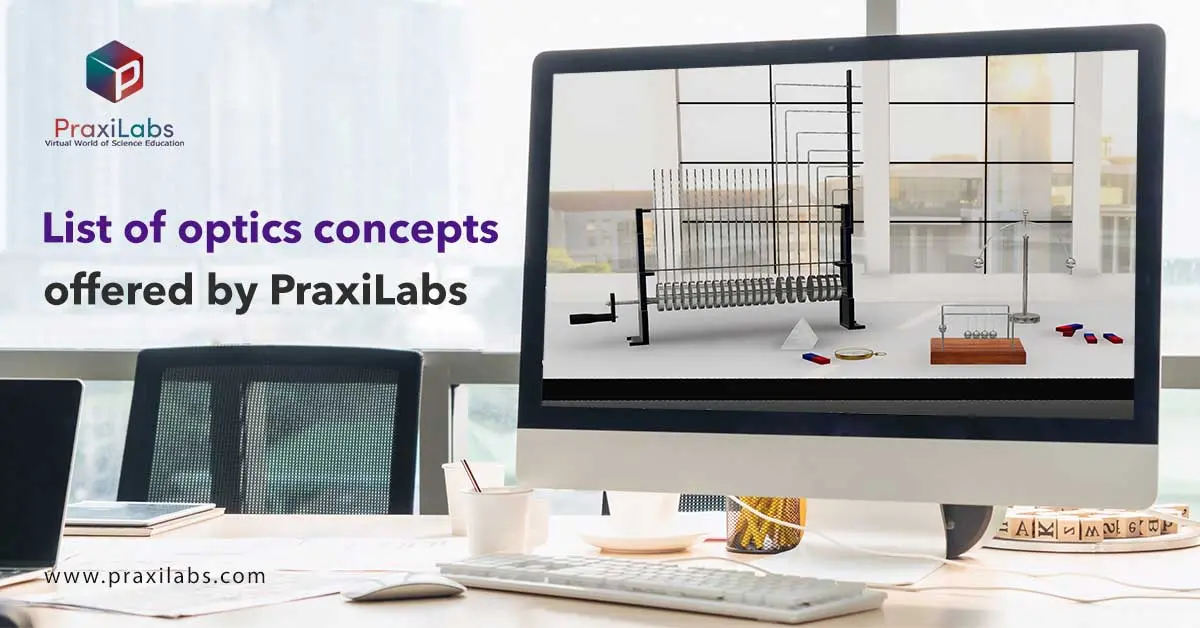
Optics Lab Simulation
PraxiLabs virtual labs provide optics lab simulations to study the interference and diffraction phenomena of light.
Monochromatic light (Laser), when passed through a screen with two (or one) slits, produces an interference (or diffraction) pattern on a distant screen.
Analyzing the observed pattern shows that equidistant bright and dark fringes are obtained on the observing screen. Also, different patterns can be obtained by using slits of different shapes and /or using an ordinary light source instead of the laser source.
By the end of this experiment, the student should be able to:
- Define the interference and diffraction phenomena of light.
- Describe Young’s double slit experiment for light.
- Use the double slit experiment to determine the width of a very thin object (human hair).
- Understand the effect of replacing the monochromatic light source with a white (polychromatic) light source on the observed pattern.
- Study the single-slit diffraction pattern.
Explore PraxiLabs’ Virtual Physics Lab Optics Experiments
Laser Electro-Optic Effect
PraxiLabs provides optics virtual labs such as laser electro-optic effect simulations to determine the half-wave voltage for a Lithium niobate crystal using the electro-optic effect, and to determine the electro-optic coefficient of a lithium niobate crystal.
Monochromatic polarized light (laser) is incident on a lithium niobate crystal that is placed at 45o with the vertical. Applying an electric field to the crystal causes it to become birefringent. The phase shift between ordinary and extraordinary light is found to depend on the square of the electric field.
By the end of laser optics virtual lab, the student should be able to:
- Understand the electro-optic effect in a lithium niobate crystal.
- Set up an experiment to study the electro-optic phenomenon.
Frequently Asked Questions
Can simulations be used in advanced optics research?
Yes, optics simulations are indispensable in modern optics research. They save time, reduce costs, and allow exploration of phenomena that may be difficult, dangerous, or impossible to observe experimentally.
How accurate are optics simulations results?
Optics simulations in advanced optics research can be very accurate, but their accuracy depends heavily on the methods used, how they are set up, and whether they’re validated against real‑world experiments.