 PraxiLabs A virtual world of science

Last Updated on February 18, 2026 by Muhamed Elmesery
The rapid evolution of educational technology has reshaped how knowledge is delivered, experienced, and retained. Among the most impactful innovations are virtual environments in education—immersive, interactive digital spaces that allow learners to explore complex concepts beyond the limits of traditional classrooms.
In science education in particular, virtual environments are no longer a luxury; they are becoming a strategic necessity for institutions seeking scalable, safe, and effective learning solutions.
This article explores what virtual environments in education are, their benefits, who can gain the most value from them, and how platforms like PraxiLabs are redefining online virtual education and science learning worldwide.
Table of Contents
What are Virtual environments in education?
Virtual environments in education are web-based platforms that enable educators to manage their courses and interact with their students remotely in a virtual learning environment that replicates the real classroom.
In science education, virtual environments often take the form of:
- Virtual laboratories.
- Simulated ecosystems.
- Interactive 3D models.
- Scenario-based scientific experiments.
Benefits of virtual environments in education
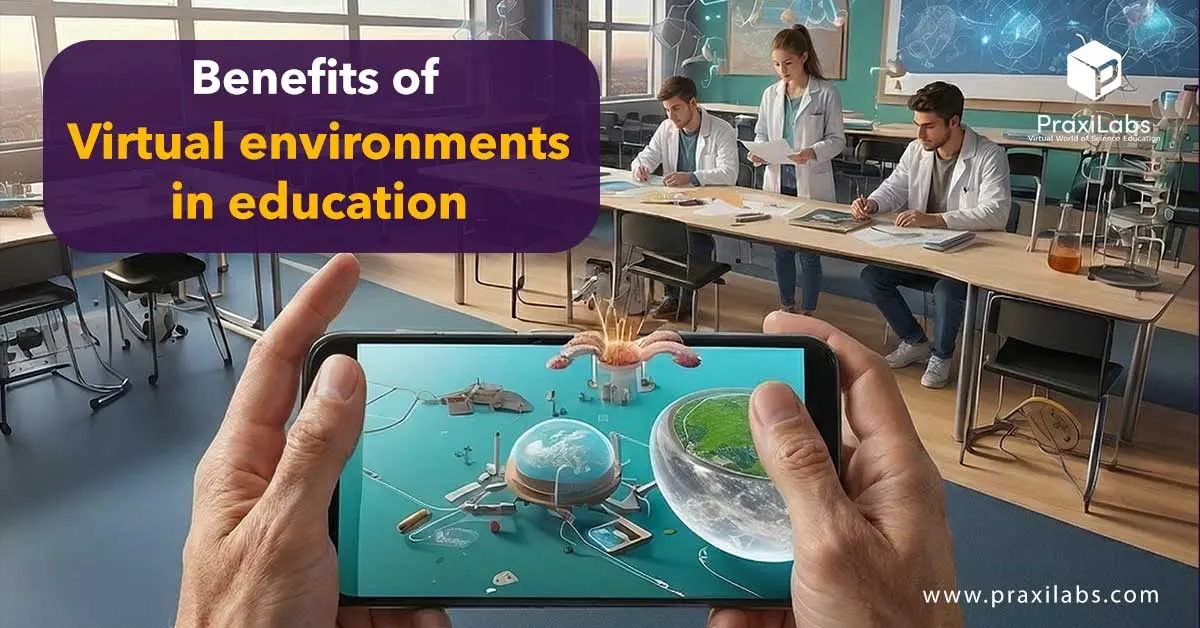
Unlike static e-learning tools, virtual environments enable hands-on virtual learning in education without physical constraints, allowing students to repeat experiments, visualize abstract processes, and safely explore complex or hazardous scenarios. Let’s explore more benefits:-
Turning Concepts into Experiences:
Interactive virtual environments help students visualize abstract ideas, making complex scientific principles easier to understand.
Building Critical Thinking Skills:
Students learn to observe, hypothesize, test, and analyze—essential skills at the core of STEM education.
Increasing Motivation and Curiosity:
Virtual environments of various types spark enthusiasm and encourage students to ask questions and explore further.
Improving Information Retention:
Learning through hands-on virtual environments helps students remember concepts better than traditional lecture-based methods.
Preparing Students for Real-World Science:
Virtual environments reflect real scientific practices, equipping learners with the practical and analytical skills needed for future careers.
Supporting Safe and Inclusive Learning:
Virtual environments in education, such as virtual and interactive lab simulations, allow for repeated practice in a risk-free environment, ensuring equal access for all learners.
Who can benefit from Virtual environments in education?
Virtual environments are adaptable and valuable across multiple educational and research contexts.
– Universities
Universities can integrate virtual environments into undergraduate and postgraduate programs to:
- Support large student cohorts.
- Standardize lab experiences.
- Enhance research-based learning.
– Educational Institutions
Integrating virtual environments helps educational institutions in:
- Eliminating hazardous materials and safety risks.
- Scaling easily beyond physical space limitations.
– High Schools
For secondary education, virtual environments:
- Introduce students to scientific inquiry early.
- Make complex topics accessible and engaging.
- Compensate for limited lab resources.
- Encourage experimentation without fear of failure.
– Researchers
Researchers use virtual environments to:
- Model scientific scenarios.
- Train students and assistants efficiently.
Explore: Advantages of simulation based learning in classrooms
Types of environmental science that can be studied virtually
Environmental science is a broad, interdisciplinary field—and today, many of its core areas can be explored effectively through virtual labs and science simulations. Here are the main types of environmental science that can be studied virtually:
- Ecology and Ecosystem Science
Students can simulate food chains, population dynamics, biodiversity changes, and ecosystem disruptions to understand how living organisms interact with their environment.
- Climate Science
Virtual models allow learners to explore greenhouse gases, global warming scenarios, carbon cycles, and long-term climate change predictions using real-world data.
- Environmental Chemistry
Through digital labs, students can analyze water quality, soil contamination, acid rain formation, and pollutant behavior—safely and without hazardous materials.
- Hydrology and Water Resource Management
Watershed modeling, groundwater flow, flood simulations, and water conservation strategies can all be studied through interactive virtual simulations.
- Environmental Microbiology
Students can virtually explore microbial processes such as decomposition, wastewater treatment, and bioremediation.
- Renewable Energy and Sustainability
Virtual platforms allow experimentation with solar, wind, and energy efficiency systems, helping learners evaluate sustainable solutions.
- Conservation Biology
Species protection strategies, habitat fragmentation, and biodiversity preservation can be modeled in simulated environments.
Outcomes of integrating Virtual environments into science education
According to studies that show the outcomes of integrating virtual environments in education and science learning such as virtual reality, the results indicate that students in the VR group demonstrated higher levels of engagement and retention than those in the control group.
Key findings include:
- Improved Understanding and Retention: The VR group scored 25% higher on post-tests compared to the control group. Students in the VR group reported that the interactive nature of VR helped them understand complex concepts more easily.
- Increased Engagement and Motivation: Survey results showed that 85% of students in the VR group found the lessons more enjoyable and engaging. Many students reported feeling motivated to learn more about STEM topics after the VR experience.
- Positive Feedback on Accessibility and Interactivity: Students noted that the ability to interact with and visualize abstract scientific processes, such as chemical reactions and cellular structures, was a key benefit of using VR.
Explore: Interactive STEM Websites for Mastering Science Experiments
What makes PraxiLabs the best virtual labs provider?
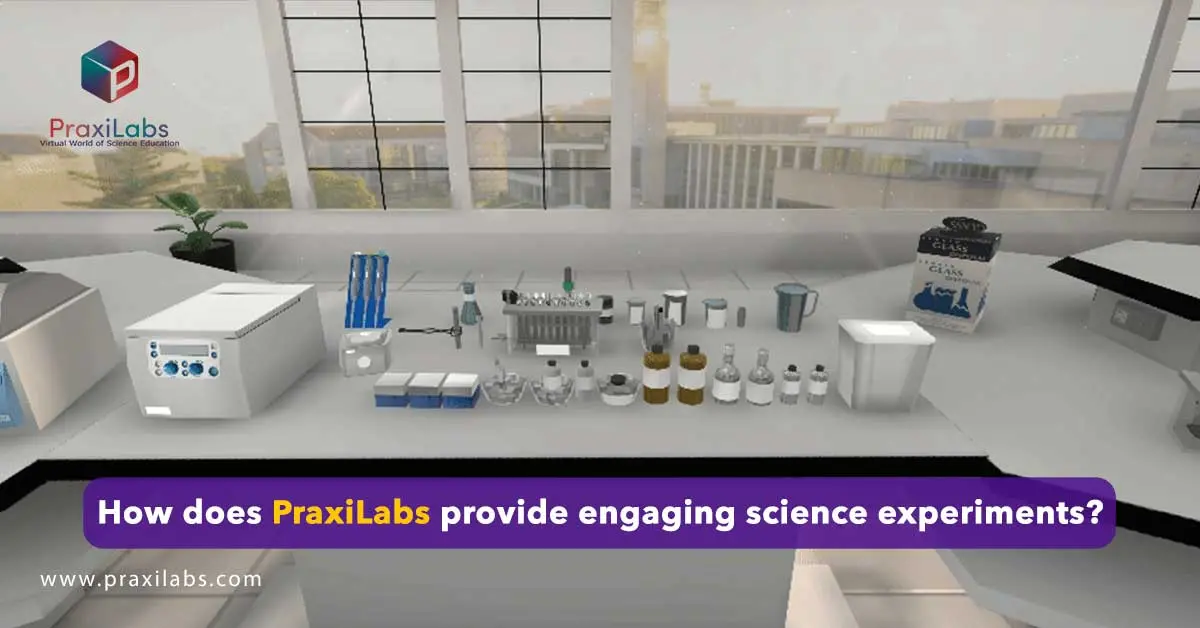
With PraxiLabs, one of the leading simulation platforms in education, students actively learn while conducting their experiments using its educational simulation software.
Students gain a complete learning experience, with guidance and educational materials that assist them throughout the learning process, rather than simply observing experiments.
According to a research article that studied the impact of integrating virtual laboratories in chemistry lessons among 22 pre-service teachers enrolled in a Bachelor of Education program using PraxiLabs virtual labs,the quantitative data analysis revealed a significant positive shift in the experimental group’s attitudes post-intervention.
The results suggest that virtual lab experiences enhance learning and student engagement. Specifically, participants exhibited improved understanding of educational methodologies and a higher level of engagement during physical lab work.
These findings support the view of virtual laboratories as a viable and effective supporting tool for science education and confirm the effectiveness of PraxiLabs as a science virtual lab provider, highlighting an excellent user experience, ease of use, variety of experiments, and accurate simulation.
Frequently Asked Questions
What is the concept of virtual environment?
A virtual environment in education is a digitally created, computer-generated space that simulates real-world or imaginary settings in a virtual academic learning environment, allowing users to interact, explore, and perform tasks as if they were physically present.
What are the 4 types of learning environments?
The four types of learning environments:
- Traditional: Face-to-face classroom learning.
- Online: Fully digital, remote education virtual learning.
- Blended (Hybrid): Combination of in-person and online learning.
- Experiential: Hands-on, learning by doing.