 PraxiLabs A virtual world of science


Last Updated on March 1, 2026 by Muhamed Elmesery
In today’s fast-evolving educational landscape, universities and schools are turning to science virtual learning to revolutionize STEM education.
By providing immersive, interactive, and safe science lab simulations, virtual labs allow students to explore complex experiments anytime, anywhere — overcoming the limits of physical labs.
From enhancing conceptual understanding to enabling data-driven insights for educators, virtual labs are transforming the way science is taught and learned, making quality STEM education more accessible and engaging than ever.
In this blog post, we will learn more about science virtual learning, advantages of using virtual technology for science learning, and obstacles that science virtual learning overcomes.
Table of Contents
What is science virtual learning?
Science virtual learning is a digital learning method that enables students to study their scientific curricula (e.g., biology, chemistry, physics, engineering) in a virtual environment that replicates the real classroom and physical lab.
Science virtual learning depends on online platforms and interactive science websites that provide virtual simulations where students can safely conduct experiments, manipulate variables, and visualize complex concepts anytime, anywhere.
Advantages of using virtual technology for science learning:
Using virtual technology such as virtual laboratories for science learning has several benefits and advantages, ranging from changes in the teachers’ roles and new possibilities for the teaching of experimental inquiry, to improved learning opportunities for students, which support the development of both scientific literacy and specific conceptual competencies.
We can summarize the main advantages of using virtual technology like virtual lab simulations as following:
- Improving students’ sense of self-efficacy and fostering a more self-regulated approach to learning.
- The possibility of manipulating multiple representational modes, with which students can make observations in both the macro- and the micro-world
- Virtual laboratories provide educators with improved opportunities for both explicit and implicit teaching. As for explicit teaching, virtual labs (VLs) can be used in presenting and discussing physical concepts in an interactive way.
- Fostering a general attitude of open-minded inquiry, which values experimentation and therefore leads to increased reliability in knowledge acquisition.
- Developing greater epistemic motivation when subsequently performing a physical hands-on experiment.
- The integration of cognitive with meta-cognitive experiences which affect attitude changes, such as positive feelings and intrinsically motivating issues.
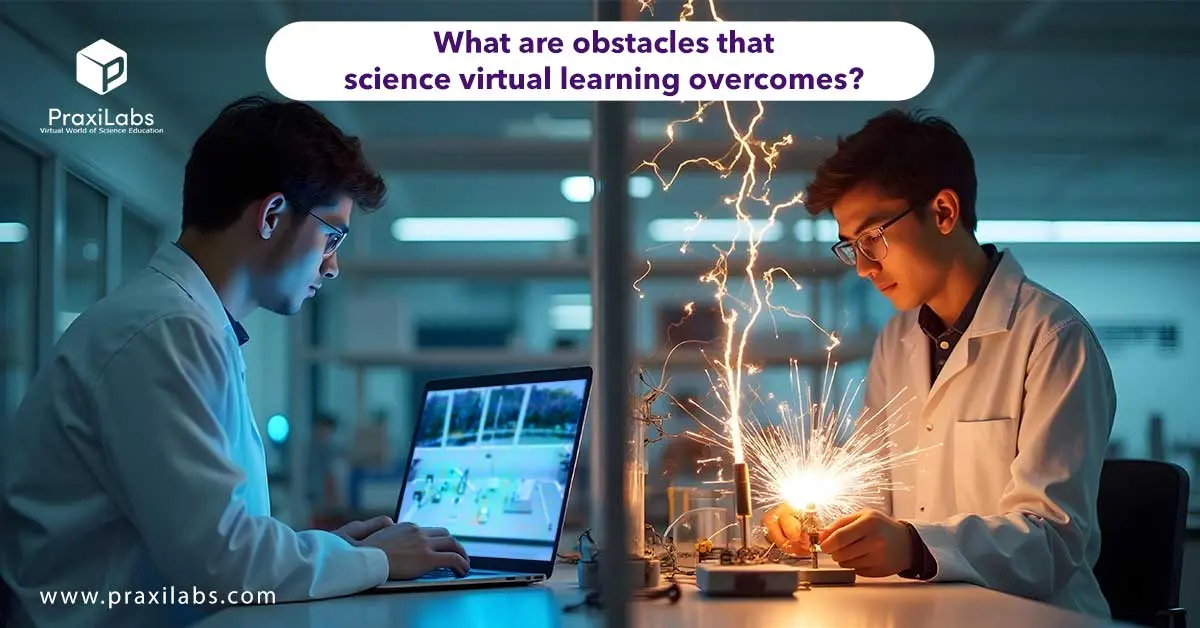
What are obstacles that science virtual learning overcomes?
The key obstacles that science virtual learning overcomes include:
- Limited access to physical labs (lack of equipment, lab space, or infrastructure).
- High costs of lab materials and maintenance.
- Safety risks from hazardous chemicals or complex experiments.
- Time constraints during limited lab sessions.
- Geographical barriers for remote or underserved students.
- Equipment shortages in overcrowded classrooms.
- Inconsistent experiment results due to human error.
- Difficulty repeating experiments for mastery.
- Lack of exposure to advanced scientific instruments.
- Disruptions such as pandemics or school closures.
- Limited hands-on practice in online learning environments.
- Fear of making mistakes in high-risk lab settings.
Future trends in science education with virtual labs:
The following table summarizes the five most important future trends in science education with virtual labs:
| Trend | What It Means | Why It Matters |
| AI-Driven Personalized Learning | Virtual labs adapt experiments, difficulty levels, and feedback based on each student’s performance. | Improves learning outcomes by addressing individual strengths and weaknesses. |
| Immersive Technologies (AR/VR) | Use of augmented and virtual reality to create highly realistic lab simulations. | Increases engagement and helps students better visualize complex scientific concepts. |
| Blended & Hybrid Learning Models | Combining virtual labs with physical lab experiences by using science learning websites for students. | Maximizes flexibility while preserving hands-on skill development. |
| Data-Driven Insights & Learning Analytics | Advanced dashboards track student progress and experiment performance. | Enables educators to make informed instructional decisions and early interventions. |
| Cloud-Based & Anywhere Access | Web-based virtual labs accessible on multiple devices without location limits. | Expands access to quality science education globally and supports remote learning. |
Explore PraxiLabs science virtual learning plans:
Regardless of the plan type, PraxiLabs provides a comprehensive virtual science learning environment that includes:
- Immersive 3D science simulations that mirror real labs.
- Real-time guidance and feedback during experiments.
- Unlimited attempts and repeatability for mastery learning.
- Performance analytics and progress reports for educators and students.
- A custom quiz builder and integrated assessments.
- Seamless LMS integration with systems like Moodle, Canvas, and Blackboard.
- Multi-language support (English and Arabic).
- 24/7 technical support & onboarding assistance for institutional customers.
PraxiLabs plans are flexible and scalable — from free starter access for individual learners to enterprise-grade solutions for schools and universities looking to empower STEM education with virtual labs.
Discover our individual learners and institutions plans

Why is PraxiLabs trusted by many universities and international schools?
Our growing list of partnerships reflects the trust leading educational institutions have in our platform, including:
- Prestigious international partnerships such as DeVry University in the USA, the University of Naples in Italy, and the University of Valencia in Spain.
- Leading partnerships in the Arab world, most notably Ain Shams University, Benha University, Al-Azhar University, Alexandria University, Cairo University – Faculty of Nanotechnology, and Galala University.
- Strategic partnerships in Saudi Arabia with King Faisal University, King Khalid University, and King Saud University.
Moreover, we have a strong presence in high schools and specialized educational institutions worldwide, from Lamuel High School in the United States to the Advanced Education School in Saudi Arabia and Blue Sands Academy in Nigeria.
Here are the key reasons PraxiLabs is trusted by many universities and international schools:
-
High-Quality, Realistic Simulations
PraxiLabs delivers immersive 3D virtual labs that accurately mimic real laboratory environments — giving students the look, feel, and decision-making experience of real experiments without real-world risks.
-
Proven Educational Impact
Institutions choose PraxiLabs because it supports measurable student learning outcomes, deepens conceptual understanding, and improves retention through repeatable hands-on practice.
-
Safe & Scalable Learning
Virtual labs eliminate safety hazards, reduce cost barriers, and can be scaled to support large cohorts — making them ideal for universities and international schools with diverse class sizes and resource constraints.
-
Advanced Tracking & Analytics
Robust reporting tools let educators monitor progress, identify struggling students early, and tailor instruction based on data — helping institutions maintain high academic standards.
-
Seamless Integration with Teaching Systems
PraxiLabs integrates smoothly with popular LMS platforms (e.g., Moodle, Blackboard, Canvas), fitting into existing educational workflows without disruption.ob
Start your free trial today and discover how PraxiLabs can elevate your science education experience.
Frequently Asked Questions
What does virtual study mean?
Virtual learning, also known as e-learning or e-learning, is an innovative educational method that uses digital technology to produce educational content and provide interactive learning experiences over the Internet.
What are the obstacles of applying virtual learning?
They include Limited access to physical labs, safety risks from hazardous materials or complex experiments, time constraints during limited lab sessions, and high costs of lab materials and maintenance.
What are safety advantages of online science labs?
Students can’t injure themselves or others, and there’s no risk of damaging costly equipment. Instead, they’re free to explore, experiment, and learn from missteps—all within a safe, controlled setting.