 PraxiLabs A virtual world of science

Last Updated on March 24, 2026 by Muhamed Elmesery
Understanding motion is fundamental to physics, yet concepts like force, inertia, and acceleration can be difficult to grasp through equations alone. Laws of motion simulation labs bridge this gap by transforming abstract principles into interactive experiences.
Through dynamic simulations, students can apply forces, adjust variables, and instantly observe how objects move according to Newton’s laws of motion. This hands-on digital approach helps learners visualize complex concepts, experiment safely, and build a deeper understanding of how motion works in the real world.
Table of Contents
What is the laws of motion simulation?
Laws of motion simulations are immersive and interactive 3D virtual environments that simulates, visualizes, and analyze Newton’s three laws of motion in classical mechanics:
- First law ( Law of Inertia): an object at rest stays at rest, and an object in motion stays in motion at a constant speed and in a straight line unless acted upon by an external unbalanced force.
- Second law (F=ma): The net force on an object is equal to its mass multiplied by its acceleration.
- Third law (Action-Reaction law): For every action, there is an equal and opposite reaction; if one object exerts a force on a second object, the second exerts an equal and opposite force on the first.
Laws of motion simulations allow users to manipulate variables like force, mass, and friction in a virtual environment to observe real-time effects on an object’s velocity and acceleration.
Laws of motion simulation learning goals:
- Understand Newton’s laws of motion.
- State Newton’s laws of motion and express them in equation form.
- Explore the relationship between force, mass, and acceleration.
- Provide an interactive environment to visualize abstract concepts.
- Manipulate variables (force, mass, friction), and observe real-time results.
- Visualize motion in real time.
- Analyze motion using data and graphs.
- Develop scientific inquiry skills.
- Apply physics concepts to real-world scenarios.
How do simulations model Newton’s laws?
Simulations model Newton’s laws of Motion by converting the physical laws into mathematical equations and algorithms that computers use to calculate motion step-by-step.
These calculations allow virtual objects to behave like real ones under forces such as gravity, friction, or applied pushes.
For more clarification, in the Newton’s First Law of Motion simulation:
- The simulation assigns each object initial conditions such as position and velocity.
- If the net force = 0, the program keeps the velocity constant.
- The object continues moving in the same direction unless another force is applied.
Explore our virtual Physics Lab for Motion Simulations
Discovering how motion affects objects around:
Motion is a fundamental concept in physics that explains when an object changes its position with respect to a reference point in a given time.
From a car accelerating on a highway to a ball falling to the ground, motion influences countless phenomena in everyday life. By studying motion, students can understand how forces, speed, direction, and acceleration affect the behavior of objects around them.
Through experiments and newton’s laws of motion simulations, learners can observe how different forces cause objects to start moving, stop, or change direction.
Features should a good motion simulation lab include:
A good laws of motion simulation lab should replicate real physics experiments while giving students the flexibility to explore motion laws interactively. The most effective simulations combine realism, interactivity, and clear visualization to help learners understand how forces affect motion.
Here are the key features that a high-quality laws of motion simulation lab should include:
Realistic Physics Modeling:
The simulation should accurately apply the principles of Newton’s laws of motion, ensuring that objects behave realistically under forces such as gravity, friction, and applied pushes. Reliable physics modeling helps students trust the results and connect simulations with real-world experiments.
Interactive Environment:
A simulation newton’s laws of motion should provide an immersive and interactive experience that mimics a real laboratory environment, allowing students to engage in practical learning in a realistic way.
Enhancing Knowledge Retention:
Motion virtual laboratories should offer scenario-based interactive learning, which enhances learners’ understanding of information and increases engagement. They are also easily accessible to large numbers of students.
Navigation:
A good laws of motion virtual simulations should work with any device connected to the internet. Whether students use a desktop computer, laptop, smartphone, or tablet, virtual laboratories should be compatible with all devices and common operating systems, with simple system requirements and browser support.
Data Analysis and Tracking:
Virtual labs should enable precise tracking of learners’ progress, allowing teachers to know the current status of each student, the steps they have completed, and the areas that need improvement, while providing multimedia reports that help develop the educational process.
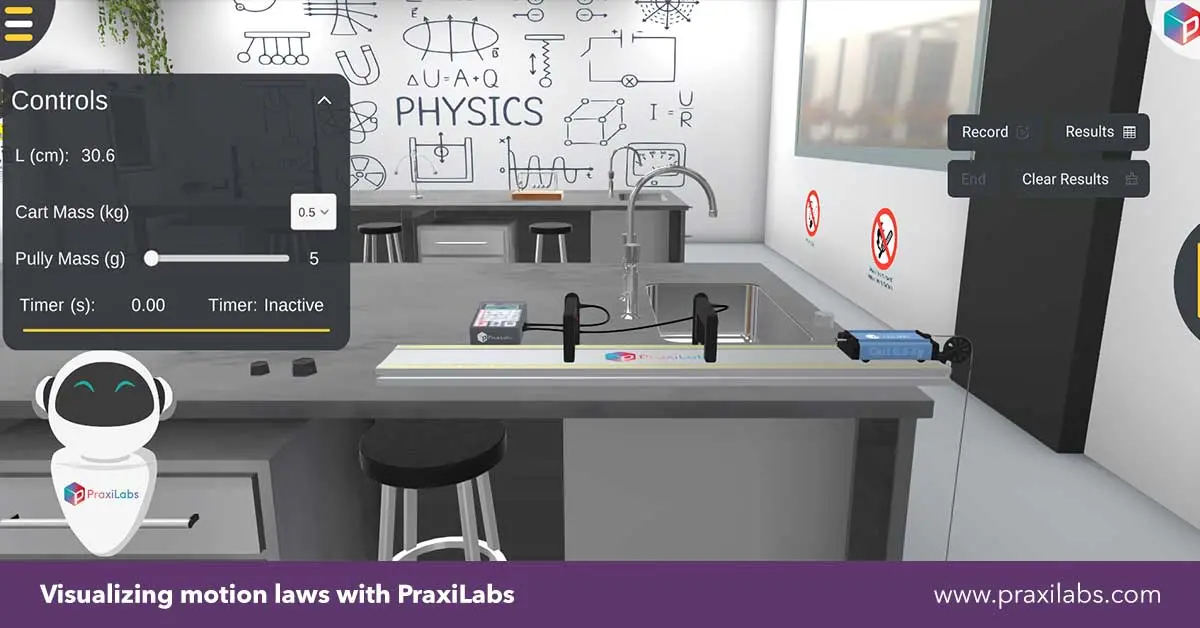
Visualizing motion laws with PraxiLabs:
Understanding motion laws can be challenging when students rely only on theoretical explanations or static diagrams. With PraxiLabs’ interactive physics simulations, learners can visualize how forces, mass, and acceleration interact in real time. Instead of imagining how objects move under different conditions, students can manipulate variables, apply forces, and instantly observe the results through dynamic simulations.
Newton’s Second Law from PraxiLabs
Using PraxiLabs, physics concepts and laws like Newton’s Second Law of Motion become clearer through hands-on digital experiments.
Your students can change the applied force on an object and watch how its acceleration responds, demonstrating the relationship described by F = ma.
Let your students learn how:
- To understand the meaning of net force and to use this understanding to relate the values of individual forces to the value of the net force.
- To distinguish between the concepts of mass and weight and perform calculations involving them.
- To state Newton’s second law of motion, express it in equation form, and use it to solve for acceleration, mass, or net force when two of these variables are known.
- To use free-body diagrams and Newton’s second law equation to determine the acceleration of an object.
Explore Newton’s Second Law Simulation with PraxiLabs
Frequently Asked Questions
Can simulations replace physical motion experiments?
Simulations work best as a complement to traditional experiments. They allow students to explore complex or difficult to recreate scenarios.
When used together, both approaches create a richer learning experience that improves students’ understanding of motion and scientific concepts.
What are the advantages of motion simulation?
Motion simulation has several advantages such as interactivity, cost effectiveness, safety, visualization of motion in real time, and developing scientific inquiry skills.