 PraxiLabs A virtual world of science

Last Updated on January 8, 2026 by Muhamed Elmesery
Science experiments become truly engaging when learners can see, test, and interact with scientific concepts—not just read about them. Virtual labs make this possible by transforming traditional experiments into immersive, hands-on digital experiences where students actively manipulate variables, observe real-time results, and learn through exploration.
Instead of being limited by lab availability, safety concerns, or resources, learners can repeat experiments, make mistakes safely, and build deep conceptual understanding at their own pace.
Engaging science experiments in virtual labs bridge the gap between theory and practice, making science more accessible, visual, and impactful for modern education.
Table of Contents
What is meant by engaging science experiments?
Engaging science experiments are interactive engaging science activities that involve hands-on experimentation to enhance critical thinking, curiosity, and understanding by letting learners actively perform, observe, question, and discover scientific principles, moving beyond passive reading or listening.

Characteristics of engaging science experiments
Engaging science experiments share a set of core characteristics that make learning active, memorable, and meaningful:
- Hands-on & interactive: Learners actively manipulate variables, tools, or simulations rather than just observing.
- Clear learning objective: Each experiment targets a specific concept or skill, not just a “wow” effect.
- Visual and tangible outcomes: Results can be seen, measured, or visualized (graphs, color change, motion, fields).
- Inquiry-based: Encourages questioning, prediction, and hypothesis testing.
- Real-world relevance: Connects scientific concepts to everyday life or real applications.
- Safe and accessible: Uses appropriate materials or virtual learning environment suitable for the learner’s level.
- Immediate feedback: Learners can quickly see the impact of changing variables.
- Encourages critical thinking: Promotes analysis, comparison, and interpretation of results.
- Adaptable difficulty: Can be simplified or extended for different ages or learning levels.
- Engaging narrative or challenge: Framed as a problem to solve, a mystery to explore, or a goal to achieve.
Learning science concepts deeply with engaging experiments
According to studies, experiments are important and essential to inquiry-based science education because they give students practical experiences that enhance their comprehension of scientific concepts.
Students can use the scientific method, record data, make observations, and develop conclusions supported by evidence by carrying out experiments. This helps develop a deeper understanding of the scientific method and enhances critical thinking abilities.
Additionally, engaging experiments allow students to interact directly with the subject matter, creating a more memorable educational experience. By integrating engaging experiments into science classes, teachers can create a dynamic and engaging learning environment that encourages scientific literacy and curiosity.
Also, digital experiments support self-paced and inclusive learning while developing essential 21st-century skills such as critical thinking, data analysis, and digital literacy.
What makes virtual learning truly engaging?
Using interactive tools and technologies makes virtual learning truly engaging. For example, immersive technologies like virtual reality (VR) significantly boost lab engagement by providing interactive, realistic simulations that enhance students’ cognitive, behavioral, and emotional participation.
In addition, integrating other interactive tools such as real-time polls, quizzes, and live Q&A sessions keeps students alert and involved in the conversation.
Moreover, giving your students opportunities to lead discussions, present ideas, or create their own quiz questions fosters a sense of ownership and accountability.
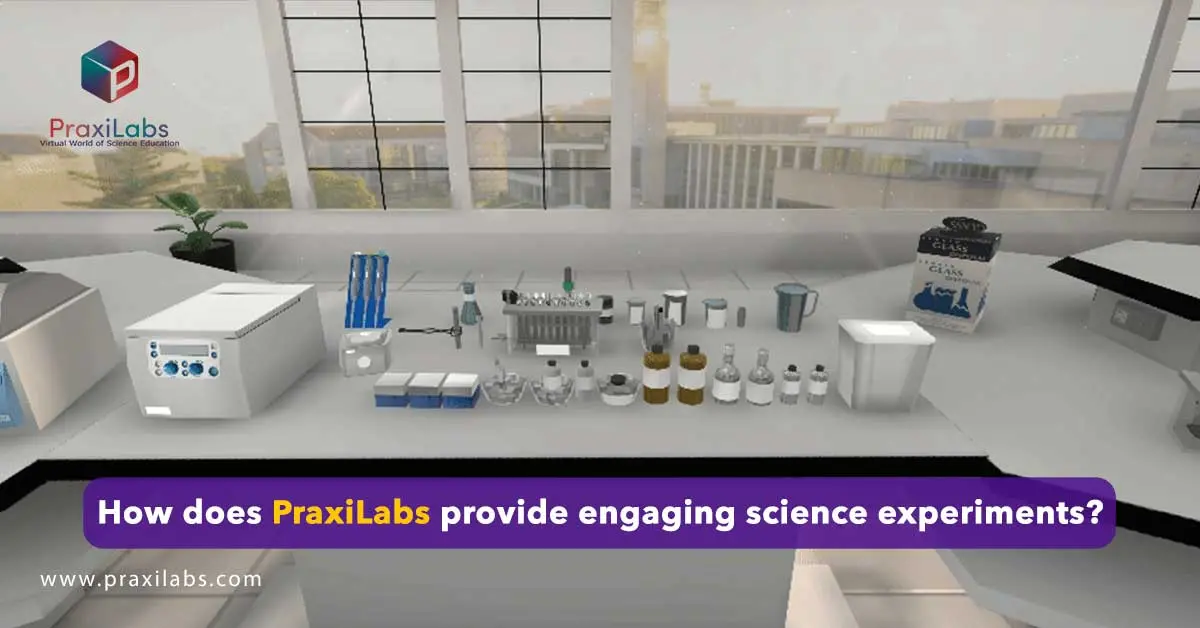
How does PraxiLabs provide engaging science experiments?
PraxiLabs provides engaging science labs by combining interactive technology, pedagogical design, and accessible virtual environments that help students actively learn core scientific concepts. Here’s how it achieves that:
Immersive interaction
3D labs simulate real-life environments to enhance attention, engagement, and hands-on learning.
Interactive Tutorials & Guided Learning
Each simulation includes guided tutorials that walk students through the lab interface, features, and tools— requiring no prior training.
Model Answers & Assessment Support
Instant access to MCQ results and model answers ensures clarity, boosts performance, and integrates seamlessly into the LMS dashboard.
Flexible Navigation
Students can move directly to specific milestones within an experiment, creating a focused and user-centered experience.
AI Lab Assistant
Your virtual lab assistant, “Oxi,” that acts as a personal tutor for every student, guiding them through experiments.
Oxi provides real-time feedback with immediate, intelligent assistance during experiments, offering hints and preventing common errors without revealing solutions.
Oxi also enables conversational learning, allowing students to ask questions and engage in interactive conversations for a deeper, immersive experience.
Pick the Best Virtual Plan or You
Explore science simulations fields at PraxiLabs
PraxiLabs offers a wide range of stem science experiments in several fields through its immersive 3D virtual labs, enabling students to explore core scientific disciplines with hands-on interactive experiments. The platform covers over 210 science simulations across more than 20 scientific disciplines, making it a comprehensive resource for STEM education.
-
Biology Simulations
PraxiLabs’ virtual biology lab lets students investigate life sciences through simulations in areas including:
- Physiology.
- Cell Culture.
- Toxicology.
- Bioenergetics.
- Biochemistry.
- Molecular Biology.
- Immunology.
- Microbiology.
These simulations help students understand living systems from molecules and cells to complex biological responses.
-
Chemistry Simulations
PraxiLabs’ virtual chemistry lab covers fundamental and advanced chemical sciences, such as:
- Basic radical tests (Inorganic Chemistry).
- Organic Chemistry.
- Acidic radical tests (Inorganic Chemistry).
- General Chemistry.
- Analytical Chemistry.
Students perform safe virtual experiments such as esterification and titrations, helping them understand chemical principles and laboratory techniques without exposure to hazards.
-
Physics Simulations
In physics, PraxiLabs provides interactive models that let learners manipulate physical systems and observe outcomes in real time. Fields include:
- Heat and Thermodynamics experiments.
- Mechanics.
- Properties of Matter.
- Electricity.
- Magnetism.
- Modern Physics simulations.
- Wave experiments.
These simulations turn abstract physical laws into visual, experiment-driven learning experiences.
Frequently Asked Questions
What are the benefits of using digital experiments?
Digital experiments provide a safe, flexible, and cost-effective learning environment that allows students to conduct scientific experiments anytime and anywhere through engaging science lessons.
They help visualize abstract concepts through interactive science simulations, offer instant feedback with accurate data, and enable easy repetition to strengthen understanding.
Are virtual labs effective for scientific research?
It can be said that the primary purpose of the virtual labs is more educational than research-oriented; through it, you can learn about protocols and carry out various experiments, but it cannot be used to analyze samples or obtain specific readings for scientific research purposes.