 PraxiLabs A virtual world of science

Last Updated on February 15, 2026 by Muhamed Elmesery
Biochemistry is evolving at the frontiers of science, uncovering the molecular mechanisms that drive life itself. Virtual labs on the frontiers in biochemistry bring these advanced concepts—such as enzymes, proteins, genetics, and nucleic acids—to life through interactive, simulation-based experiments.
By allowing students to explore complex biochemical processes in a safe, flexible, and engaging digital environment, virtual labs bridge the gap between theory and practice, making cutting-edge biochemistry more accessible, visual, and effective than ever before.
Table of Contents
What are virtual labs on frontiers in biochemistry?
Virtual labs on frontiers in biochemistry are immersive and interactive virtual simulations that let students understand the core concepts in biochemistry, and also allow them to perform several procedures such as protein estimation, DNA sequencing, the role of enzymes, gene regulation, and more in a safe, virtual environment.
Virtual biochemistry lab simulation offers a cost-effective, accessible way to learn complex biochemical processes without physical lab constraints, often enhancing engagement and skill development.
Virtual labs on frontiers in biochemistry main topics:
The virtual labs on frontiers in biochemistry are structured into four core themes, each with interactive learning elements such as animated major events, virtual lab biochemistry experiments, and revision questions for self-assessment.
-
Enzymes
Focus: Study of enzymes as biological catalysts—how they work, what affects their activity, and their roles in biochemical reactions.
Interactive Elements:
- Yeast fermentation experiment (measuring gas production).
- Factors affecting enzyme activity: enzyme concentration, substrate concentration, temperature, pH, and inhibitors.
-
Protein
Focus: Proteins as essential biomolecules made of amino acids, including how their sequence and structure inform their function.
Interactive Elements:
- Virtual lab on protein sequencing using methods like Edman degradation.
- Insight into mechanisms of protein structure and analysis.
-
Genetics
Focus: The genetic basis of life—DNA structure, sequencing, and heredity.
Interactive Elements:
- Virtual lab on DNA sequencing (e.g., Sanger’s method) that demonstrates concepts from synthesis to fragment separation.
- Nucleic Acids
Focus: Structures and functions of DNA and RNA, gene regulation, and expression.
Interactive Elements:
- X chromosome inactivation simulation and exploration of the regulation of gene expression.
What are the limitations of traditional Biochemistry labs?
- High construction and maintenance costs, as real biochemistry real labs require instruments, reagents, and enzymes
- Hazardous materials and safety risks, as students deal with exposure to bioactive substances, which may increase the risks of lab accidents.
- Limited space and scalability, students with disabilities or those in remote locations may face difficulties accessing physical labs, limiting inclusive learning opportunities.
- Low student engagement in conventional lab settings.
- Lack of flexibility for remote or self-paced learning.

Virtual labs on frontiers in biochemistry benefits:
- Interactive simulations help students visualize and explore biochemical processes (like enzymes, proteins, and nucleic acids) at the molecular level, making abstract concepts easier to grasp.
- Virtual labs on frontiers in biochemistry improve the quality of learning, teaching, and learning outcomes through flexibility and personalization, increased accessibility, and enhanced student engagement and collaboration.
- It also allows students to learn at a pace that suits them and provides content specifically designed to meet their individual needs, while expanding access to educational resources and creating new opportunities for interaction between students and teachers.
- The impact of e-learning on student performance has been documented in numerous studies. These studies indicate a positive effect on student performance and engagement, noting that success depends on factors such as digital literacy and effective platform design.
PraxiLabs Biochemistry Virtual Lab Objectives:
- Simplify complex biochemistry concepts and procedures through interactive simulations.
- Enable safe, repeatable practice of biochemical experiments.
- Bridge theory with hands-on laboratory skills by using interactive 3D simulations.
- Improve student engagement and concept retention.
- Support curriculum-aligned learning and assessment.
- Prepare students for real laboratory work without cost or safety risks.
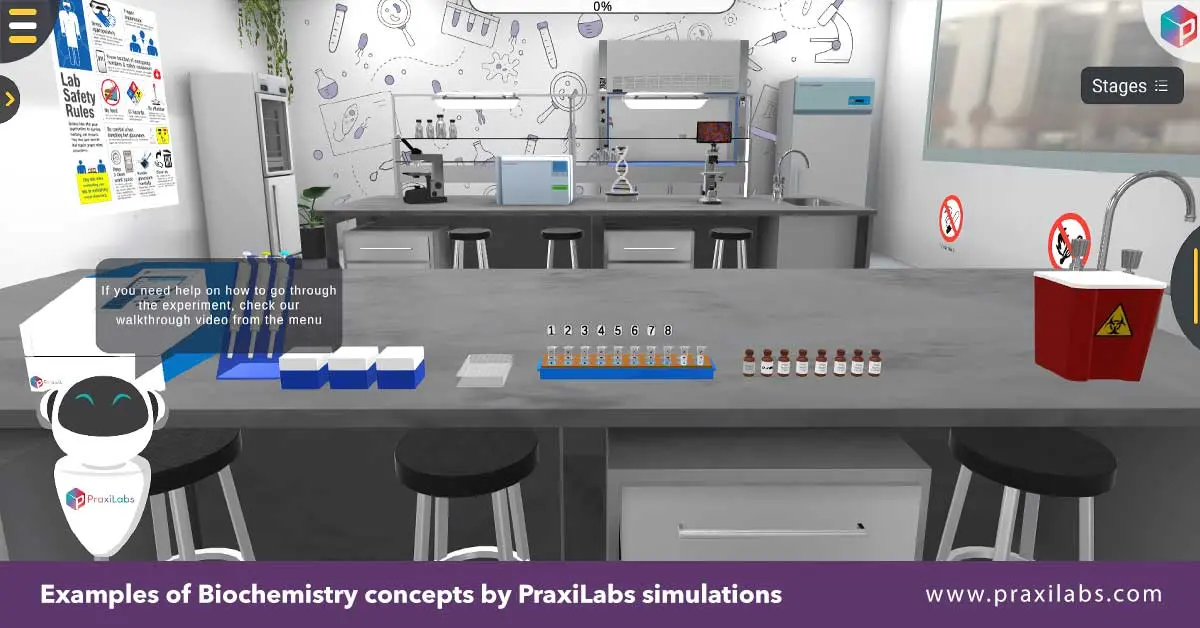
Examples of Biochemistry concepts by PraxiLabs simualtions
PraxiLabs offers 3D virtual biology lab simulations that can complement those topics by letting students practice procedures and visualize key biochemical/genetic processes in a realistic lab environment. Examples relevant to the biochemistry themes include:
Enzymes Activity & Biochemical Reactions
In this experiment, your students will learn how to examine the effect of the amylase enzyme on starch breakdown.
This test is mainly used to investigate factors that affect the activity of the amylase enzyme (such as temperature, pH, and the source of amylase).
Let your students understand the biochemical process of hydrogen peroxide detoxification by aerobic bacteria through the production of the enzyme catalase, and describe how catalase production can be determined.
Teach your students how coagulase confers a survival advantage to bacteria that produce this enzyme, and describe how pathogenic species of Staphylococci can be differentiated from nonpathogenic species.
Proteins
Total Protein Estimation (Bradford)
By the end of the experiment, your students will be able to:
- Identify the amino acids that the Bradford Protein Assay measures.
- Describe the color change that occurs when proteins combine with Coomassie dye under acidic conditions.
- Illustrate the correct standard curve equation for an example BSA standard.
- Interpret the standard curve equation when given example data.
- Calculate the protein concentration of an example sample.
- Name the instrument used to measure the color change in the Bradford assay.
- Explain when the Bradford Protein Assay might not be the appropriate test to use.
- Recall the substance commonly used as standards in the assay.
Affinity Chromatography and HPLC
By the end of the experiment, your students will be able to understand how amino acids are separated and detected in tissue samples.
Genetics & Nucleic Acids
Agarose Gel Electrophoresis of DNA
Let your students visualize, identify, and distinguish molecules that have been processed by a previous method such as PCR, enzymatic digestion, or an experimental condition.
Teach your students how to:
- Apply DNA sample purification using ExoSAP-IT.
- Apply library preparation steps properly.
- Apply DNA fragmentation, adapter ligation, clean up, and amplification of fragmented DNA.
- Practice library normalization, denaturing, and dilution. •
- Perform the AMPure bead protocol to purify DNA libraries.
Frequently Asked Questions
What does frontier mean in science?
In science, “frontier” refers to the outermost edge of current knowledge, understanding, or technological capability within a field.
It represents cutting-edge areas of active research where new discoveries are being made, often involving high uncertainty, unconventional approaches, and exploration of unknown or unproven concepts.
Who can benefit most from virtual Biochemistry laboratories?
- students in distance learning or hybrid programs.
- institutions with limited funding or infrastructure.
- instructors looking to enhance engagement
- researchers conducting pre-experiment simulations.