 PraxiLabs A virtual world of science

Last Updated on February 4, 2026 by Muhamed Elmesery
Thermodynamics is one of the most conceptually challenging areas in physics—filled with abstract ideas like energy conservation, internal energy, and heat transfer that students often struggle to visualize in traditional classrooms.
This is where a thermodynamics virtual lab becomes a game-changer. By transforming complex theories into interactive, experiment-driven experiences, virtual labs allow learners to explore advanced thermodynamics concepts through hands-on experimentation rather than memorization.
From gas laws and Joule’s experiment to thermodynamic processes and energy transformations, virtual labs bridge the gap between theory and practice—making advanced concepts clearer, measurable, and deeply engaging.
Table of Contents
What is a thermodynamics virtual lab designed for?
A thermodynamics virtual lab is designed to provide an interactive and immersive environment that replicates the real physical lab to help students understand the complex principles and concepts related to thermodynamics such as heat transfer, energy exchange, and thermodynamic processes.
Virtual lab thermodynamics enable students to perform their experiments anytime and repeat them multiple times in a safe environment, overcoming the limitations of physical labs such as high cost, safety risks, and logistical constraints.
By performing virtual simulations, students can explore theoretical thermodynamics laws, observe physical behaviors, and perform quantitative analysis without the restrictions of traditional labs.
The objectives of a thermodynamics virtual lab
- Visualizing abstract principles such as conduction, convection, radiation, phase changes, entropy, and energy conversion.
- Allowing manipulation of variables and verification of thermodynamic laws through experimentation.
- Exploration real-world systems, such as jet engines and thermal machines.
- Enhancing learning through interaction by offering a flexible, low-cost environment for exploration, repetition, and self-paced learning.
- Developing practical skills and measurable learning outcomes.
- Apply thermodynamics concepts to real-world applications.
- Collect and interpret data from the simulation.
- Develop scientific inquiry and problem-solving skills.
How do virtual labs simplify thermodynamics experiments?
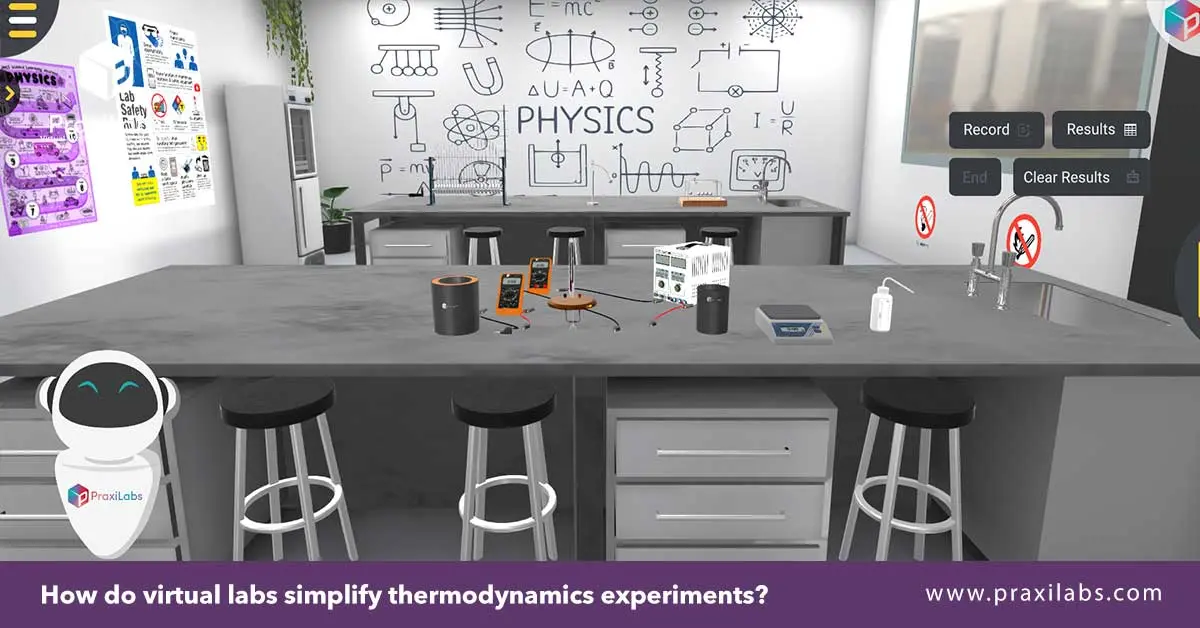
Virtual lab simulations simplify and enhance the thermodynamics experiments by providing interactive and immersive 3D virtual science environments that replicate realistic labs. These simulations help students manage time, efficiently, develop practical skills, and strengthen conceptual understanding, ultimately improving learning outcomes.
Thermodynamics simulation online visualizes core principles such as heat transfer (conduction, convection, radiation), phase changes, and energy laws (the First and Second Laws). Through thermodynamics simulation software, students can observe complex concepts, design experiments, analyze data, and develop problem-solving skills, without physical constraints or safety risks.
Explore Praxilabs’ Science Simulations Catalog
Thermodynamics concepts discover through the virtual lab
Here’s a clear, academic-style overview of thermodynamics concepts discovered using a virtual lab (such as PraxiLabs):
| Thermodynamics Concept | What Students Discover in the Virtual Lab |
| Temperature vs Heat | The distinction between temperature change and heat transfer in a system |
| Specific Heat Capacity | How different materials respond differently to the same amount of heat |
| Thermal Equilibrium | How heat flows between bodies until equilibrium is achieved |
| Boyle’s Law | The direct relationship between gas pressure and temperature volume at constant |
| Charles’s Law | The relationship between gas pressure and temperature at constant volume |
| Gay-Lussac’s Law | The relationship between gas pressure and temperature at constant volume |
| First Law of Thermodynamics | of Energy conservation through work, heat, and internal energy |
| Internal Energy | How molecular motion and temperature affect a system’s energy |
| Joule’s Experiment | The conversion of mechanical work into thermal energy |
| Modes of Heat Transfer | The differences between conduction, convection, and radiation |
| Thermodynamic Processes | Characteristics of isothermal, isobaric, isochoric, and adiabatic processes |
Who can use PraxiLabs thermodynamics virtual lab?
PraxiLabs thermodynamics virtual labs are designed for students, educators, academic instructors, educational institutions.
- For students (undergraduate students and graduate students), thermodynamics virtual labs provide hands-on virtual experiments that reinforce theoretical concepts through active learning.
- For educators, these labs can enhance their student engagement through immersive 3D simulations, interactive guidance, multimedia-rich content, and a comprehensive tutorial system requiring no prior training.
- For educational institutions (schools, colleges & universities), virtual labs support physics and engineering courses by helping institutions expanding practical lab offerings without physical limitations.
Virtual labs are a cost-effective solution that reduces traditional lab expenses, eliminates hazardous materials and safety risks, and scales easily beyond physical space and equipment limitations.
List of thermodynamics simulations in PraxiLabs
PraxiLabs provides a Heat & Thermodynamics category within its Physics Virtual Lab simulations, allowing students to perform and interact with fundamental thermodynamic experiments in a fully immersive 3D environment.
Let’s explore some of these simulations:
Boyle’s law
By the end of Boyle’s law simulation, your students will be able to:
- Define the pressure.
- Identify the different units used to measure pressure.
- Convert pressure and volume between different units.
- Explain the relationship between the pressure exerted on an ideal gas and the volume it occupies.
- Set up an experiment to study the pressure-volume relationship of an ideal gas.
Joule’s Experiment
The aim of Joule’s experiment is to determine:
- The value of the mechanical equivalent of heat (Joule’s equivalent).
- The resistance value of the heating(coil).
Students will learn how to:
- State the principle of conservation of energy.
- Identify which types of energy were involved in the experiment.
- Recognize the conversion of electrical energy into thermal energy.
- Identify different units used to measure energy.
- Determine the mechanical equivalent of heat and the coil resistance.
Specific Heat of Solids
The aim of specific heat virtual lab is to determine the specific heat of a solid using mixture method.
Students will learn how to:
- Define specific heat capacity and state its SI unit.
- Set up an experiment to measure the specific heat of a solid using the mixture method.
- Apply the principle of conservation of energy to a mixture.
Whether used in universities, schools, or remote learning environments, thermodynamics virtual labs empower learners to think like scientists and gain a deeper understanding of how heat and energy govern the physical world.
Frequently Asked Questions
Are there assessments after completing experiments?
Yes, PraxiLabs includes assessments after completing experiments. The platform offers a comprehensive question bank that enables instructors to design customized, outcome-aligned assessments.
This feature empowers educators to go beyond generic quizzes, providing flexibility, fairness, and control in evaluating student progress— ensuring assessments are accurate, and personalized to learners’ needs.