Cloning Virtual Lab - Transformation
Biology | Biochemistry | Genetics | Microbiology



2.5M+
Active Users Worldwide

80%
Improved Learning Retention

60%
Reduction in Laboratory Costs
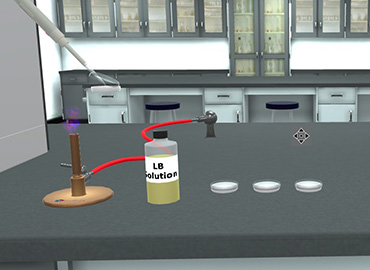
To create a recombinant DNA molecule, through cloning simulation, followed by the transformation and the plating of E. coli JM101.
⦁ Recombinant DNA molecule synthesis using DNA ligase. ⦁ Transformation using T-solution. ⦁ Plating using the spread-plate technique.
To understand the role of the devices, the reagents, and the enzymes used in the processes of Recombinant DNA molecule synthesis, competent cells preparation, transformation, and plating.
Formation of a recombinant DNA molecule is done by ligation of the cut yeast DNA fragment with the cut plasmid DNA. Ligase enzyme is used for this reaction.
Both yeast and plasmid DNA were cut with the same restriction enzyme, which means both are cut at the same sequence of nucleotides (restriction site of EcoRI). This creates complementary sticky ends in both DNA fragments (yeast and plasmid).
Complementary ends can easily attach to each other in the presence of ligase enzyme.
Transformation means the introduction of genetic material into bacterial cells.
At last, begin plating out the transformed bacteria using the spread-plate technique onto a medium containing Ampicillin, X-Gal, and IPTG (isopropyl-β-D-thiogalactopyranoside).
1- Recombinant DNA molecule synthesis is done by ligating:
The ‘dephosphorylated/EcoRI-digested pUC19 plasmid’ with the ‘EcoRI-digested yeast genome fragments’
This creates a recombinant DNA molecule ‘Expt ligation’ that can be used as a ‘vector’, demonstrating the recombinant DNA simulation process. Remember: Both (a) and (b) were prepared in unit (1).
2- Transformation:
Vectors are then introduced into competent cells of ‘Escherichia coli strain JM101’ which is a process called transformation, illustrating the bacterial transformation simulation procedure.
You start by preparing the e. coli ‘JM101’ to be competent.
Transformation using the “Expt Ligation”.
Transformation using diluted uncut pUC19 to be used as CONTROL.
Transformation using sterile water “No pUC19 DNA” to be used as CONTROL (referred to as No DNA sample).
3- Plating:
The transformed bacteria should be plated onto agar medium containing ampicillin, X-Gal and IPTG, allowing you to select and screen for recombinant DNA vector(s).
This DNA cloning transformation experiment provides hands-on experience with fundamental genetic engineering simulation techniques used in modern molecular biology research.



I love the idea of virtual labs. It's gonna be something that takes our R&D and work in labs to another level. And I look forward to seeing what PraxiLabs can do with it.
Michelle Anderson, Head of Innovation
IE University - Spain
Although there are now several vendors offering virtual reality software for physics labs, there is only one that offers a realistic, I feel like I’m in a real lab solution: PraxiLabs.
Dr. William H. Miner, Jr., Professor of Physics
Palm Beach State College, Boca Raton, FL
PraxiLabs offered my students a chance to actively engage with the material. Instead of watching videos on a topic, they could virtually complete labs and realize the practical applications of class topics. This is a quality alternative to in-person labs.
Crys Wright, Teaching Assistant
Texas A&M University, USA
With the onset of the COVID-19 pandemic, we found ourselves in a situation that forced us to act quickly to find the best solution available to provide our students with a quality molecular genetics laboratory experience.
Korri Thorlacius, B.Sc., Biology Lab. Instructor
Biology Department - Kwantlen Polytechnic University