 PraxiLabs A virtual world of science

Last Updated on April 5, 2026 by Muhamed Elmesery
Physics experiments for college are essential for helping students move beyond theory and truly understand how physical laws work in real-world situations.
However, access to fully equipped laboratories is not always possible. Thanks to modern simulation technology, students can now explore complex experiments through virtual labs, making physics learning more accessible and interactive.
Through platforms like PraxiLabs, students can perform a wide range of experiments online— ranging from mechanics and waves to electricity and modern physics.
Table of Contents
What are modern approaches to physics experiments?
Modern approaches for physics experiments for college are methods that emphasize active and remote learning, where students and researchers actively manipulate variables and analyze results rather than merely observing passive demonstrations.
These approaches include integrating technology such as physics virtual lab simulations, and utilizing active/inquiry-based learning methods such as project-based learning methods.
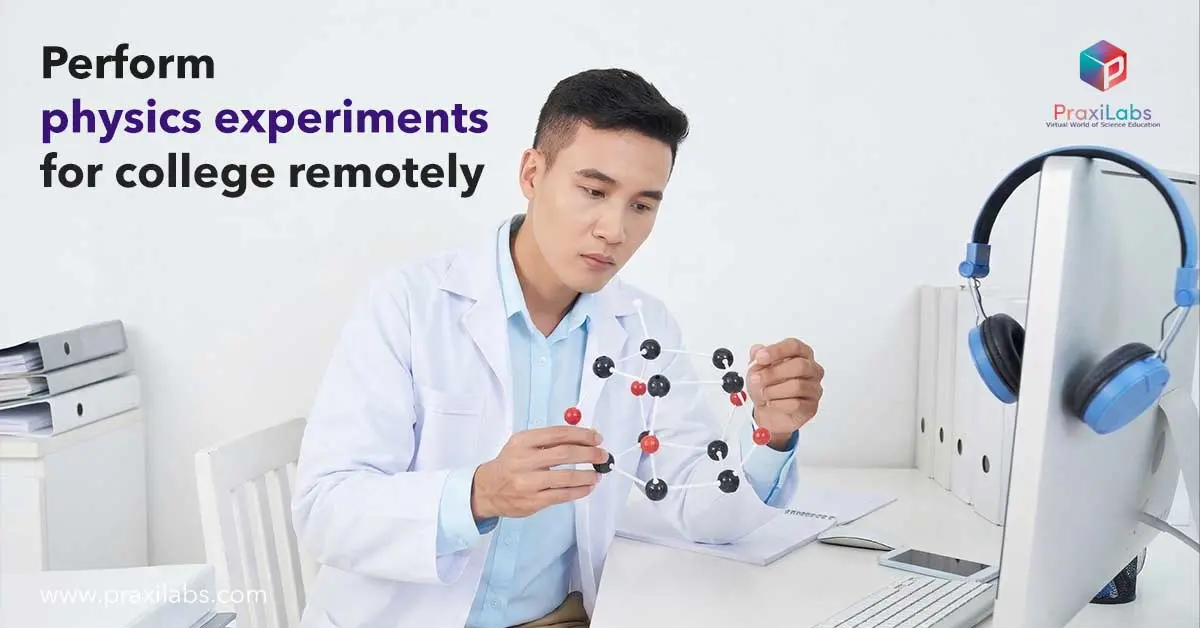
Performing physics experiments for college remotely:
Performing online physics experiments remotely has become increasingly feasible thanks to modern educational technologies such as virtual laboratories and simulation platforms.
These tools allow college students to conduct and analyze experiments from anywhere while still gaining valuable scientific insights.
Virtual simulations for college-level physics experiments for college offer several advantages that make them highly valuable in modern education:
- Safe experimentation: Students can perform complex or hazardous experiments without risk.
- Cost efficiency: Institutions avoid expensive lab equipment, maintenance, and consumables.
- Accessibility: Students can access experiments anytime and from anywhere.
- Visualization of complex concepts: Simulations help students see microscopic or abstract processes that are difficult to observe in physical labs.
For example, platforms like PraxiLabs allow students to run interactive and interesting experiments in physics, chemistry, and biology while receiving step-by-step guidance and instant feedback.
Physics topics that work best in virtual environments:
There are several physics topics that work best in a virtual lab and help students imagine the theoretical principles and laws. PraxiLabs’ virtual physics lab topics include:
Mechanics and Motion
Virtual environments help students visualize motion and understand how different variables affect it.
PraxiLabs covers topics that include:
- Ballistic Pendulum.
- Newton’s Second law of motion.
- Free Fall Simulation.
- Lami’s Rule.
Electricity and Magnetism
Electric circuits and electromagnetic fields are easier to understand when students can visualize invisible forces.
By using PraxiLabs simulations, students can explore:
- Electrostatic Demonstration.
- Faraday’s Law.
- Kirchhoff’s Loop Rule.
- Magnetic field of a circular loop current.
- Magnetic Force on a Wire.
- Temperature Coefficient of Resistance.
Waves and Optics
Wave behavior is highly visual, making it ideal for simulation-based learning.
Students can understand more about:
- Speed of sound using closed columns.
- Reflection and refraction of light.
- Optical lenses and mirrors.
Explore: Physics Wave Simulator to Master all Waves Properties
Modern Physics
Many experiments in modern physics cannot be easily performed in standard university labs.
PraxiLabs virtual environments allow students to explore:
- Black Body Radiation and Stefan-Boltzmann Law of Radiation.
- Laser Beam Divergence.
- Zeeman Effect Simulation.
Thermodynamics and heats
Simulations help students observe how heat, pressure, and volume interact in controlled environments.
PraxiLabs simulations in thermodynamics and heat include:
- Boyle’s law.
- Joule’s Experiment.
- Specific Heat of Solids.
Understanding cause and effect with physics simulations:
According to a study conducted to investigate the effect of using physics simulations to enhance students’ motivation and problem-solving skills in learning physics.
The population for this research consisted of 57 students from Grade XII MIA. There were 50 students taken by random sampling. The instrument was a questionnaire in the form of an essay and a Likert scale. The data of this research was analyzed by an average test, N-gain, and independent-sample t-test.
The result showed that the average score of motivation in the experiment class is in the high category, and in the control class it was in the low category, while the N-gain score for problem-solving skills for experiment class was in the high category and in control class it was in the medium category.
Moreover, based on an independent sample t-test, it was obtained that there was a significant difference in problem-solving motivation and skill, this is strengthened by the positive response of students using physics simulations in learning.’
It can be concluded that physics simulations in learning physics can enhance students’ motivation and problem-solving skills.
Can colleges fully rely on virtual laboratories?
Virtual laboratories have become a powerful educational tool, but colleges cannot fully rely on them solely—especially in science and engineering fields. Instead, they work best when combined with traditional physical labs.
Most universities are adopting a hybrid model, where:
- Virtual labs are used for pre-lab preparation, conceptual learning, and remote practice.
- Physical labs are used for hands-on experimentation and professional skill development.
This approach improves understanding while reducing costs and laboratory time.
Discovering physics through PraxiLabs’ virtual labs:
Discovering physics experiments for college through virtual laboratories has become an engaging and effective way for college students to explore complex scientific concepts. Through interactive simulations, learners can perform experiments, manipulate variables, and observe results in real time—all within a safe and accessible digital environment.
Physics experiment simulation software and platforms like PraxiLabs provide immersive 3D simulations that allow students to experience physics experiments at home as if they were in a real laboratory. Instead of merely studying theoretical formulas, students can actively test ideas, analyze outcomes, and better understand how physical laws work in practice.
One of the key advantages of PraxiLabs’ virtual labs is interactive learning. Students can adjust experimental conditions—such as force, velocity, voltage, or resistance—and immediately observe how these changes affect results. This hands-on approach strengthens conceptual understanding and encourages scientific inquiry.
Explore PraxiLabs’ list of physics experiments for college:
You can explore a wide range of college-level physics experiments through PraxiLabs, which offers interactive 3D simulations covering several core areas of physics. These virtual experiments allow students to perform, repeat, and analyze lab activities in a realistic digital environment in disciplines such as:
- Mechanics.
- Magnetism.
- Modern Physics.
- Waves.
- Heat and Thermodynamics experiments.
- Properties of matter.
- Electricity.
Discover our individual learners and institutions plans
Frequently Asked Questions
Do virtual physics labs count as real lab experience?
Yes! Virtual physics labs are generally considered effective methods for learning theoretical concepts, data analysis, and experimental design, but they do not fully replicate the physical, tactile skills gained in hands-on labs.
Can students use virtual labs for exam preparation?
Yes, students can effectively use virtual labs for exam preparation. Virtual labs provide interactive, digital simulations of laboratory techniques and equipment that allow students to perform their experiments outside of a traditional lab setting anytime and anywhere.
Can virtual labs simulate experiments failures?
Yes, virtual labs can effectively simulate experiment failures. They allow students to make mistakes, such as using incorrect chemical amounts or improper procedures, to observe negative outcomes.