 PraxiLabs A virtual world of science

Last Updated on March 4, 2026 by Muhamed Elmesery
Realistic physics simulation is transforming the way students experience science, turning abstract equations into dynamic, interactive discoveries. Instead of passively observing theories on a board, learners can manipulate variables, test hypotheses, and witness real-time cause-and-effect relationships in a fully immersive digital lab environment.
Table of Contents
What is a realistic physics simulation?
Realistic physics simulation is a computer-generated recreation of real-world physics phenomena and behaviors.
These simulations help students understand and visualize several physical behaviors and laws such as gravity, energy, energy, and momentum.
Realistic physics simulations work by creating immersive and interactive 3D environments where students can perform virtual experiments remotely, mimicking real-world laboratory settings.
What does realistic simulation add to science?
Realistic simulation adds significant value to science by enabling the safe, cost-effective, and repeatable study of complex, dangerous, or inaccessible systems.
The use of realistic physics simulation aims to help students understand the complex physical principles and theories that may be difficult to study experimentally or theoretically in a real laboratory. It also addresses the problems faced by students and educational institutions in conducting experiments in a real laboratory, such as:
- Safety and security risks.
- High costs.
- Ethical challenges.
- Limited access for students.
- Lack of student interaction and interest.
- High failure rates among students.
- Inability to accommodate the large and growing number of students.
- Excessive time constraints on teachers and professors.
How does science simulations support inquiry-based learning?
Science simulations strongly support inquiry-based learning by shifting students from passive listeners to active investigators.
Using platforms like PraxiLabs, students don’t just follow instructions — they explore, question, test, and draw conclusions.
Here’s how simulations enhance inquiry-based learning:
- Encourage hypothesis formation: Students predict outcomes before manipulating variables.
- Enable safe experimentation: They test ideas without safety risks or material limitations.
- Allow variable control: Learners change one factor at a time to observe cause-and-effect relationships.
- Promote data-driven conclusions: Real-time measurements help students analyze evidence rather than guess.
- Support repeated experimentation: Experiments can be repeated instantly to refine understanding.
Demonstrate physics concepts with realistic physics simulation:
Physics becomes powerful the moment students see forces act, circuits respond, and waves interact in real time. With scientifically accurate simulations, abstract formulas turn into measurable, observable experiences.
That’s exactly what PraxiLabs delivers — immersive, curriculum-aligned physics simulations designed to mirror real laboratory conditions.
Instead of passively reading equations, students can:
- Adjust force and mass to observe acceleration
- Build electrical circuits and measure current and voltage
- Manipulate lenses and track light refraction
- Analyze motion graphs generated in real time
- Test conservation laws with dynamic simulations
Every experiment responds realistically to variable changes — just like in a physical lab.
Let’s take an example from PraxiLabs realistic physics simulations:
Archimedes Principle
Understanding buoyancy can be challenging when students only rely on equations. But when they see how fluid displacement creates an upward force, the concept becomes intuitive.
By using PraxiLabs realistic physics simulation, educators can demonstrate Archimedes’ Principle through an interactive, data-driven virtual experiment, and their students will be able to:
- Explain Archimedes’ principle.
- Apply Archimedes’ principle to a body that is completely immersed in water and other liquids.
- Set up an experiment to determine the specific gravity ofr both a solid and a liquid.
Scaling universities physics labs using virtual simulations:
The increasing trend toward using virtual simulations to scale universities physics labs is due to several reasons, the most important of which are:
- Providing a safe and risk-free learning environment that is also realistic, with the possibility of repeating experiments an unlimited number of times, anytime and anywhere.
- It also provides an interactive learning experience while reducing costs for educational institutions.
- It offers practical simulation of real physics lab procedures in a virtual environment where virtual laboratories simulate real physics experiments, enabling students to conduct various physics techniques and clearly understand their scientific principles.
- Analyzing results just as they would in real-life settings.
- Providing an interactive learning experience, realistic physics simulation is not just videos but fully interactive and immersive, guiding students to select materials and components, make decisions, and receive immediate feedback and corrections. This improves students’ understanding and critical thinking, and thus their learning outcomes.
What is the best simulator for physics experiments?
PraxiLabs, as one of the best simulators for physics experiments (real time simulation software) offers a variety of real physics simulations for educational purposes, including simulations of real-life scenarios and foundational physics concepts.
These real time physics simulations allow students to explore and understand different physics topics such as:
- Mechanics.
- Heat.
- Thermodynamics.
- Magnetism.
- Modern Physics.
- Electricity.
- Waves.
- Properties of Matter.
Praxilabs’ virtual laboratories provide a unique opportunity to learn through making mistakes without any risks to students’ safety or additional costs due to wasted materials and resources.
Praxilabs’ virtual simulations address the limitations imposed by traditional science laboratories, such as safety hazards, high costs, ethical challenges like animal testing, limited student access, lack of engagement and interest, and high student failure rates.
Here is the opinion of the Director of the Physics Degree Programme (GFIS):
“For now, I am happy with its use during this first year. I think it is working well and that the students and the teacher who used it were satisfied. Now we are going to start again with the platform. I was preparing the Excel documents that we were told to use so that we could enroll all the students at once. I haven’t done it yet, so as not to disturb anyone during this exam period and cause confusion, but I think it’s quite simple and I hope it works well. Overall, I would say that we are happy with the platform, but we would like it to be in Spanish (for greater convenience) and to have more simulations, of course.
Overall, it’s a good tool and we’re finding it useful for our Experimental Techniques classes.”
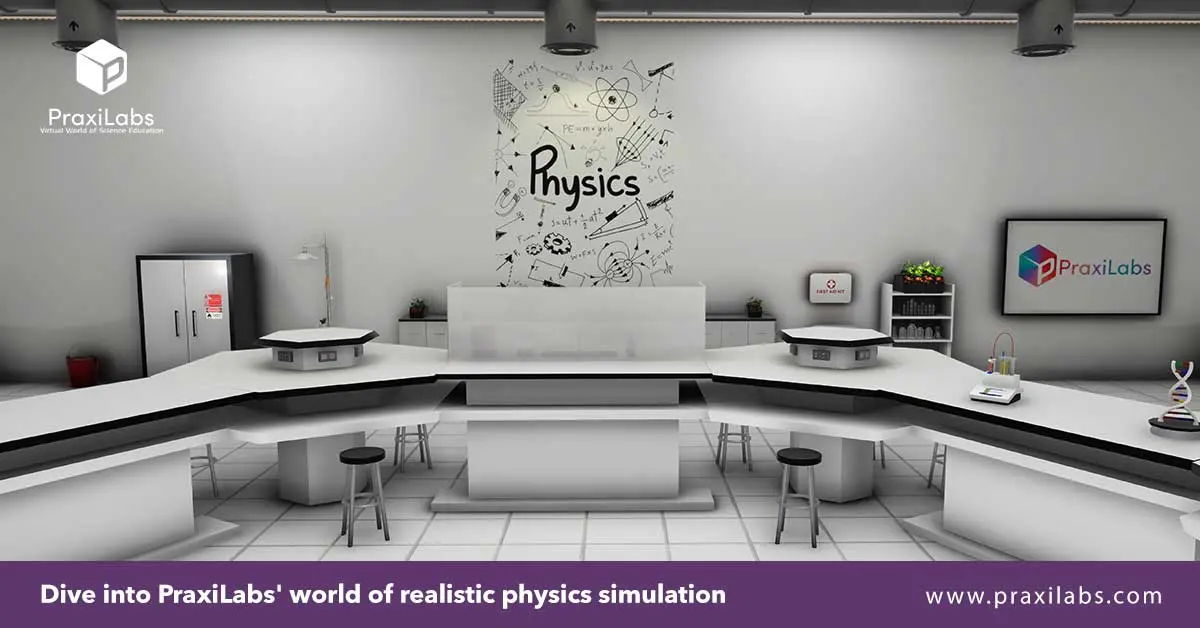
Dive into PraxiLabs’ world of realistic physics simulation:
Physics isn’t meant to be just imagined — it’s meant to be explored, tested, and experienced. In the world of PraxiLabs, students step inside fully interactive laboratories where scientific laws respond in real time, just like in a physical lab.
Explore Key Physics Domains:
Mechanics
- Ballistic Pendulum Simulation.
- Free Fall.
- Lami’s Rule.
Heat and Thermodynamic Experiments
- Boyle’s law.
- Joule’s Experiment.
- Specific Heat of Solids.
Properties of matter
- Archimedes’ principle.
- Density Simulation Measurements.
- Determination of the coefficient of viscosity using stokes’ Law.
Electricity
- Demonstration of Electrostatic Simulation.
- Faraday’s Law.
- Kirchhoff’s loop rule.
Magnetism
- Determination of Unknown Capacitance and Inductance Using Phasor Diagrams.
- Magnetic Field Due to Circular Loop Simulation.
- Magnetic Force on a Wire.
Modern Physics
- Band Gap Energy of Semiconductor Simulation.
- Black Body Radiation and Stefan-Boltzmann Law of Radiation.
- Characteristics of Solar Cell (I) Dark and illumination I-V under dark and illuminated conditions.
Waves
- Convex Lens.
- Forced Oscillations.
- Hooke’s Law Simulation.
PraxiLabs redefines science education by transforming abstract principles into interactive, measurable experiences. When students can manipulate variables, analyze data, and repeat experiments freely, physics becomes intuitive — not intimidating.
Frequently Asked Questions
What is the best real life physics simulator for training?
The best real-life physics simulator for training in an educational/e-learning context—especially if you’re thinking about classroom use, virtual labs, or preparing students before they work in a physical lab—is PraxiLabs.
PraxiLabs is a professional-grade virtual lab platform designed specifically to replicate real physics experiments in an accurate, interactive, and user-friendly way.
Is it difficult to replicate actual physics in virtual labs?
Yes — replicating actual physics in virtual physics lab is challenging, but with advanced simulation technology, it is absolutely achievable at a high level of accuracy.
Why is realism important in simulation?
Realism is important in simulation because the closer a simulation behaves to real life, the more transferable the learning, skills, and decisions become.
Whether in medicine, engineering, or physics education, realism directly impacts credibility, engagement, and skill retention.