


2.5M+
Active Users Worldwide

80%
Improved Learning Retention

60%
Reduction in Laboratory Costs
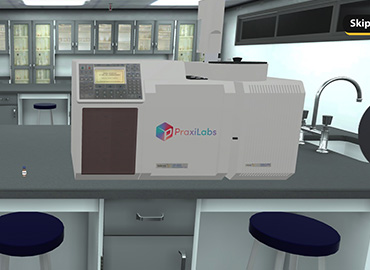
Analyzing pesticides in a water sample through mass spectrometry simulation.
⦁ An environmental water sample containing a combination of pesticides will be analyzed using a GC/MS instrument. ⦁ First, the pesticides will be extracted from the water sample through solid phase extraction setup. ⦁ Then, the extract will be dried, purified, and solubilized again in a specific solvent to be compatible with GC/MS instrument. ⦁ Afterwards, GC will be used to detect the number of pesticides as well as their relative abundance and retention time using the GC simulator platform. ⦁ Finally, mass spectrometry will be used to detect the m/z of each component to predict its chemical structure along with other characterization techniques, followed through gas chromatography simulation.
Become proficient at basic concepts of water samples analysis, demonstrating gas chromatography simulation.
Pesticide residue analysis is carried out through several steps, e.g., extraction from the sample matrix, clean up, and final chromatographic separation and determination.
Thus, environmental water samples cannot be analyzed without some preliminary sample preparation.
Solid phase extraction “SPE” is considered one of the most reliable techniques that could be used for pesticide residues isolation from environmental water samples.
This returns back to that it is fast, cost effective, accurate, and precise.
In addition, it consumes a small volume of organic solvent in addition to being easily adapted for fieldwork.
The other most widely used methods for the analysis of pesticides in water are based on “Gas Chromatography” (GC) and Liquid Chromatography” (LC).
However, identification based only on chromatographic analysis (retention time) without the use of spectrometric detection is not suitable as a confirmatory method.
Therefore, “Mass spectrometry” (MS) connected to GC “GC/MS” was found to be indispensable for high sensitivity and unambiguous detection, confirmation, and determination of such residues in different matrices.
GC-MS is counted as a very efficient technique with a high resolution power for a variety of compounds including but not limited to volatile and semi-volatile compounds.
A water sample containing a combination of different pesticides are analyzed through GC coupled MS instrument in the gc ms analysis laboratory setting.
GC is used to detect the number of compounds by detecting their elution time versus their relative abundance through gc-ms analysis.
Then each compound is further analyzed using a mass spectrometry simulator to detect its chemical structure.



I love the idea of virtual labs. It's gonna be something that takes our R&D and work in labs to another level. And I look forward to seeing what PraxiLabs can do with it.
Michelle Anderson, Head of Innovation
IE University - Spain
Although there are now several vendors offering virtual reality software for physics labs, there is only one that offers a realistic, I feel like I’m in a real lab solution: PraxiLabs.
Dr. William H. Miner, Jr., Professor of Physics
Palm Beach State College, Boca Raton, FL
PraxiLabs offered my students a chance to actively engage with the material. Instead of watching videos on a topic, they could virtually complete labs and realize the practical applications of class topics. This is a quality alternative to in-person labs.
Crys Wright, Teaching Assistant
Texas A&M University, USA
With the onset of the COVID-19 pandemic, we found ourselves in a situation that forced us to act quickly to find the best solution available to provide our students with a quality molecular genetics laboratory experience.
Korri Thorlacius, B.Sc., Biology Lab. Instructor
Biology Department - Kwantlen Polytechnic University