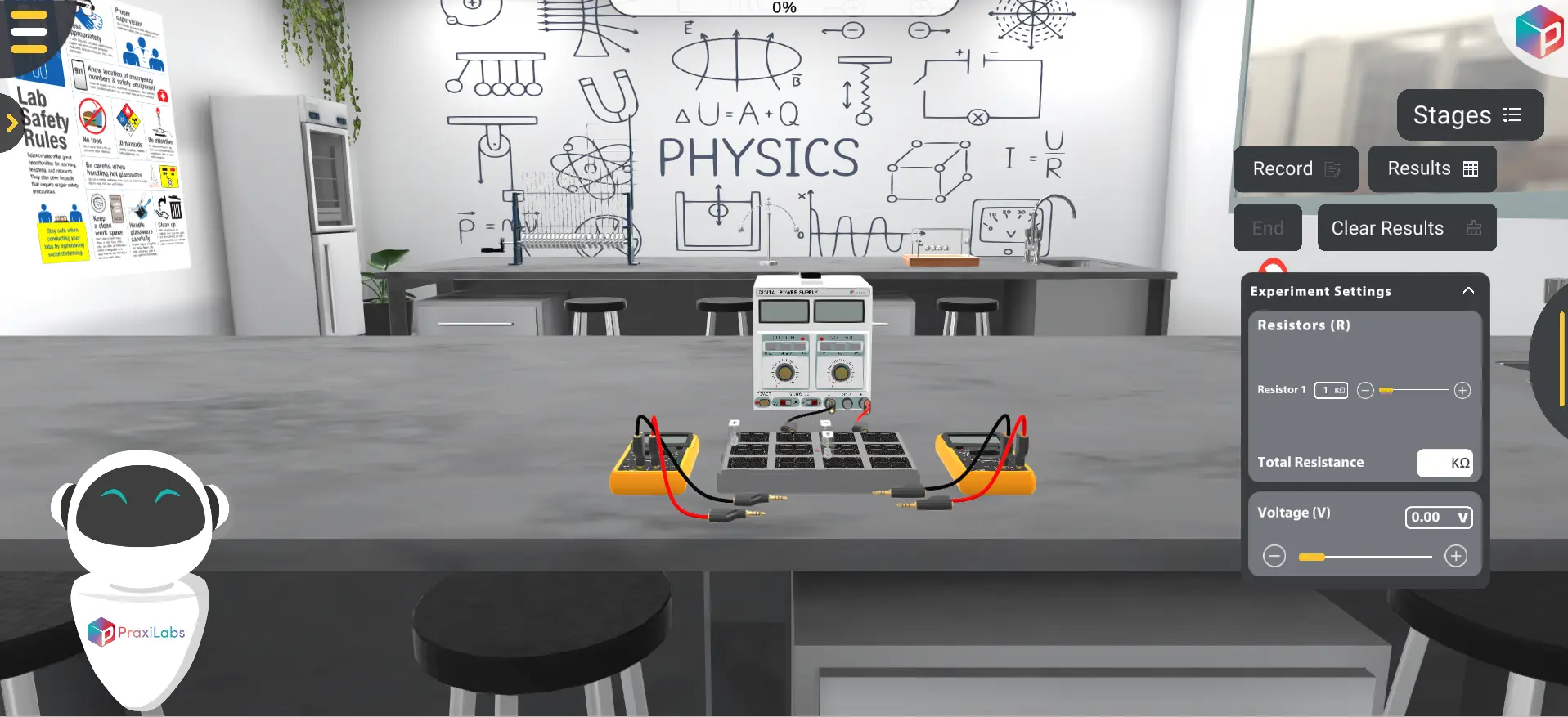


Ohm’s Law Virtual Lab

Physics | Electricity

Get it Now
Ohm's Law Simulation Ohm's Law Simulation

As Featured In

Millions of Users. Better Learning. Lower Costs

icon

2.5M+

Active Users Worldwide

icon

80%

Improved Learning Retention

icon

60%

Reduction in Laboratory Costs

Ohm’s Law Virtual Lab

General Aim of Ohm's law virtual lab

  • To verify Ohm’s law.
  • To verify the series and parallel laws of resistors connection.

Method

There are several common methods used to study Ohm’s law virtual lab including: single resistor, series resistors, parallel resistors and mixed series and parallel resistors. In Ohm’s Law Virtual Lab experimental setup, we will use all the above protocols in 7 different configurations. Single resistor. Two resistors in series. Two resistors in parallel. Parallel and series resistors. Four Randomly Placed Resistors with two bridges. Four randomly placed resistors with four bridges. Three randomly placed resistors.

Learning Objectives (ILOs)

  • By the end of the Ohm's law virtual lab experiment, the student should be able to:
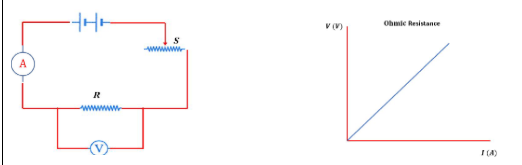
  • Understand the relation between current and voltage in a circuit with Ohmic resistance (voltage resistance current relationship).
  • Calculate the equivalent resistance in parallel and series circuits when many resistors are connected.
  • Gain an understanding of how to connect the bridge to create a closed electrical circuit.

Theoretical Background / Context

  • Ohm’s law states that: “The electric current passing through a conductor of resistance R, is directly proportional to the potential difference V at constant temperature”.
  • V  = IR — Where R is the resistance and is measured in Ohm. 
  • This voltage current resistance formula represents the fundamental relationship between the three quantities and forms the basis for the experimental verification of Ohm’s Law.
  • If we plot V versus I for an Ohmic resistance, we obtain a straight line that passes through the origin whose slope is equal to the resistance R. 

This linear relationship is clearly demonstrated in the verification of Ohm’s Law circuit diagram, where the components are connected to measure voltage and current accurately.


Principle Work of Ohm's Law Virtual Lab

  • The principle of Ohm's Law virtual lab involves verifying the relationship between voltage (V), current (I), and resistance (R) in a circuit, expressed as 𝑉=𝐼×𝑅.
  • The Ohm’s law experiment setup includes a power supply, a known resistor, an ammeter to measure current, and a voltmeter to measure voltage. 
  • The resistor is connected in series with the ammeter and the power supply, while the voltmeter is connected in parallel across the resistor. 
  • By adjusting the power supply to provide different voltage levels, corresponding current readings are measured with the ammeter, and voltage readings are taken with the voltmeter. 
  • Multiple sets of voltage and current readings are recorded, and the resistance is calculated using these values. 
  • A graph of voltage versus current is plotted to analyze the relationship. 
  • A linear relationship indicates that the resistor obeys Ohm's Law, with the slope of the graph representing the resistance. 
  • This confirms the direct proportionality of voltage and current, verifying Ohm's Law.
  • The principle is extended to seven configurations, including a single resistor, two resistors in series, two resistors in parallel, a combination of parallel and series resistors, four randomly placed resistors with two bridges, four randomly placed resistors with four bridges, and three randomly placed resistors.
  • Additionally, the Ohm's law virtual lab features an interactive stage where users are prompted to think critically about how to connect the bridges to close the circuit, encouraging problem-solving skills and a deeper understanding of circuit design while applying the principles of Ohm's Law.
  • This makes it an effective Ohm's law practice test environment for students to consolidate their understanding before formal assessment.

Trusted by Leading Universities & Institutions


What Professors Are Saying

Start the Way That Works Best for Your Institution

Start Free Trial
Schedule Personalized Demo
Get Pricing Details

Globally Recognized for Transforming STEM Education

Discover More Virtual Labs to Power Your Curriculum

Tailored Licensing to Fit Your Course, Faculty, or Whole Institution