


2.5M+
Active Users Worldwide

80%
Improved Learning Retention

60%
Reduction in Laboratory Costs
Investigate the factors affecting the capacitance and charge storage of a parallel plate capacitor during a parallel plate capacitor simulation, including the effects of plate separation, plate area, applied voltage, and the presence of a dielectric material.
Additionally, the experiment aims to verify the theoretical relationships governing capacitance, as derived from Gauss’s Law, and to understand the role of dielectric materials in enhancing capacitor performance.
This parallel plate capacitor experiment investigates the behavior of a parallel-plate capacitor under different conditions. The effect of plate separation (d) on capacitance is studied by systematically varying the distance between the plates. The impact of introducing a dielectric material between the plates is then analyzed by measuring how the dielectric constant εr influences the capacitance. The relationship between the applied voltage and the quantity of charge on the plates is explored to demonstrate the proportionality between charge and voltage. Finally, the combined effect of varying the applied voltage and introducing a dielectric material is examined to understand how the dielectric alters charge storage under different voltage conditions in the parallel plate capacitor simulation.
By the end of the experiment, the student should be able to:
Capacitance is a constant of proportionality. It relates the potential difference V between two conductors to their charge Q. The charge Q is equal and opposite on the two conductors. The relationship can be written: C=QV
The capacitance C of any two conductors depends on their size, shape, and separation. One of the simplest configurations is a pair of flat conducting plates, which is called a “parallel-plate capacitor.” Theoretically, the capacitance of parallel-plate capacitors is described by the parallel plate capacitor formula: C= εAd
Where =r0 is the dielectric constant of materials, 0=8.854×10⁻¹² F/m is the permittivity of vacuum, r is the relative dielectric constant of the material between the plates. For air r≅1, for an ordinary printing paper r≅3.85,for water r≅12.9. d distance between plates and A is a plate area.
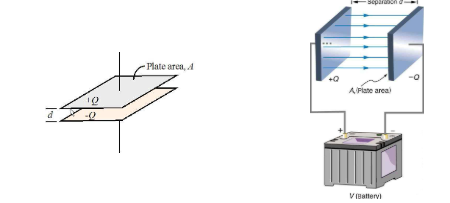
By changing the parameters in the above formula (d, A and =r0) and measure the capacitance of the parallel plate capacitor, one can verify this formula that is deduced from Gauss’s Law in Electricity.
This relationship represents the capacity of a parallel plate capacitor and can be visualized using a parallel plate capacitor diagram.
Here is the basic idea of the experiment you will do. Suppose that you had a parallel-plate capacitor with the plates separated by a distance d, and you applied a charge Q to the electrodes, so that they have a potential V = Q / C.
Suppose that you then arranged for the two electrodes to be electrically insulated, so that the charge Q could not go anywhere.
What would happen if you then increased the electrode separation d? The charge would remain constant, because it has nowhere to flow, whereas the capacitance would decrease (C=εAd).
Thus, the potential V will increase. If you measured V as a function of d, you would expect to find that the potential increases linearly with separation. In an actual experiment, however, you will find that V and d are not proportional, because the effect of additional capacitances in the setup is not zero.
The second part of the experiment is related to calculating the dielectric constant of different materials by inserting them between the plates and measuring the potential difference after and before the insertion of the material. This demonstrates the principle of parallel plate capacitor operation.
The third part of the experiment involves examining how changes in the voltage applied to the parallel plates affect the quantity of charge on the plates in the parallel plate capacitor lab.
The fourth part is similar to the third, but with a dielectric material placed between the plates. This part focuses on observing the effect of the dielectric material on the plates and how it influences the charge quantity as the applied voltage is varied in the parallel plate capacitor simulation, reinforcing concepts studied in physics parallel plate capacitor.



I love the idea of virtual labs. It's gonna be something that takes our R&D and work in labs to another level. And I look forward to seeing what PraxiLabs can do with it.
Michelle Anderson, Head of Innovation
IE University - Spain
Although there are now several vendors offering virtual reality software for physics labs, there is only one that offers a realistic, I feel like I’m in a real lab solution: PraxiLabs.
Dr. William H. Miner, Jr., Professor of Physics
Palm Beach State College, Boca Raton, FL
PraxiLabs offered my students a chance to actively engage with the material. Instead of watching videos on a topic, they could virtually complete labs and realize the practical applications of class topics. This is a quality alternative to in-person labs.
Crys Wright, Teaching Assistant
Texas A&M University, USA
With the onset of the COVID-19 pandemic, we found ourselves in a situation that forced us to act quickly to find the best solution available to provide our students with a quality molecular genetics laboratory experience.
Korri Thorlacius, B.Sc., Biology Lab. Instructor
Biology Department - Kwantlen Polytechnic University