Test for Unknown Basic Radical 6 Virtual Lab Simulation
Chemistry | Inorganic Chemistry | Analytical Chemistry



2.5M+
Active Users Worldwide

80%
Improved Learning Retention

60%
Reduction in Laboratory Costs
Identification of some basic radicals in their salts.
Determination of some basic radicals in their salts through chemical identification tests.
Students understand various tests to identify the cation present in a given salt.
Metals may be classified into six analytical groups, depending on the variation of the solubilities of their chlorides, sulphides, hydroxides,
and carbonates. for each group, there is a certain group reagent that makes a precipitate only with the members of this group.
The six analytical groups are summarized in the following table:
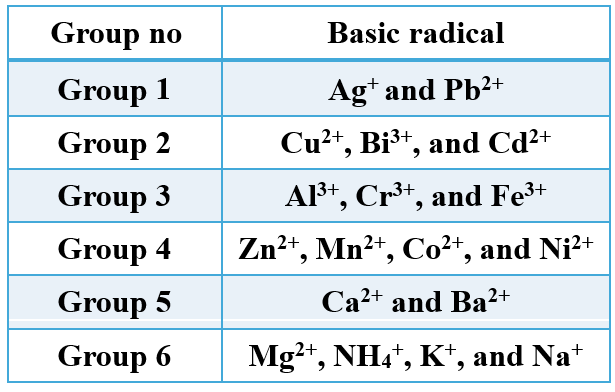
Basic radicals are classified according to the chemical tests carried out to identify them.
First principle test group identification test is carried out to determine which group the radical belongs to then some confirmatory tests are carried out to identify the basic radical.
Identification of basic radicals and classifying them according to a set of principal and confirmatory chemical tests.



I love the idea of virtual labs. It's gonna be something that takes our R&D and work in labs to another level. And I look forward to seeing what PraxiLabs can do with it.
Michelle Anderson, Head of Innovation
IE University - Spain
Although there are now several vendors offering virtual reality software for physics labs, there is only one that offers a realistic, I feel like I’m in a real lab solution: PraxiLabs.
Dr. William H. Miner, Jr., Professor of Physics
Palm Beach State College, Boca Raton, FL
PraxiLabs offered my students a chance to actively engage with the material. Instead of watching videos on a topic, they could virtually complete labs and realize the practical applications of class topics. This is a quality alternative to in-person labs.
Crys Wright, Teaching Assistant
Texas A&M University, USA
With the onset of the COVID-19 pandemic, we found ourselves in a situation that forced us to act quickly to find the best solution available to provide our students with a quality molecular genetics laboratory experience.
Korri Thorlacius, B.Sc., Biology Lab. Instructor
Biology Department - Kwantlen Polytechnic University