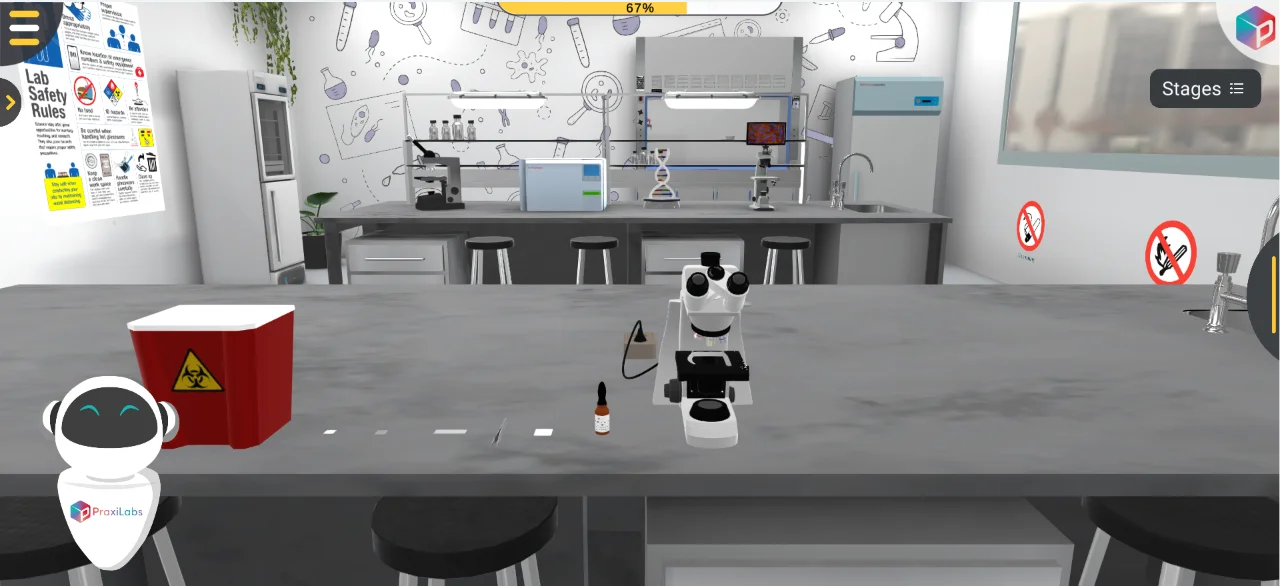


Virtual Microscopy Lab: Introduction to Microscopes

Biology | Microbiology

Buy Now

As Featured In

Millions of Users. Better Learning. Lower Costs

icon

2.5M+

Active Users Worldwide

icon

80%

Improved Learning Retention

icon

60%

Reduction in Laboratory Costs

General Aim

To explore the compound light microscope and the stereoscopic dissecting microscope, and to learn how to use them effectively to observe a variety of specimens in a virtual microscopy lab. 

Method of Virtual Microscopy Lab

This microscopy experiment utilized a combination of interactive elements, visual aids, and guided exploration to introduce students to compound light microscopes and stereoscopic dissecting microscopes. By actively engaging with the microscope components and following step-by-step instructions, students could gain hands-on experience and develop a deeper understanding of these valuable scientific tools in a virtual microscopy lab.

Learning Objectives (ILOs) of Virtual Microscopy Lab

  • By the end of the experiment, the student should be able to:

  • Identify various microscope types.
  • Practice proper handling and use of the compound light microscope.
  • Identify the parts of a compound light microscope.
  • Prepare a wet mount slide of human cheek cells.
  • Locate and observe human cheek cells under low- and high-power magnifications using the compound microscope.
  • Understand the use of immersion oil for high-magnification observations using a microscope simulator. 

Theoretical Background

  • Microscopes are essential tools for scientists, allowing them to explore the microscopic world that is invisible to the naked eye. They have revolutionized our understanding of life and have led to countless discoveries through various microscopy techniques. 

Types of Microscopes:

  1. Compound light microscope: Used for examining thin specimens on slides.
  2. Stereoscopic dissecting microscope: Provides a three-dimensional view of larger specimens.

Principles of Microscopy:

  • Refraction: The bending of light as it passes through different mediums.
  • Magnification: The ability to enlarge objects.
  • Resolution: The ability to distinguish between two closely spaced points.
  • Contrast: The difference in brightness between the specimen and its background.

Key Factors Affecting Microscope Performance:

  • Magnification: Determined by the objective and eyepiece lenses.
  • Resolution: Influenced by numerical aperture and wavelength of light.
  • Contrast: Can be enhanced through staining or microscope settings.
  • Working distance: Distance between the objective lens and the specimen.
  • Field of view: Area of the specimen visible at once.

Using a Compound Light Microscope:

  • Prepare the specimen.
  • Adjust the condenser and diaphragm.
  • Focus the microscope.
  • Observe the specimen.
  • Change magnification as needed.
  • Using a Stereoscopic Dissecting Microscope:
  • Place the specimen on the stage.
  • Adjust the focus.
  • Observe the specimen.

Microscopes are essential for scientific research, providing valuable insights into the microscopic world. Understanding the different types of microscopes and their applications is crucial for effective use.


Principle Work of Virtual Microscopy Lab

The Compound Light Microscope

  • The compound light microscope operates on the principle of refraction. This is the bending of light as it passes from one medium (such as air) to another (such as glass). 

The microscope uses a system of lenses to magnify objects in two stages:

  • Objective Lens: The first lens, located closest to the specimen, produces a real, inverted, and magnified image of the specimen.
  • Eyepiece: The second lens, located near the observer's eye, magnifies the image produced by the objective lens. This creates a virtual, inverted, and further magnified image that the observer sees.

The total magnification of the compound microscope is calculated by multiplying the magnification of the objective lens by the magnification of the eyepiece, as demonstrated in the virtual microscopy lab.

The Stereoscopic Dissecting Microscope:

  • The stereoscopic dissecting microscope uses a similar principle of refraction to magnify objects. However, it employs a system of prisms to create a stereoscopic effect, providing a three-dimensional view of the specimen. This is particularly useful for tasks that require precise manipulation, such as dissection using a microscope simulation.

Key Factors Affecting Microscope Performance:

  • Magnification: The ability of the microscope to enlarge the image of a specimen. This is determined by the focal lengths of the objective and eyepiece lenses.
  • Resolution: The ability of the microscope to distinguish between two closely spaced points. This is influenced by the numerical aperture of the objective lens and the wavelength of light used.
  • Contrast: The difference in brightness between the specimen and its background. This can be enhanced by using staining techniques or adjusting the microscope's settings.
  • Working distance: The distance between the objective lens and the specimen. A longer working distance is often desirable for manipulating specimens.
  • Field of view: The area of the specimen that can be seen at once. A larger field of view is useful for observing larger specimens in the virtual microscopy lab. 

By understanding the principles of light refraction and the key factors affecting microscope performance, you can effectively use these instruments to explore the microscopic world.


Trusted by Leading Universities & Institutions


What Professors Are Saying

Start the Way That Works Best for Your Institution

Start Free Trial
Schedule Personalized Demo
Get Pricing Details

Globally Recognized for Transforming STEM Education

Discover More Virtual Labs to Power Your Curriculum

Tailored Licensing to Fit Your Course, Faculty, or Whole Institution