 PraxiLabs A virtual world of science

Last Updated on August 5, 2026 by Muhamed Elmesery
A virtual momentum lab gives students a way to explore motion, collisions, and conservation of momentum without setting foot in a physical classroom. Traditional physics lessons often rely on static diagrams or textbook equations, leaving momentum feeling abstract rather than something students can actually observe. By simulating collisions in a 3D environment, learners adjust mass and velocity and watch outcomes unfold in real time. This interactive approach turns momentum into a hands-on, engaging learning experience that builds lasting intuition.
Table of Contents
What is a virtual momentum lab?
A virtual momentum lab is an online simulation environment where students study how mass and velocity combine to produce motion. Instead of physical equipment, learners work inside a 3D interface built on real physics rules.
Each simulation lets students adjust a few key variables to see how outcomes change:
- Object mass.
- Starting velocity.
- Collision type (elastic or inelastic).
- Surface conditions such as friction.
This kind of momentum simulator makes formulas visible, letting learners see cause and effect on screen rather than only on paper.
Concepts covered in the virtual momentum lab:
A well-designed momentum simulation walks students through several connected ideas, moving from basic definitions toward more applied scenarios.
Linear momentum
- Momentum is calculated by multiplying an object’s mass by its velocity.
- Changing either value in the simulation shows immediately how the overall momentum shifts.
- Students compare light, fast objects with heavy, slow ones to see how each produces different momentum values.
Conservation of momentum
- Total momentum in a closed system stays constant, even as objects exchange energy during a collision.
- Students verify this rule themselves by running repeated trials with different starting conditions.
- The principle applies whether the collision is elastic or inelastic.
Elastic and inelastic collisions
- Elastic collisions conserve kinetic energy between both objects.
- Inelastic collisions convert some energy into heat or deformation.
- Comparing both types side by side makes the distinction concrete rather than theoretical.
Impulse
- Impulse describes how a force applied over time changes an object’s motion.
- A small force applied briefly can produce the same effect as a larger force applied instantly.
- Research on interactive physics labs supports this kind of simulation-based approach to teaching impulse and force.
Real-world applications
- Vehicle safety features such as airbags and crumple zones rely on momentum and impulse principles.
- Sports mechanics, from a bat striking a ball to a tackle in football, follow the same rules.
- Connecting formulas to familiar situations helps students remember them long after the lesson ends.

Benefits of momentum simulations in motion concepts study:
Studying motion through a virtual momentum lab offers advantages that go beyond convenience for students who learn best by doing.
Advantages for students
- Instant repetition of experiments without needing new equipment for every trial.
- Immediate visual feedback that reinforces cause and effect as variables change.
- Safer exploration of scenarios that would be difficult or costly to recreate physically.
- An interactive momentum simulation that builds stronger intuition than memorizing formulas alone.
Advantages for instructors
- Automated performance tracking, since PraxiLabs tracks every student’s actions and completions in real time.
- Performance reports that highlight exactly where each student needs support.
- A documented link between simulation-based formats and stronger outcomes, which peer-reviewed findings support.
Explore: Laws of Motion Simulation Labs
How do collision simulations work in a virtual momentum lab?
Collision simulations inside a virtual momentum lab model how two objects behave after impact.
Types of collisions
- Elastic collisions, where kinetic energy is conserved between both objects.
- Inelastic collisions, where some energy converts into heat or deformation.
- A conservation of momentum simulation that shows total momentum staying constant before and after impact.
- Impulse and momentum simulation scenarios that reveal how force applied over a short time changes velocity, the same idea behind airbags absorbing crash impact.
Running an experiment
- Students set the mass and initial velocity of two objects before starting.
- The simulation calculates outcomes automatically, so learners focus on interpreting results rather than manual computation.
- Results display instantly, allowing students to test a new scenario within seconds.
Comparing results
- Repeating a collision with different masses highlights patterns easy to miss in a single textbook example.
- A heavier object typically transfers less of its velocity in an elastic collision.
- Side-by-side comparisons of multiple runs show how small changes in starting conditions lead to very different outcomes.
Explore: Realistic Physics Simulation for Interactive Experiments
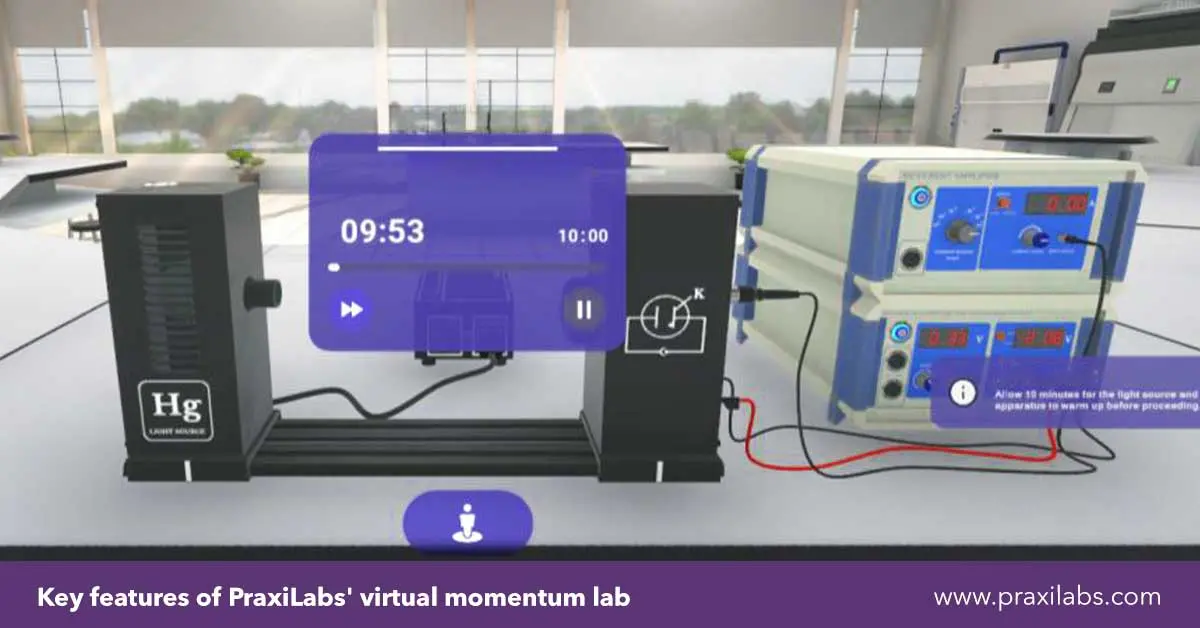
Key features of PraxiLabs’ virtual momentum lab:
PraxiLabs builds its virtual momentum lab around several core features designed to support both independent learners and classroom instruction.
| Feature | What It Offers |
| Oxi AI Lab Assistant | Real-time, personalized guidance during experiments |
| Custom Quiz Builder | Quizzes linked directly to experiments with automated grading |
| LMS Integration | Connects to Moodle, Canvas, and Blackboard in 24 hours |
| Bilingual Access | Experiments available in both Arabic and English |
| 24/7 Support | Continuous technical assistance for institutions and students |
Beyond the platform
- A place within a wider catalog of 210+ science simulations across biology, chemistry, and physics.
- Assessment tools that let teachers link quizzes directly to a specific momentum experiment.
- Consistent access for students moving between motion-related topics and other science branches.
Why this matters for growth in the field
- Demand for simulation-based STEM learning continues to expand across institutions worldwide.
- This trend is projected to grow at a CAGR of 8.57% between 2026 and 2030.
- Institutions adopting a physics momentum simulation approach early tend to see faster gains in student engagement.
Momentum topics to discover using PraxiLabs:
Within PraxiLabs’ virtual momentum lab, two mechanics simulations connect directly to momentum and motion analysis.
Ballistic Pendulum Simulation
- Students fire a projectile into a stationary pendulum and measure the angle of deflection.
- Conservation of momentum is used to calculate the ball’s initial velocity across short, medium, and long ranges.
- The experiment also introduces the difference between elastic and inelastic collisions in a practical context.
Explore Ballistic Pendulum Simulation at PraxiLabs
Newton’s Second Law Simulation
- This momentum simulation lab lets learners isolate force and mass to observe how each affects acceleration.
- Since force and momentum are closely linked, the experiment reinforces how momentum changes when a net force acts over time.
- Students can compare results across multiple trials to confirm the relationship holds consistently.
Explore Newton’s Second Law Simulation with PraxiLabs
FAQs
What are the learning objectives of momentum?
Learning objectives include understanding how mass and velocity determine momentum, applying conservation of momentum to collisions, and distinguishing elastic from inelastic interactions.
What challenges do students face without interactive labs?
Without interactive labs, students often struggle to visualize how momentum transfers during a collision, leading to weaker cause-and-effect understanding and lower engagement.