 PraxiLabs A virtual world of science


Last Updated on July 22, 2026 by Muhamed Elmesery
A redox virtual lab gives chemistry students a safe, fully digital environment to practice oxidation-reduction experiments from any location. In traditional settings, these reactions often involve hazardous oxidizing agents and strict equipment requirements that limit access. Virtual labs remove those barriers entirely, letting students repeat procedures as many times as they need before an exam. This article covers what makes a redox virtual lab effective, what students learn from it, where real labs fall short, and how PraxiLabs supports this kind of digital chemistry training.
Table of Contents
What is a redox virtual lab?
A redox virtual lab is a browser-based or platform-hosted simulation that lets students carry out oxidation-reduction chemistry online, without physical reagents, glassware, or a campus laboratory visit.
Unlike a general redox lab tool, this type of simulation focuses specifically on reactions where electrons transfer between chemical species: one compound loses electrons (oxidation) while the other gains them (reduction). Students can visualize these changes in real time, including shifts in electrode potential, color changes from indicator reactions, and the formation of new ionic compounds.
Three categories of content are typically available across this type of platform:
- Titration-based experiments, such as permanganometry and iodometry.
- Electrochemical cell simulations showing oxidation and reduction half-reactions.
- Inorganic reaction experiments covering transition metal chemistry.
Learning objectives of redox virtual lab:
The simulations in this category are built around core skills that align directly with undergraduate analytical and inorganic chemistry curricula. By the end of a typical redox reaction lab session, students are expected to:
- Define oxidation and reduction in terms of electron transfer.
- Identify oxidizing and reducing agents in a given chemical equation.
- Balance redox equations using the half-reaction method.
- Calculate the molarity or strength of an unknown solution from titration data.
- Explain how indicators signal the endpoint in permanganometric and iodometric procedures.
- Apply safety awareness by understanding which reagents would carry real hazards in a physical setting.
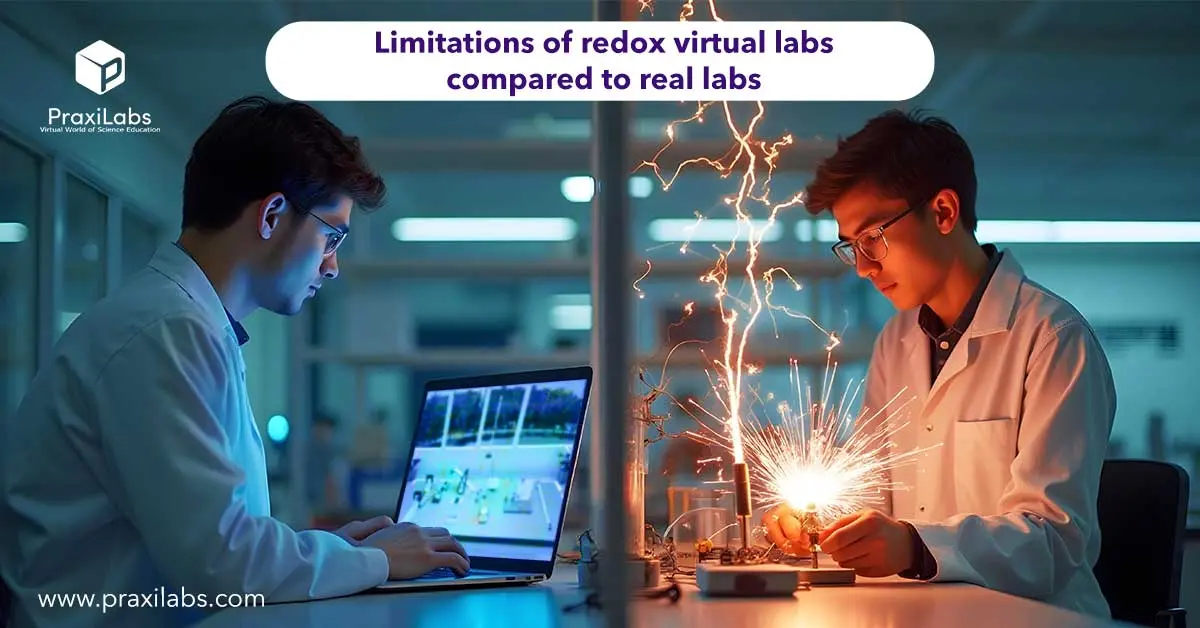
Limitations of redox real labs compared to virtual labs:
Physical laboratories impose real constraints on how, when, and how often students can perform oxidation-reduction procedures. A redox virtual lab removes most of those constraints at once.
The table below compares the two environments across the dimensions that matter most for learning:
| Aspect | Traditional Lab | Virtual Lab |
| Running cost | High: chemicals, reagents, waste disposal | Up to 60% lower |
| Safety risk | Exposure to corrosive and toxic oxidizing agents | Zero chemical exposure |
| Lab hours | Fixed schedule, limited by campus access | Available 24/7 |
| Experiment repetition | Restricted by reagent quantities | Unlimited repeats |
| Error consequences | Wasted chemicals, potential hazards | Reset and restart instantly |
| Geographic access | On-campus presence required | Any device, any location |
These differences have a direct impact on learning outcomes. A study published in JMIR research on virtual chemistry lab use in undergraduate settings found that computer-based labs significantly improved student performance and offered a viable alternative when physical labs were inaccessible.
Redox experiments risks to avoid using virtual simulations:
Physical redox experiment setups carry real hazards that a redox virtual lab eliminates entirely:
- Potassium permanganate (KMnO4) causes skin and eye burns on contact.
- Concentrated sulfuric acid releases heat on dilution and causes severe chemical burns.
- Iodine solutions can stain skin and damage mucous membranes if inhaled as vapor.
- Improper disposal of chromium(VI) or mercury-containing reagents creates environmental contamination.
How do you recognize redox reactions in virtual labs?
The key visual cue in any redox reaction simulation is a color change:
in permanganometry, each KMnO4 drop added to the colorless analyte is immediately consumed and decolorized until a faint pink color persists permanently in the flask; in iodometry, the starch indicator shifts from deep blue-black to colorless at the equivalence point.
Beyond color, students also track:
- Changes in electrode potential shown on the simulation’s digital readout.
- Shifts in oxidation number as the reaction progresses step by step.
- Formation of precipitates in displacement-type reactions.
- pH curve shape when the titration runs under acidic or basic conditions.
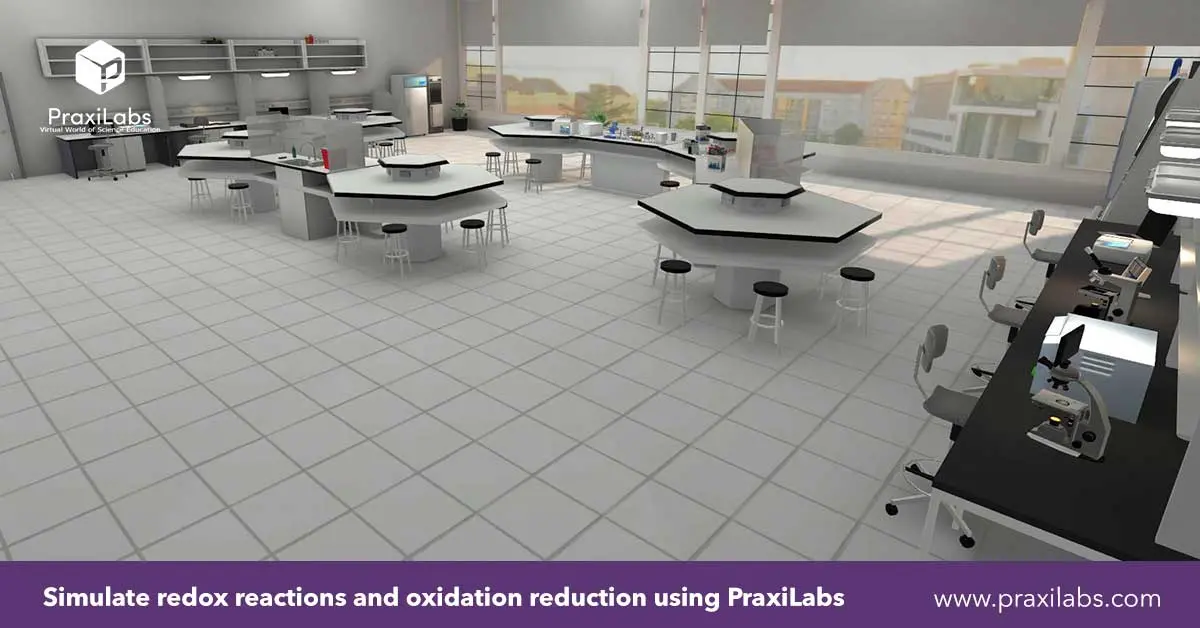
Simulate redox reactions and oxidation reduction using PraxiLabs:
PraxiLabs supports full simulation of oxidation-reduction chemistry across its analytical and inorganic chemistry catalog, with tools that go well beyond basic experiment replay.
Using a redox virtual lab on the PraxiLabs platform, students benefit from a complete set of supporting features:
- Oxi, the AI Lab Assistant, provides real-time personalized guidance through each step of the procedure.
- A custom quiz builder links assessment questions directly to the simulation, with automated grading built in.
- LMS integration with Moodle, Canvas, and Blackboard, set up in as little as 24 hours.
- Bilingual access in Arabic and English, so institutions serve mixed-language student bodies without running separate systems.
- 24/7 availability, meaning lab practice is never limited to a fixed campus schedule.
A study published in Frontiers in Education on virtual chemistry platform integration found that platforms enabling repetitive experimentation in a safe digital environment produced significant improvements in student comprehension, academic performance, and learning motivation compared to traditional lecture-based instruction.
Explore some of PraxiLabs’ redox virtual lab simulations:
The four simulations below represent key entry points for students developing their understanding of oxidation-reduction chemistry.
Standardization of Potassium Permanganate
Students standardize a KMnO4 solution against oxalic acid under acidic conditions; the endpoint is the first persistent faint pink in the flask, with KMnO4 acting as its own indicator.
Standardization of Sodium Thiosulphate using Iodometric Titration
A redox reaction lab experiment where sodium thiosulphate reduces iodine; the starch indicator shifts from blue-black to colorless at the equivalence point.
Redox Titration Analytical Chemistry
A dedicated redox simulation covering direct and back-titration approaches in analytical chemistry, with potential monitoring and titration curve analysis.
Alamar Blue Assay
A biology-based redox simulation showing how cells reduce resazurin to resorufin, producing a visible indigo-to-red shift as a measure of cell viability.
Frequently Asked Questions
What are redox reactions?
Redox reactions involve electron transfer between chemical species: the oxidized species loses electrons, the reduced one gains them. A redox lab lets students observe these transfers directly through titrations, electrochemical cells, and color-change indicators.
What are the 4 types of redox reactions?
The four main types are combination reactions, decomposition reactions, single displacement reactions, and combustion reactions. In each case, at least one element changes its oxidation state as electrons transfer between the reacting species.