 PraxiLabs A virtual world of science

Last Updated on July 1, 2026 by Muhamed Elmesery
The science of toxicology education often involves studying hazardous chemicals and risky laboratory procedures, making safety a major challenge for students and institutions.
A Toxicology virtual lab transforms this learning experience by providing a completely safe, interactive, and immersive environment where students can perform experiments without exposure to harmful substances.
Through realistic 3D simulations, learners can build practical laboratory skills, understand toxic effects, and confidently apply scientific concepts while enjoying flexible, risk-free learning anytime and anywhere.
Table of Contents
What is a Toxicology virtual lab?
Toxicology virtual lab is an immersive 3D, computer-based or simulation environment that is designed to help students learn fundamental scientific methods and practical lab skills without the hazards of exposure to toxic materials and organisms.
Your students can conduct their toxicological experiments, test for unknown substances, and predict chemical and biological hazards in a safe, digital environment anytime, and anywhere.
Learning goals of Toxicology virtual lab:
- A Toxicology virtual lab helps students develop a deeper understanding of how toxic substances interact with biological systems through safe, interactive, and realistic experimentation.
- Learning goals of a toxicology virtual lab include:
- Understand the principles and foundations of toxicology.
- Identify the effects of toxic substances on cells, organs, and body systems.
- Learn proper laboratory safety procedures when handling hazardous chemicals.
- Analyze dose-response relationships and toxicity levels.
- Develop skills in observing, recording, and interpreting experimental results.
- Perform toxicology experiments using accurate scientific methods and lab techniques.
- Enhance problem-solving and critical thinking through virtual experimentation.
- Explore real-world applications of toxicology in medicine, environmental science, and pharmacology.
- Improve confidence in conducting laboratory procedures through repeated practice.
Virtual Toxicology laboratory study sectors:
- Medical Toxicology: Studies the effects of toxins, drugs, and chemicals on human health and treatment methods.
- Environmental Toxicology: Analyzes how pollutants and hazardous substances impact ecosystems and living organisms.
- Pharmaceutical Toxicology: Evaluates drug safety, side effects, and toxicity during drug development.
- Forensic Toxicology: Investigates toxins, poisons, and substances involved in criminal and legal cases.
- Industrial Toxicology: Examines workplace chemical exposure risks and occupational safety measures.
- Food Toxicology: Studies contaminants, additives, and toxic substances that may affect food safety.
- Clinical Toxicology: Focuses on diagnosing and managing poisoning and toxic exposure cases in healthcare settings.
- Chemical Toxicology: Explores the biological effects and hazards of industrial and laboratory chemicals.
What limitations does Toxicology virtual lab overcome?
- Eliminates risks associated with handling hazardous and toxic substances.
- Reduces the high costs of chemicals, equipment, and laboratory maintenance.
- Provides unlimited experiment repetition without material waste.
- Solves accessibility issues for institutions with limited laboratory resources.
- Allows students to perform complex experiments anytime and from anywhere.
- Minimizes errors and accidents commonly encountered in traditional labs.
- Enhances visualization of toxicological processes that may be difficult to observe physically.
How does Toxicology virtual lab provide safety standards?
- Creates a completely risk-free environment for experimenting with toxic substances.
- Simulates proper laboratory safety protocols and handling procedures.
- Trains students on emergency responses and safe chemical management.
- Prevents exposure to harmful chemicals, fumes, and biological hazards.
- Encourages safe experimentation practices before entering real laboratories.
- Provides guided instructions and controlled virtual environments to reduce mistakes.
Why Choose PraxiLabs’ Toxicology Virtual Lab?
Toxicology education becomes far more impactful when students can safely explore the effects of toxic substances through realistic, hands-on experimentation.
With PraxiLabs toxicology lab software, learners can engage in immersive 3D toxicology simulations that replicate real laboratory environments while eliminating the risks and limitations of traditional labs.
- Provides a completely safe and risk-free environment for handling toxic substances.
- Offers realistic 3D science simulations for immersive practical learning.
- Enables students to repeat experiments anytime for better understanding.
- Supports remote and self-paced learning from any location.
- Helps institutions reduce laboratory costs while maintaining high-quality training.
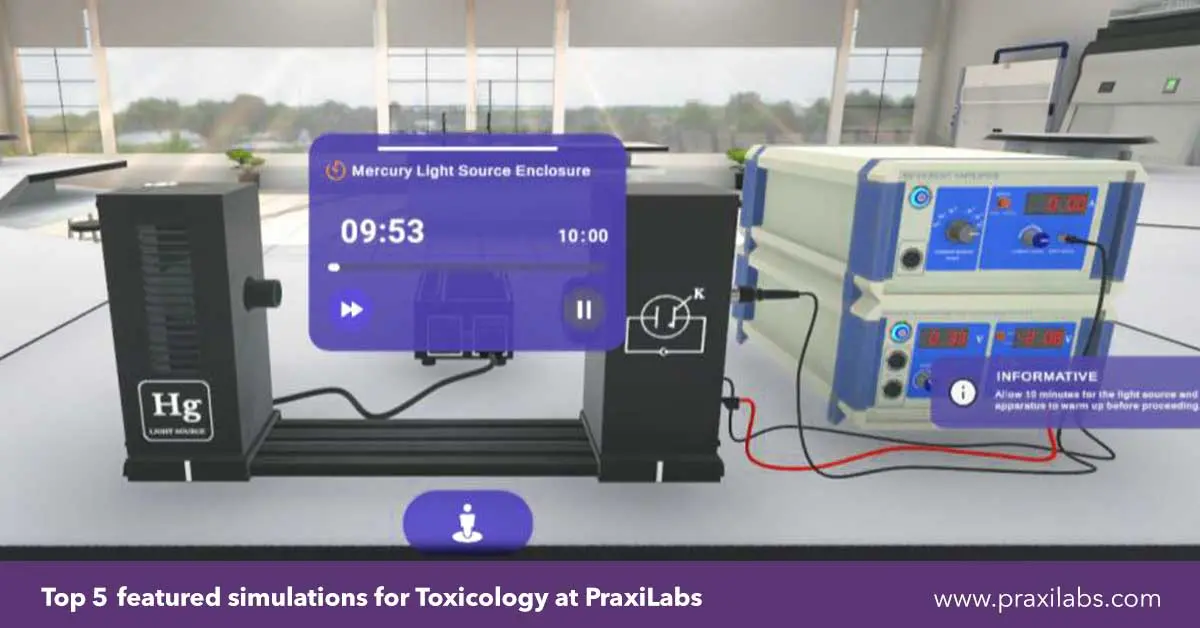
Top 5 featured simulations for Toxicology at PraxiLabs:
Simulations for chemistry and toxicology labs at PraxiLabs help students analyze toxic compounds, understand cellular responses and experimental procedures while strengthening both their theoretical knowledge and practical lab skills through interactive, repeatable experiences.
Available in vitro toxicology simulations include:
- Cell Culture
- In Vitro 80HdG DNA Adduct Assay
- In Vitro Acid Phosphatase Assay
- In Vitro Bromodeoxyuridin (BrdU) Assay
- In Vitro Caspase 3/7 assay
- In Vitro Cytokinesis-Block Micronucleus Assay
- In Vitro Histone H2AX Phosphorylation Assay
- In Vitro Mammalian Chromosomal Aberration Test
- In Vitro Neutral Red Uptake Assay
- XTT Viability Assay
Let’s explore the Top 5 featured simulations for Toxicology at PraxiLabs in more detail:
1. In Vitro Mammalian Chromosomal Aberration Test
This experiment aims to detect structural chromosomal aberrations by estimating different classes of chromosome changes scored in metaphase using the light microscope.
By the end of the chromosome aberration test, the postgraduate student will be able to:
- Successfully handle the required instruments and consumables needed in the experiment.
- Check the confluence and count cells under the microscope.
- Dilute the cells to a specific count suitable for seeding in the 24-well plate.
- Calculate the concentration of tested chemicals and prepare the calculated doses in the cell culture medium.
- Treat cells with the genotoxic agent(s) or nanoparticles and observe under the microscope.
- Harvest cells, fix them and stain with Giemsa stain.
- Analyze cells using a light microscope and evaluate analyzed data.
- Represent and interpret the resulted data graphically using dot plots.
2. In Vitro Cell Viability by the Lactate Dehydrogenase Assay (LDH)
This Lactate dehydrogenase test aims to determine the activity of the cytoplasmic enzyme Lactate dehydrogenase (LDH) released by damaged cells after exposure to geometric concentrations of different nanoparticles.
3. In Vitro Acid Phosphatase Assay
This cell viability assay aims to quantify the amount of acid phosphatase activity on the cell membrane of viable cells using a microplate reader.
4. In Vitro Cytokinesis-Block Micronucleus Assay
This in vitro micronucleus assay aims to detect chromosome damage,, both chromosome loss and chromosome breakage, to evaluate the induction of genotoxic effects of nanoparticles and nanomaterials using the light microscope.
5. XTT Viability Assay
This XTT cell viability assay aims to test the viability of cultured cells after exposure to geometric concentration of different nanoparticles.
By the end of this experiment, the post-graduate student will be able to:
- Aspirate the old medium and add the new medium containing the tested chemicals in the appropriate wells.
- Add the XTT solution to cells and read the results using the microplate reader after incubation of cells.
- Read the results of XTT and calculate the viability percent of cells exposed to different doses of tested chemicals.
Frequently Asked Questions
What does a toxicology lab test for?
A toxicology lab test for unknown substances, and predict chemical and biological hazards in a safe, digital environment anytime, and anywhere.
What is the most common toxicology test?
The most common toxicology test is the urine toxicology screening test. It is widely used because it is quick, non-invasive, cost-effective, and capable of detecting a wide range of drugs, chemicals, and toxic substances.