 PraxiLabs A virtual world of science

Last Updated on June 10, 2026 by Muhamed Elmesery
Biochemistry education is evolving beyond the limitations of traditional laboratories, giving students access to more flexible, interactive, and immersive learning experiences.
A biochemistry virtual lab allows learners to perform complex experiments, explore molecular processes, and practice essential laboratory techniques in a safe digital environment.
From enzyme reactions and protein analysis to metabolic pathway simulations, virtual lab biochemistry helps bridge the gap between theory and practical application.
With advanced 3D simulations, real-time feedback, and remote accessibility, these platforms are transforming how students engage with scientific learning while improving understanding, confidence, and academic performance.
Table of Contents
What a Biochemistry virtual lab?
Biochemistry virtual lab is an interactive and immersive 3D simulation that replicates the real biochemistry experiments and procedures in a safe virtual environment.
Biochemistry simulations let students understand and perform several techniques in biochemistry such as total protein estimation (Bradford), affinity chromatography, HPLC, and more in a safe environment away from any risks for several times, and from anywhere.
How does Biochemistry virtual lab work?
A biochemistry virtual lab works by simulating real laboratory experiments through interactive 3D digital environments. Students can perform experiments online using virtual equipment, chemicals, and biological samples, just like in a physical lab.
Typically, the process includes:
- Selecting an experiment (such as protein estimation).
- Following guided lab procedures step by step and performing the experiment.
- Using virtual tools like microscopes, pipettes, or a centrifuge.
- Mixing reagents and observing biochemical reactions.
- Recording and analyzing simulated results in real-time.
These labs often include animations, instant feedback, quizzes, and safety guidance to help students understand complex biochemical concepts more effectively while learning remotely or in blended classrooms.
Explore: Virtual Labs as Modern Stem Teaching Tools for Education
Benefits of studying Biochemistry in a virtual environment:
The most important benefits of studying Biochemistry in a virtual environment are to:
- Visualize concepts and phenomena of biochemistry that are not visible.
- Enhance deep understanding of various scientific topics.
- Provide a safe and interactive environment to improve learning outcomes.
- Increase scientific curiosity.
- Reduce costs.
- Provide interactive education.
- Increase flexibility in learning.
- Enable repetition and training anytime and anywhere.
Explore: Integrating Virtual Environments in Education
Target audience of the Biochemistry virtual lab:
The target audience of a virtual biochemistry labs includes:
- University and college students studying biochemistry, biotechnology, medicine, pharmacy, and life sciences.
- STEM educators and laboratory instructors.
- Higher education institutions seeking flexible science learning solutions.
- Remote and online learners needing practical laboratory experience.
- Researchers and trainees requiring safe, repeatable experiment practice.
The virtual biochemistry lab simulations help students to understand the different biological processes and concepts.
All you need to start our virtual labs biochemistry simulations is:
Create Free Account
No hardware setup. No credit card required. Get started in seconds
Choose from 220+ Simulations
Select 3 Free Simulations and get started
Practice as Many Times as You Want
Your lab partner will help you out, plus walkthrough videos, tutorials, & more
Biochemistry virtual lab adoption in higher education:
Biochemistry virtual lab adoption in higher education is rapidly increasing as universities seek more scalable, accessible, and interactive ways to teach complex biochemical concepts and laboratory procedures.
Virtual labs are especially valuable in biochemistry because they help students
- Visualize abstract molecular processes.
- Simulate expensive or hazardous experiments.
- Practice techniques repeatedly without material limitations.
Studies show that virtual laboratory environments can improve conceptual understanding, student engagement, and learning flexibility when integrated effectively into undergraduate science curricula.
In a study highlights the effect of virtual laboratories on undergraduate chemistry education. Initially, students in real laboratory, virtual laboratory, and lecture-only groups had similar baseline knowledge, indicating that teaching methods, rather than initial proficiency, shape learning outcomes.
Post test results revealed that the real laboratory group scored higher than both the virtual laboratory and lecture-only groups, underscoring the enhanced understanding and retention achieved through hands-on real laboratory experiences. However, virtual laboratories proved to be a valuable supplementary tool, offering significant advantages over lecture-only methods and providing benefits comparable to real laboratories when physical laboratory access is limited.
Overall, while real laboratories are crucial for deepening scientific understanding, computer-based laboratories offer flexibility and accessibility, making them an effective complement in resource-constrained settings.
Combining both virtual and real laboratories can enhance the educational experience in practical chemistry and other experimental sciences.
PraxiLabs: The best virtual labs platform for Biochemistry
Praxilabs’ Biochemistry Virtual Lab Experiments provide students with a dynamic, engaging, safe, and accessible platform to explore and learn about biochemistry concepts.
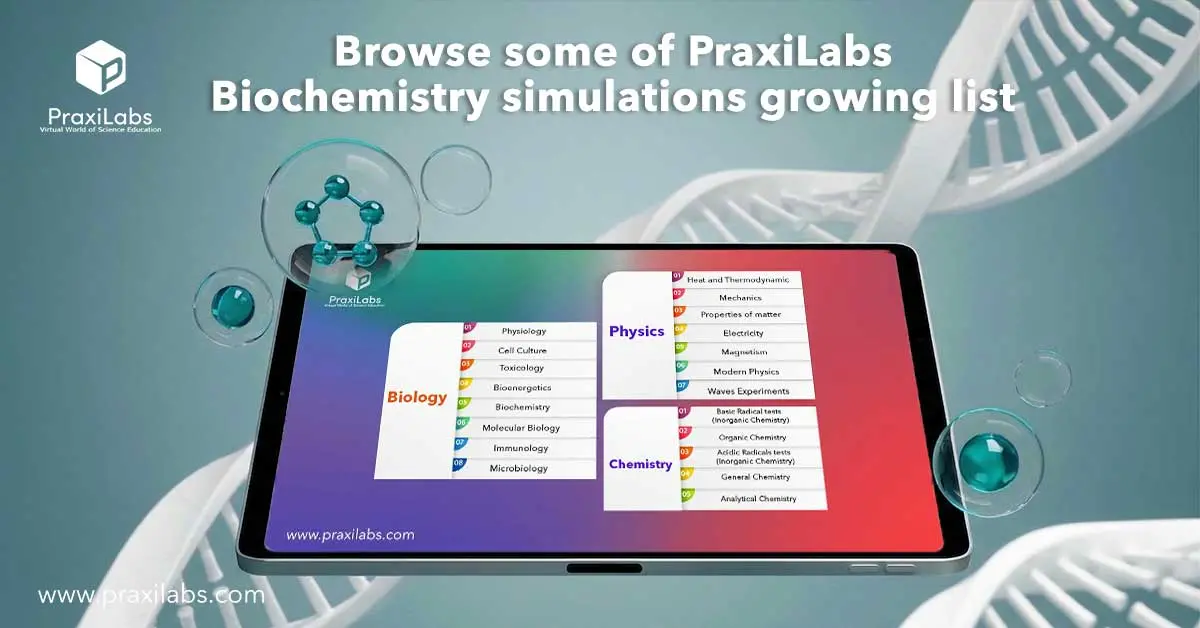
Browse some of PraxiLabs Biochemistry simulations growing list:
In the Biochemistry Virtual Lab, students can delve into the world of molecules, enzymes, proteins, and metabolic pathways. They can manipulate different variables, observe reactions in real-time, and analyze the outcomes
Here are some examples of the virtual lab experiments available:
Affinity Chromatography and HPLC
Learning Objectives:
- To prepare the mobile phase by vacuum filtration.
- To prepare protein samples by acid hydrolysis prior to injection.
- Perform online OPA/FMOC sample derivatization/injection.
- To list the parameters set for an HPLC run.
- To visualize the results of HPLC on a chromatogram.
Explore: PraxiLabs’ HPLC Simulator of proteins
Building a Model for Catalytic Interactions
This simulation aim to demonstrate the importance of presence of enzymes in biochemical reactions showing their absence may lead to slowing down the rate of these reactions or even preventing them from taking place.
The concept is explained through this experiment by studying the effect of acidic medium inside the stomach (represented by seven up here) on food (represented by biscuits). Then, the digestion of food (biscuits) is monitored in order to understand the necessity of the digestive enzymes for the vital process inside living organisms.
Explore: Catalyst Simulation | A Model for Catalytic Interactions
Total Protein Estimation (Bradford)
Learning Objectives:
- Identify the amino acids that the Bradford Protein Assay measures.
- Describe the color change that occurs when proteins combine with Coomassie dye under acidic conditions.
- Perform serial dilutions of a standard.
- Illustrate the correct standard curve equation for an example BSA standard.
- Interpret the standard curve equation when given example data.
- Calculate the protein concentration of an example.
- Recall the substance commonly used as standards in the assay and the device used to measure the color of the samples.
Simulate Bradford Assay with PraxiLabs
Frequently Asked Questions
What do you do in a biochemistry lab?
In a biochemistry lab, students and researchers study the chemical processes inside living organisms. Common activities include analyzing proteins, enzymes, DNA, and other biomolecules through experiments, testing reactions, and using laboratory instruments.
How accurate are results in a virtual lab?
Virtual labs provide highly accurate, simulation-based results that follow real scientific principles. They are designed to replicate real lab experiments, helping students practice procedures, understand concepts, and achieve consistent outcomes in a safe learning environment.