 PraxiLabs A virtual world of science

Last Updated on July 16, 2026 by Muhamed Elmesery
Ed-tech for virtual labs is reshaping how universities deliver science education, As institutions worldwide shift toward flexible, technology-driven learning models, virtual lab platforms eliminate physical barriers, reduce operational costs, and give students immersive 3D access to experiments — anytime, anywhere, The global virtual laboratories market was valued at USD 1.5 billion in 2024 and is projected to reach USD 4.2 billion by 2033, This article outlines seven compelling reasons why universities are investing in ed-tech for virtual labs, and what to look for in a platform.
Table of Contents
What Is Ed-Tech for Virtual Labs and How It Works?
Ed-tech for virtual labs combines simulation technology, AI-powered guidance, and digital assessment tools to recreate laboratory environments online, Students interact with 3D equipment, perform step-by-step experiments, and receive instant feedback — all from a browser, with no hardware installation required.
Key Ed-tech tools include:
- 3D Immersive Simulations: Scientifically accurate virtual environments that replicate real lab equipment and reactions.
- AI Lab Assistant: Real-time, personalized guidance that adapts to each student’s progress.
- Custom Quiz Builder: Assessments linked directly to experiments with automated grading.
- Performance Analytics: Dashboards tracking experiment completions, time on task, and assessment results.
- LMS Integration: Seamless connection with Moodle, Canvas, Blackboard, and other platforms.
Benefits of Ed-Tech for Virtual Labs for Students:
Not all virtual lab solutions are created equal, It is important to distinguish between the general benefits that any virtual lab platform can offer and the advanced capabilities that only a comprehensive platform like PraxiLabs delivers.
General Benefits of Virtual Labs
At a foundational level, virtual lab platforms of all kinds provide students with:
- Anytime, Anywhere Access: Experiments available 24/7 from any device — no lab scheduling required.
- Unlimited Practice: Students can repeat any experiment as many times as needed, reinforcing understanding.
- Safer Learning Environment: No exposure to toxic chemicals, electrical hazards, or broken equipment.
- Reduced Costs: Virtual labs lower the operational expenses associated with maintaining physical lab infrastructure.
Explore: 4 Benefits for Using Ed-Tech in Higher Education
What PraxiLabs Adds Beyond the Basics
PraxiLabs goes significantly further than standard virtual lab platforms, In addition to the general benefits above, PraxiLabs specifically delivers:
- Improved Retention: PraxiLabs reports an 80% improvement in learning retention through immersive, game-like simulations designed to keep students actively engaged throughout each experiment.
- Personalized AI Support: The built-in AI assistant Oxi provides real-time hints, model answers, and personalized feedback tailored to each learner’s actions — not just generic guidance.
- Adaptive Learning Styles: PraxiLabs addresses all three primary learning styles simultaneously: visual learners benefit from multimedia-rich content (65% of learners), auditory learners from voice-over guidance (30%), and kinaesthetic learners from the virtual hands-on interaction (5%).
- Bilingual Access: All experiments are fully available in both Arabic and English, with equal quality and user experience in each language — supporting diverse student populations across the MENA region and beyond.
- Beyond the Lab Content: PraxiLabs enriches each experiment with explanatory videos, textual references, and electronic manuals, transforming the virtual lab into a complete learning resource rather than a standalone simulation tool.
According to a 2024 ISTE survey, 85% of teachers using virtual labs reported improved student engagement and comprehension in STEM subjects.
Virtual Lab Compared to Traditional Physical Lab:
The table below highlights the key differences between a traditional physical lab and PraxiLabs:
| Feature | Traditional Physical Lab | Virtual Lab (PraxiLabs) |
|---|---|---|
| Access | Fixed schedule, on-campus only | 24/7, any device, any location |
| Cost | High — equipment, reagents, maintenance | Up to 60% lower operational costs |
| Safety | Real chemical and equipment hazards | Fully safe — no physical risks |
| Scalability | Limited by lab capacity | Unlimited concurrent students |
| Repeat Attempts | Restricted by resources | Unlimited at no extra cost |
| Feedback | Delayed, manual grading | Instant automated reports |
| LMS Integration | Manual grade export | Native setup in 24 hours |
| Analytics | Not available in real time | Full real-time dashboards |
| Language Support | Limited | Fully bilingual (Arabic & English) |
| Offline Access | Not available | Available on smartphones and tablets |
How Does Digital Innovation Transform Science Education?
Beyond convenience, education technology solutions like ed-tech for virtual labs fundamentally change pedagogy, AI-driven platforms adapt content to individual learning styles, analytics give educators real-time insight into student progress, and seamless LMS integration removes administrative friction.
A global survey by the World Economic Forum (WEF) found that 72% of over 27,500 respondents predict hybrid learning models will become the norm, Virtual labs are the infrastructure that makes that shift possible — supporting visual, auditory, and kinaesthetic learners through multimedia content, voice guidance, and interactive simulations within a single platform.
Explore: 7 Benefits of Digital Simulations for Students
Virtual Labs’ Market Size Statistics in Education:
Investment in ed-tech for virtual labs is accelerating globally:
- Virtual Laboratories Platform Market: USD 1.5 billion in 2024 → USD 4.2 billion by 2033, CAGR 12.5% (Verified Market Reports, 2025).
- Virtual & Remote Laboratories Market: USD 1.32 billion in 2024 → USD 3.11 billion by 2033, CAGR 10% (Business Research Insights, 2025).
- Virtual Lab Platforms Market: To reach USD 2.98 billion by 2030, CAGR 13.7% (Research and Markets, 2026).
- VR in Education Sector: CAGR of 8.57% between 2026 and 2030 (Technavio, 2026).
Challenges of Applying Ed-Tech for Virtual Labs:
Adoption is not without hurdles, The most common challenges — and their solutions:
Faculty Adoption
Challenge: Educators unfamiliar with digital lab tools may resist change.
Solution: PraxiLabs provides dedicated faculty training to onboard institutional staff efficiently, with all training materials delivered in both Arabic and English at no additional cost.
Curriculum Alignment
Challenge: Generic simulations may not match specific course syllabi.
Solution: PraxiLabs provides 210+ experiments in both Arabic and English, with assessments directly linkable to specific simulations to support curriculum alignment.
Demonstrating Outcomes
Challenge: Institutions need measurable evidence to justify EdTech investment.
Solution: Automated performance reports and real-time analytics — including attempt tracking, grade reporting, and at-risk student identification — provide the data leadership and accreditation bodies require.
Explore: Engaging Science Labs for STEM Experiments
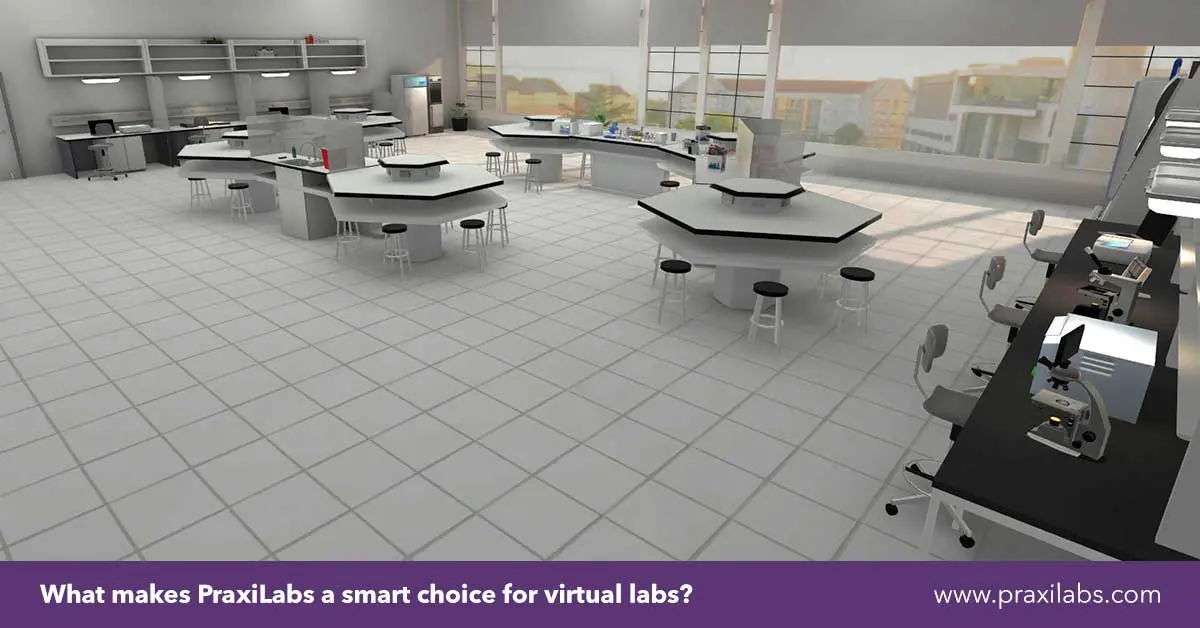
What Makes PraxiLabs a Smart Choice for Virtual Labs?
PraxiLabs is a globally recognized ed-tech platform for virtual labs, trusted by over 2.5 million active users in 160+ countries and more than 1,000 educational institutions worldwide. Key differentiators include:
- +2.5M Active Users across 160+ countries worldwide.
- 210+ Simulations spanning Biology, Chemistry, and Physics across 20+ science disciplines.
- AI Assistant Oxi — real-time, conversational, personalized guidance for every student, with post-experiment analysis and motivational support.
- 60% Cost Reduction in laboratory operational expenses.
- 80% Retention Improvement through immersive, practice-centric simulations.
- Advanced Question Bank — instructors can create custom quizzes (SCQ, MCQ, True/False) linked to specific experiments, with difficulty levels, ILO alignment, randomization, and flexible scoring.
- miniLMS Built-In — for institutions without an LMS, PraxiLabs provides a full web-based dashboard with the same reporting and administrative tools.
- LMS Integration in 24 Hours — Moodle, Canvas, Blackboard, Skolera, and more at no extra cost.
- AI-Driven Analytics — automated reporting, predictive insights on at-risk students, and natural language queries for educators.
- 11 Global Awards for excellence in science education.
- 24/7 Technical Support for institutions at every stage of adoption.
- Certified by the National eLearning Center of Saudi Arabia (Certification No. Q2204263, valid through May 2027) — confirming PraxiLabs’ compliance with national standards for virtual lab service providers.
Trusted by Leading Institutions Worldwide
PraxiLabs is trusted by universities and schools across the globe, including:
🇺🇸 United States
Texas A&M University, Palm Beach State College, D’Youville University
🇪🇸🇬🇧🇮🇹🇷🇴 Europe
IE University (Spain), Universitat Politècnica de València (Spain), Ulster University (UK), Naples University (Italy), Carol Davila University of Medicine and Pharmacy (Romania)
🇦🇪🇸🇦 Middle East & Gulf
UAE Ministry of Education (all public schools), King Saud University, King Faisal University, King Khalid University, Education Pathways Dubai, Universum Schools
🇪🇬 Egypt
Ain Shams University (8 faculties), Menofia National University (7 faculties), Benha National University (7 faculties), Galala University (4 faculties), Alexandria University, Cairo University, Al Azhar University, Mansoura Ahleya University, Deraya University, New Valley University, New Valley National University, and many more.
Africa & Asia
Covenant University (Nigeria), AMA University (Philippines), De La Salle Andres Soriano Memorial College (Philippines), Kotelawala Defence University (Sri Lanka), BroadTech Pte Ltd (Singapore)
🇨🇦🇧🇬 Canada & Bulgaria
Westfield Secondary School and 11+ schools across Bulgaria
Key Simulation Branches Provided by PraxiLabs:
PraxiLabs covers 20+ science branches across three core virtual labs:
| Virtual Lab | Science Branches Covered |
|---|---|
| Biology | Molecular Biology, Genetics, Microbiology, Biochemistry, Bioenergetics, Proteomics, Toxicology, Pharmacology, Cell Culture, Microscopy, Immunology |
| Physics | Heat & Thermodynamics, Properties of Matter, Electricity, Magnetism, Modern Physics, Mechanics, Waves |
| Chemistry | Inorganic Chemistry, Analytical Chemistry, Organic Chemistry |
All simulations are curriculum-aligned and support unlimited repeat attempts.
Explore Praxilabs’ Science Simulations Catalog
Frequently Asked Questions
What is virtual lab tech?
Virtual lab tech is software that simulates laboratory environments digitally. Platforms using ed-tech for virtual labs — like PraxiLabs — provide interactive 3D science simulations with AI guidance, automated assessments, and real-time analytics.
What software is used for virtual labs?
Leading platforms include PraxiLabs, which delivers ed-tech for virtual labs through a browser-based interface integrating with Moodle, Canvas, Blackboard, and Skolera — with no installation required.
What is the future of virtual laboratories?
The virtual lab platform market is on track to exceed USD 4.2 billion by 2033. AI personalization, AR integration, and real-time collaboration will define the next generation of ed-tech for virtual labs.
Can virtual labs truly replace hands-on learning?
Ed-tech for virtual labs is designed to complement — and in many cases replace — physical lab access for foundational coursework. PraxiLabs delivers an 80% improvement in learning retention, with educators at leading universities confirming it as a quality alternative to in-person lab sessions.