 PraxiLabs A virtual world of science

Last Updated on June 24, 2026 by Muhamed Elmesery
Virtual pharmacology labs are revolutionizing healthcare education by making complex drug-related concepts more interactive, accessible, and engaging.
Instead of relying solely on traditional lectures and limited physical lab sessions, students can now explore realistic simulations that enhance practical understanding and clinical decision-making skills.
In this blog post, we will delve into virtual pharmacology labs, their features, Pharmacology concepts that can be explored in virtual laboratories, the unique aspects of PraxiLabs’ virtual pharmacology lab, and explore some Pharmacology experiments offered by PraxiLabs.
Table of Contents
What is a virtual Pharmacology lab?
A virtual pharmacology lab is a computer-based environment that virtually replicates a real pharmacology lab virtually to help students conduct drug experiments, test tissue samples, and analyze pharmacological data in a digital environment.
It completely eliminates the need for physical laboratory equipment or animal testing, students can perform their experiments anytime and anywhere safely and without any risks.
Features of a virtual Pharmacology lab:
- Safe Learning Environment: Students can practice drug administration, dosage calculations, and patient management without risking patient safety.
- Enhanced Understanding of Drug Mechanisms: Interactive 3D models and simulations help learners visualize how medications interact with the human body.
- Improved Clinical Decision-Making: Virtual case scenarios encourage students to analyze symptoms, select treatments, and evaluate patient outcomes.
- Hands-On Experience Anytime: Learners can repeat experiments and simulations multiple times, allowing for self-paced and continuous learning.
- Greater Student Engagement: Gamified and immersive experiences make pharmacology lessons more engaging and easier to understand.
- Bridging Theory and Practice: pharmacology simulation labs connect classroom concepts with real-world healthcare applications, preparing students for clinical practice more effectively.
- Accessible and Cost-Effective Training: Virtual labs reduce the need for expensive physical resources while making quality education accessible from anywhere.
Request a free Demo for Virtual Biology Lab of PraxiLabs
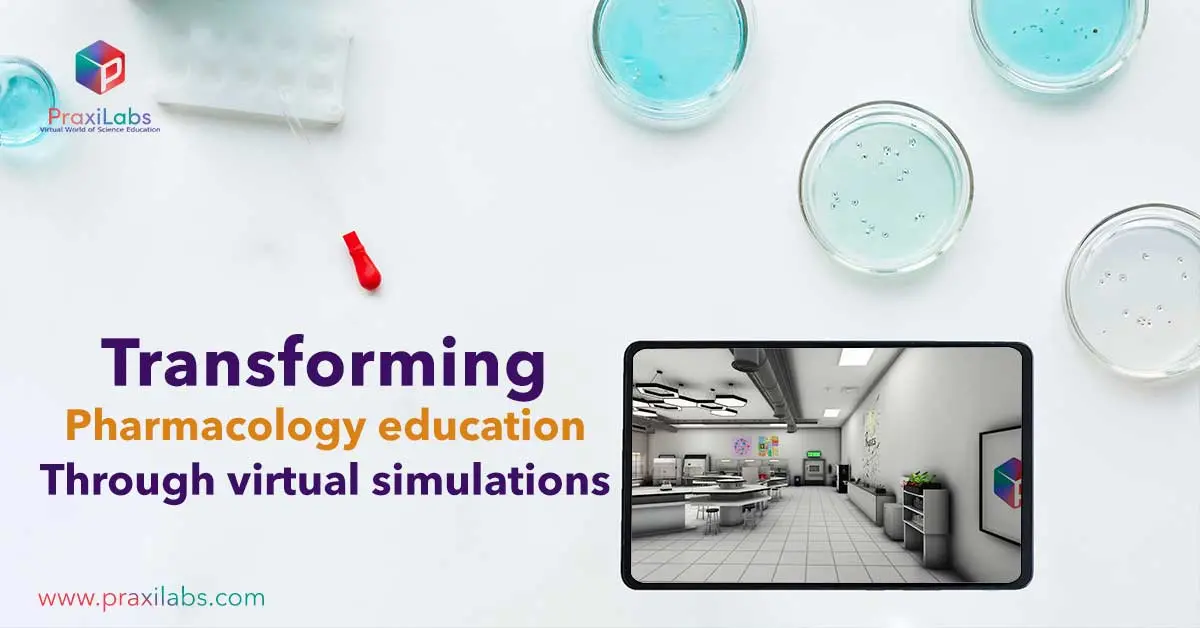
Transforming Pharmacology education through virtual simulations:
Virtual simulations are transforming pharmacology education by enabling students to explore drug mechanisms, dosage calculations, pharmacokinetics, and patient interactions in a safe, interactive, and risk-free environment.
These immersive technologies enhance conceptual understanding, improve clinical decision-making skills, and bridge the gap between theoretical learning and real-world medical practice.
By offering realistic scenarios, instant feedback, and repeatable experiments, virtual simulations make pharmacology education more engaging, accessible, and effective for modern healthcare training.
According to a study that surveyed medical students on their perceptions of virtual experiments in pharmacology, focusing on 10 key areas, results from pre-test and post-test evaluations revealed several significant findings:
- A marked improvement in understanding drug mechanisms was observed, with post-test results indicating enhanced clarity.
- Agreement on the benefit of increased practice opportunities also rose significantly.
- Students expressed fewer concerns about equipment-related challenges in virtual settings.
- Virtual experiments were recognized as a strong aid in skill acquisition, showing significant post-test improvements.
Pharmacology concepts that can be studied in virtual laboratories:
virtual lab pharmacology provides an interactive and practical approach to understanding complex pharmacology concepts that are often difficult to visualize through traditional teaching methods alone.
By simulating real clinical and laboratory environments, virtual labs allow students to experiment with medications, observe physiological responses, and analyze treatment outcomes in a safe and controlled setting.
Key Pharmacology Concepts That Can Be Studied in Virtual Laboratories:
- Drug Absorption, Distribution, Metabolism, and Excretion (ADME): Understanding how drugs move through and affect the human body.
- Pharmacokinetics and Pharmacodynamics: Exploring how drug concentration influences therapeutic and toxic effects.
- Mechanisms of Drug Action: Visualizing how medications interact with receptors, enzymes, and cellular pathways.
- Drug Interactions: Simulating the effects of combining multiple medications and identifying potential risks.
- Toxicology and Side Effects: Analyzing adverse drug reactions and overdose scenarios in a risk-free environment.
- Antibiotic Resistance and Antimicrobial Therapy: Investigating how microorganisms respond to various antimicrobial agents.
For example: The Antibiotic Sensitivity Test from PraxiLabs virtual lab enables students to:
- Utilize specific monitoring techniques to evaluate the susceptibility of a microbe to different antibiotics.
- Distinguish the range of activity of an antibiotic.
- Perform the test.
Explore the Antibiotic Sensitivity Virtual Lab with PraxiLabs
In what ways is PraxiLabs’ virtual Pharmacology lab unique?
PraxiLabs offers an advanced virtual pharmacology learning experience designed to help students understand complex medical and pharmaceutical concepts through immersive, interactive simulations.
Unlike traditional laboratory settings, PraxiLabs combines realistic scientific experimentation with accessible digital technology, allowing learners to gain practical skills anytime and from anywhere.
What Makes PraxiLabs’ Virtual Pharmacology Lab Stand Out?
- Highly Interactive 3D Simulations: Students can perform pharmacology experiments in realistic virtual environments that closely mimic real laboratory procedures.
- Safe and Risk-Free Learning: Learners can explore drug effects, dosage calculations, and experimental outcomes without exposure to hazardous materials or patient risks.
- Accessible Anytime and Anywhere: Cloud-based access enables students to practice experiments remotely using laptops or tablets, supporting flexible learning.
- Curriculum-Aligned Content: The virtual lab supports educational curricula in medicine, pharmacy, nursing, and life sciences programs.
- Self-Paced Learning Experience: Students can repeat simulations multiple times to reinforce understanding and improve practical skills.
- Enhanced Visualization of Complex Concepts: Interactive models help simplify difficult topics such as pharmacokinetics, drug mechanisms, and physiological responses.
- Instant Feedback and Performance Tracking: Learners receive immediate guidance and evaluation throughout the experiment process.
- Cost-Effective Laboratory Training: Institutions can reduce laboratory equipment costs while still providing high-quality practical education.
- Supports Modern Educational Approaches: PraxiLabs integrates seamlessly with blended learning, e-learning, and digital transformation strategies in higher education.
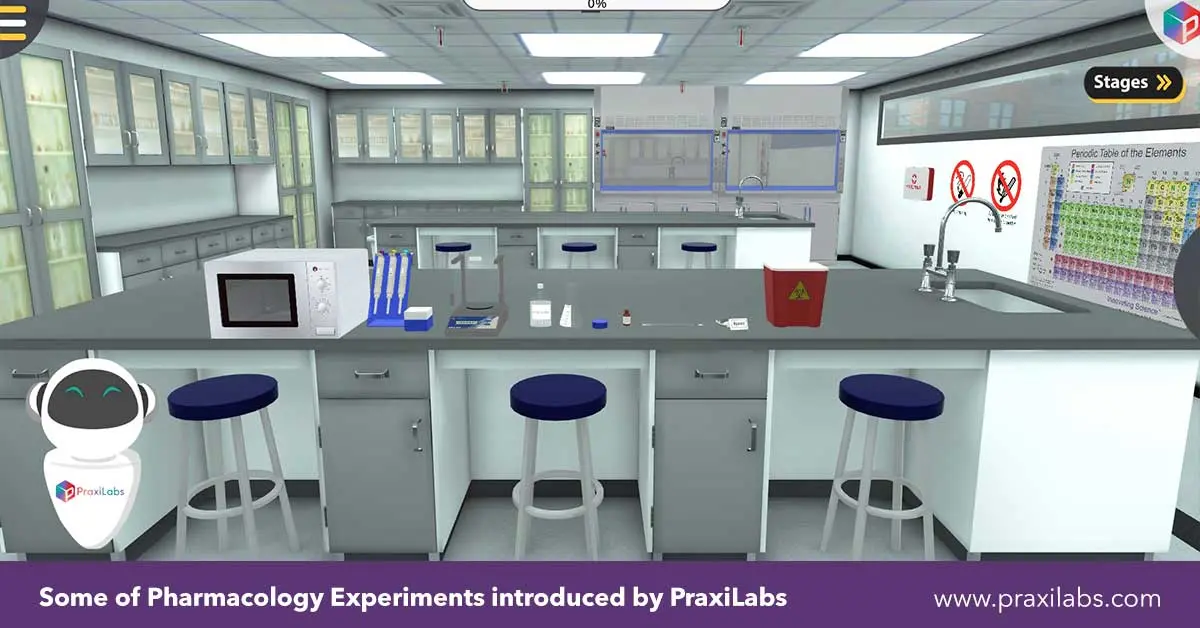
Some Pharmacology experiments introduced by PraxiLabs:
Let’s explore some pharmacology lab experiments introduced by PraxiLabs:
In Vitro Viability Assay Using Tetrazolium Salt XTT
In XTT cell viability assay experiment, students will test the viability of cultured cells after exposure to the geometric concentration of different nanoparticles.
By the end of the experiments students will be able to:
- Handle the required instruments which are needed for the experiment successfully.
- Check the count of cells and confluence by using the microscope.
- Understand the XTT viability assay protocol, procedure, and principle of work.
- Dilute the cells to a specific count suitable for the process of seeding in the 96-well plate.
- Calculate the tested chemical concentration and then prepare the required doses in the cell culture media.
- Add the solution of the XTT assay to the cells and by using the microplate reader, you can read the XTT viability assay results.
- Read the results of the XTT viability assay experiment
- Perform the XTT viability assay calculation: calculate the viability percentage of cells exposed to different doses of tested chemicals.
Annexin V Assay
Learn how to determine and quantify necrotic and apoptotic cells through Annexin-V binding and Propidium Iodide (PI) uptake by using a fluorescent microscope.
By the end of the Annexin V assay experiment, students will be able to:
- Treat cells with nanoparticles or cytotoxic agents and then observe them using the microscope.
- Harvest the cells with the binding buffer of Annexin (Annexin-V / Propidium Iodide buffer).
- Analyze both the cells (by using the fluorescent microscope) and resulted data.
- Represent and interpret the resulting data graphically using dot plots.
- Understand the principle and procedure of annexin V assay.
Adherent Cell Culturing using Mammalian Cell Lines
Learn how to culture, propagate and sub-culture cells. Discover also how cells are frozen in liquid nitrogen for the process of long-term storage.
In cell culture virtual lab, students will be able to:
- Apply aseptic techniques for cell culturing.
- Handle the required instruments that are needed for the cell culturing and sub-culturing successfully.
- Prepare the cells needed for all subsequent In Vitro Genotoxicity and Cytotoxicity assays.
- Understand the general aim, principle, and protocol of the cell culturing using mammalian cell lines experiment.
- Work while applying the general safety guidelines for Good Laboratory Practice (GLP).
- Check and count the harvested cells microscopically.
- Freeze cells in liquid nitrogen for long-term storage.
- Thaw cells from Liquid Nitrogen and then seed them in cell culture flasks.
Frequently Asked Questions
Which software is commonly used for virtual Pharmacology experiments?
One of the commonly used Pharmacology experiment software and platforms for virtual Pharmacology experiments is PraxiLabs. It provides interactive 3D virtual laboratory simulations that help students perform Pharmacology experiments safely and efficiently in a realistic digital environment.
Which platform is best for Pharmacology?
The best Pharmacology platform depends on the learning goals and institutional needs, but PraxiLabs is considered a strong option for virtual Pharmacology education because it offers:
- Interactive and immersive virtual lab simulations
- Safe, risk-free experiment practice
- Accessible online learning anytime and anywhere
- Curriculum-aligned scientific content
- Support for self-paced and remote learning
What is a good Pharmacology app?
A good Pharmacology app should combine theoretical knowledge with interactive practical learning. PraxiLabs is a useful solution for students and educators looking for virtual Pharmacology lab experiences.