 PraxiLabs A virtual world of science


Last Updated on July 19, 2026 by Muhamed Elmesery
Virtual learning solutions have shifted from a nice-to-have option to a core part of how schools and universities teach science today. Lockdowns proved that lectures could move online almost overnight, but the real challenge was replacing hands-on lab work without losing the depth of practical training. That gap is exactly what these solutions are built to close, giving students a safe, repeatable, and engaging way to practice real experiments from any device. This article looks at why that shift happened and what it means for universities going forward.
Table of Contents
What are virtual learning solutions?
Virtual learning solutions are digital tools that recreate real classroom and laboratory experiences online, letting students watch, interact, and practice without needing physical equipment or a campus visit.
Under this umbrella sit several related tools, including virtual learning environment platforms that host courses and grades, 3D lab simulations for science subjects, and AI-guided tutors that respond to each learner in real time.
These tools generally take one of three forms:
- Virtual classrooms for live or recorded lectures.
- Virtual laboratories for hands-on science experiments.
- AI-driven assessment tools for instant feedback.
Top virtual learning solutions and its benefits:
The benefits go well beyond convenience, and the data behind PraxiLabs’ own platform shows the scale of that impact.
Across institutions already using these tools, four advantages stand out:
- Lower lab costs: simulation-based practice can cut equipment and consumable expenses by up to 60 percent compared with fully physical labs.
- Better retention: students using interactive simulations have shown learning retention gains of up to 80 percent over passive instruction.
- Round-the-clock access: built-in 24/7 support means students and instructors are never stuck waiting on a lab technician or a campus opening time.
- Faster rollout: most institutions can connect these systems to an existing LMS, such as Moodle, Canvas, or Blackboard, within 24 hours.
These gains are part of why universities increasingly treat virtual education solutions as a core part of the curriculum rather than a temporary fix.
Explore: A Virtual Learning Environment For Modern Education
Reasons to rely on virtual learning solutions in universities:
Universities have their own reasons for building these tools into science programs, on top of the general benefits already listed above.
A systematic review published through Frontiers in Education on immersive learning in higher education found that removing the physical barriers of a traditional lab lets students explore structures and processes that would otherwise be inaccessible, while also widening access for learners in regions with limited lab funding.
Three reasons stand out for science departments in particular:
- Safety first: students can run hazardous chemistry or biology procedures without any real-world risk.
- Equipment access: a single virtual classroom solutions license can replace dozens of physical instruments that a department could never afford to buy in full.
- Consistent practice: every student repeats the same experiment as many times as needed before an exam, something a shared physical lab cannot support.
Built for distance and blended programs:
Many universities also rely on virtual training solutions to support students enrolled in distance or blended programs, who would otherwise have no lab access at all between campus visits.
Explore: Advantages of Simulation Based Learning in Classrooms

How big is virtual tech in the education market?
The market behind virtual learning solutions is growing quickly, and two independent research firms have tracked the pace of that growth.
The numbers below outline where that growth is concentrated:
| Source | Market | Growth |
|---|---|---|
| Technavio | Virtual Labs for STEM Education | CAGR of 8.57% (2026–2030) |
| Verified Market Reports | Virtual Classroom Market | $6.5B (2025) to $15.5B (2034), CAGR 10.5% |
That growth lines up with what institutions report on the ground: lower costs, stronger retention, and demand for flexible access across the 160-plus countries where these systems are already in use.
Explore virtual labs as one of the virtual learning solutions:
Virtual labs are the most hands-on category in this space, and they are where PraxiLabs has focused most of its development.
A 2024 review published in a Wiley journal on virtual labs in science education found that simulation-based labs expand access to experimentation, offering a safe and cost-effective alternative when physical equipment, space, or safety protocols would otherwise limit hands-on practice.
PraxiLabs currently supports virtual lab solutions across three major science branches:
| Field | Sub-Disciplines |
|---|---|
| Biology | Molecular Biology, Genetics, Microbiology, Biochemistry, Proteomics, Toxicology, Pharmacology, Cell Culture, Microscopy, Bioenergetics, Immunology |
| Physics | Heat & Thermodynamics, Properties of Matter, Electricity, Magnetism, Modern Physics, Mechanics, Waves |
| Chemistry | Inorganic Chemistry, Analytical Chemistry, Organic Chemistry |
With more than 210 science simulations spanning over 20 branches of science, the catalog covers most of what a standard undergraduate curriculum needs.
Explore: Using Virtual Labs for Hands on Science Learning Experience
Learn how PraxiLabs supports virtual learning solutions:
PraxiLabs supports this shift through a mix of AI features and integration tools built specifically for science departments.
Three features stand out:
- Oxi, the AI Lab Assistant, gives students real-time, personalized guidance while they work through an experiment.
- A custom quiz builder links assessments directly to each simulation, with automated grading built in.
- LMS integration with Moodle, Canvas, and Blackboard, completed in as little as 24 hours.
Support is available 24/7, and every simulation comes with bilingual access in both Arabic and English, so institutions can serve mixed-language student bodies without running two separate systems.
Explore: Science Virtual Learning for Universities and Schools
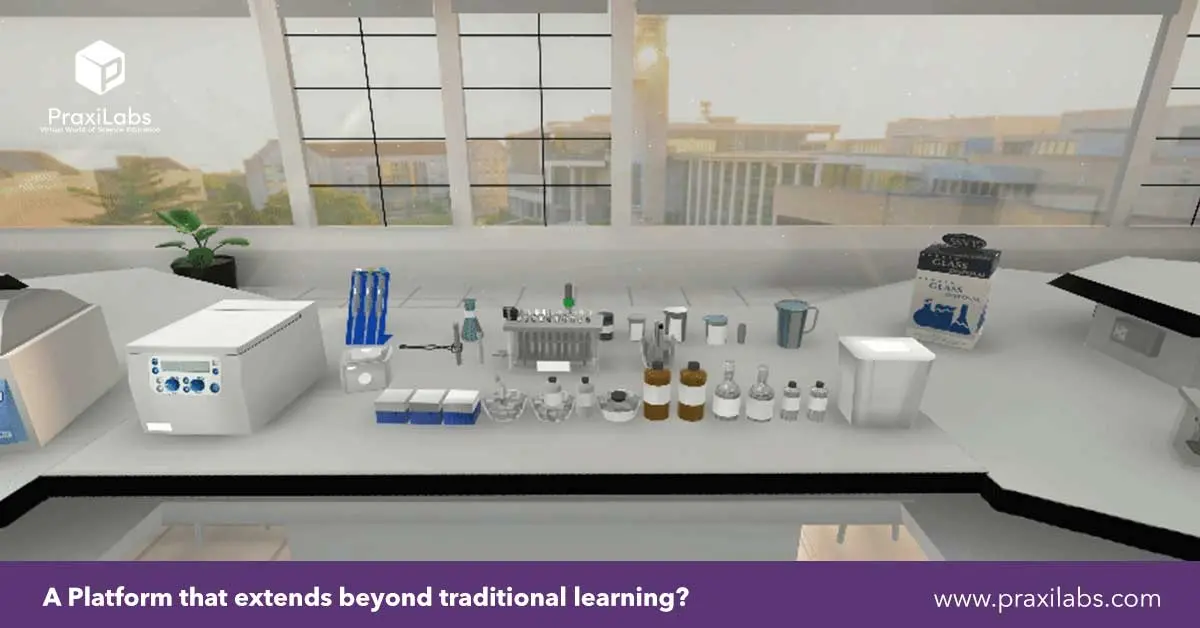
PraxiLabs: A Platform that extends beyond traditional learning
More than 2.5 million active users across over 160 countries now rely on PraxiLabs in some form, a scale that reflects how far virtual learning solutions have moved beyond a niche experiment.
The platform has picked up 11 global awards along the way, and it continues to expand its simulation catalog rather than standing still.
For universities still weighing whether to make the switch, the data above offers a clear answer: structured virtual labs, AI guidance, and fast LMS integration outscore the practical limits of physical-only science teaching.
Frequently Asked Questions
What is the best part of virtual learning?
Most students and instructors point to the freedom to repeat an experiment as many times as needed, in a safe environment, without using up real chemicals or equipment.
How do virtual tech support distance learning?
Virtual tech supports distance learning by giving remote students the same lab access as on-campus peers, with simulations, AI guidance, and instructor oversight available from any location with an internet connection.