 PraxiLabs A virtual world of science

Last Updated on July 12, 2026 by Muhamed Elmesery
Organic chemistry sits at the heart of modern science, from drug synthesis and materials engineering to food science and environmental research, Yet for many students, the gap between understanding organic chemistry in theory and executing it safely in a lab remains a persistent challenge, Organic molecules virtual labs are closing that gap, By replicating complex organic chemistry experiments in immersive, risk-free 3D environments, these platforms give institutions a powerful tool to enhance learning outcomes, reduce costs, and expand access to quality science education.
Table of Contents
What is the organic molecules virtual lab?
An organic molecules virtual lab is a browser, based simulation replicating a real organic chemistry laboratory, without safety risks or resource constraints:
- Interact with 3D virtual equipment and follow scientifically accurate experimental workflows
- Each organic chemistry simulation engages students actively performing reactions, observing outcomes, and learning from errors in a consequence free environment
- Cover key topics from electrophilic substitution and esterification to macromolecular synthesis
The organic compounds virtual lab complements physical lab sessions, supports distance learning, and extends student practice time beyond scheduled lab hours.
Key features of the organic molecules virtual lab:
Not all virtual lab platforms are built the same, The most effective organic molecules virtual labs combine scientific accuracy with pedagogical depth, Key features to look for include:
- Immersive 3D Environment: Realistic lab settings where students manipulate virtual glassware, reagents, and instruments, building procedural confidence before entering a physical lab.
- RealTime AI Guidance: Intelligent assistants that alert students to errors, provide hints, and deliver model answers, personalizing the learning experience at every step.
- Unlimited Repetition: Students can repeat any organic chemistry experiment as many times as needed without consuming reagents or generating chemical waste.
- Enriched Learning Content: Each simulation is supported by explanatory videos, textual references, and electronic manuals going beyond the experiment itself to deepen conceptual understanding.
- LMS Integration: Seamless connection with institutional Learning Management Systems for assignment, tracking, and automated reporting.
- Bilingual Support: Full access in Arabic and English critical for institutions across the MENA region and multilingual academic environments.
- Advanced Assessment Tools: Custom quizzes linked to specific simulations, with ILO alignment, difficulty levels, and automated grading.
Explore: Organic Reaction Simulator for Chemistry Experiments
Learning objectives of the molecules virtual lab:
A well-designed macromolecules virtual lab or organic chemistry simulation is built around clear, measurable learning outcomes, Across PraxiLabs’ organic chemistry simulations, students are expected to:
- Understand the mechanisms of key organic reactions including electrophilic substitution, nucleophilic addition, and condensation reactions
- Develop proficiency in standard organic synthesis procedures and laboratory techniques
- Identify, name, and work with major classes of organic compounds including esters, aldehydes, ketones, alcohols, and aromatic compounds
- Apply knowledge of reaction conditions, reagents, and safety protocols to experimental scenarios
- Interpret experimental results and relate observed outcomes to underlying chemical principles
- Build transferable laboratory skills applicable to both academic and professional scientific settings
These objectives align with the competency frameworks used in universities and science faculties worldwide, making PraxiLabs’ organic compounds virtual lab a curriculum compatible solution for undergraduate and postgraduate programs alike.
Explore the Virtual Chemistry Lab with PraxiLabs
Can organic molecules be built virtually?
Yes, and with greater depth than many educators initially expect, Modern organic chemistry simulations go far beyond simple molecular model viewers, PraxiLabs’ platform replicates the actual experimental procedures used to synthesize, analyze, and identify organic compounds including multi step reactions with realistic outcomes.
In PraxiLabs’ organic molecules virtual lab, students can:
- Perform electrophilic aromatic substitution reactions including nitration and Friedel Crafts acylation observing how substituents direct incoming groups on the benzene ring
- Carry out esterification reactions through Fischer and related mechanisms, understanding how alcohol and acid components combine to form esters
- Execute Grignard reactions one of the most versatile tools in organic synthesis to form new carbon carbon bonds
- Conduct Diels Alder cycloaddition reactions, building six membered ring systems through diene dienophile interactions
- Identify functional groups through qualitative analysis tests including detection of hydroxyl, carbonyl, amide, and carboxylic acid groups
The macromolecules virtual lab environment also enables students to observe molecular behavior that is difficult to visualize in a traditional lab setting enhancing conceptual understanding alongside practical skills.
Benefits of PraxiLabs’ organic molecules virtual lab:
PraxiLabs is trusted by over 2.5 million users across 160+ countries and 1,000+ educational institutions worldwide, Its organic chemistry virtual lab delivers measurable benefits for both students and institutions:
For Students
- Safe experimentation: No exposure to toxic organic reagents, flammable solvents, or hazardous reaction conditions
- Flexible access: Available 24/7 on any device students can practice before scheduled lab sessions or revise afterward
- Improved retention: PraxiLabs achieves an 80% learning retention rate through its immersive, practice-centric simulations.
- Real Time AI Guidance: AI assistant Oxi provides real time hints and error corrections personalizing the learning experience at every step.
- Unlimited attempts: Students can repeat any experiment without additional cost or resource consumption
For Institutions
- Cost reduction: Up to 60% reduction in laboratory operational costs eliminating reagent waste, equipment maintenance, and safety management overheads
- Curriculum alignment: Simulations linkable to specific course ILOs with automated reporting delivered directly to instructors via LMS
- Scalability: Unlimited concurrent student access no lab scheduling conflicts or capacity constraints
- LMS integration in 24 hours: Seamless setup with Moodle, Canvas, Blackboard, and Skolera at no extra cost
- Certified quality: PraxiLabs holds official certification from the National eLearning Center of Saudi Arabia (No. Q2204263, valid through May 2027)
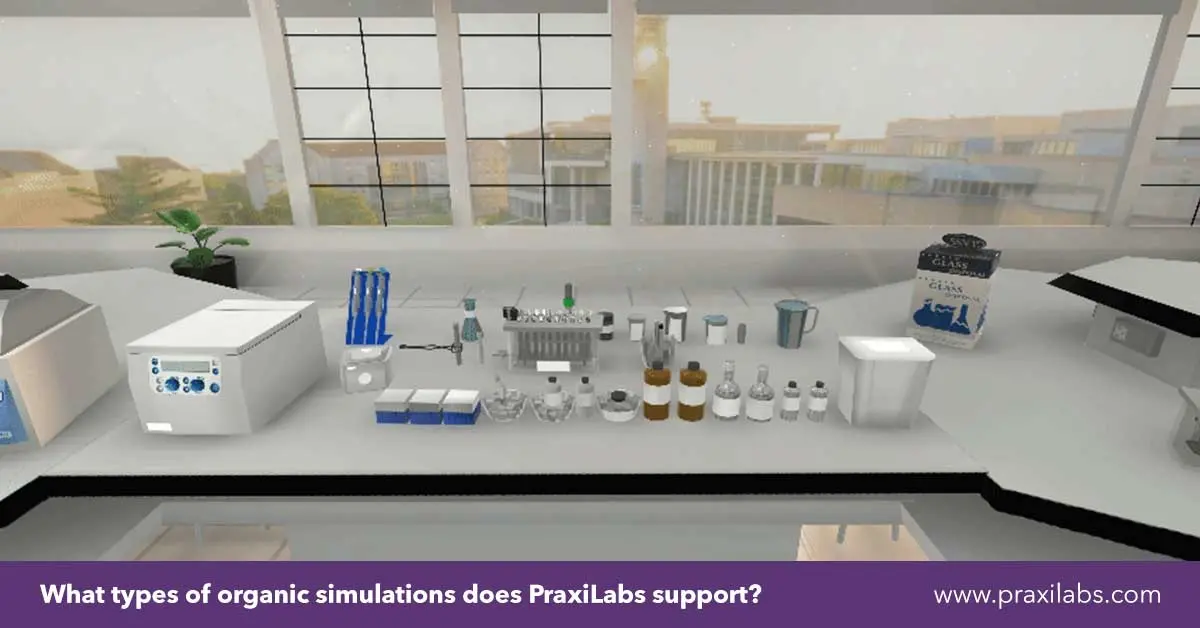
What types of organic simulations does praxiLabs support?
PraxiLabs provides a growing library of organic chemistry simulations spanning key reaction types and laboratory techniques, The following five simulations represent the core of PraxiLabs’ organic molecules offering:
1. Nitration of Methyl Benzoate
Covers electrophilic aromatic substitution students learn how NO2+ attacks the benzene ring using nitric and sulfuric acids, COOCH3 directing substitution to the meta position:
- Understand electrophilic nitration mechanisms
- Master aromatic substitution reaction principles and organic synthesis procedures
2. Friedel Crafts Reaction (Acylation of Anisole)
Students explore Friedel Crafts acylation anisole reacts with acyl chloride (AlCl3 catalyst) to produce an aryl ketone, with OCH3 directing to ortho and para positions:
- Understand Lewis acid catalysis and electrophilic substitution selectivity
- Learn the role of directing groups in aromatic chemistry
3. Fischer Esterification Experiment
Guides students through the Fischer esterification reaction acid catalyzed condensation of a carboxylic acid and alcohol to produce an ester, applying Le Chatelier’s principle:
- Understand esterification mechanisms and reversibility
- Master practical ester synthesis techniques and applications
4. Grignard Reagent Reaction
Introduces carbon carbon bond formation organomagnesium halide + carbonyl compound → new alcohol, under strict anhydrous conditions:
- Plan and execute multi step organic synthesis procedures
- Understand nucleophilic addition to carbonyl groups
5. Diels Alder Experiment
Covers Diels Alder cycloaddition a [4+2] pericyclic reaction between a conjugated diene and dienophile forming a six membered ring, exploring the endo rule:
- Understand pericyclic reaction mechanisms and stereochemistry
- Apply cycloaddition reactions in building complex molecular architectures
Conclusion
The organic molecules virtual lab is a core component of modern science pedagogy not an alternative, By providing safe, scalable access to organic chemistry simulations, PraxiLabs helps institutions deliver higher quality outcomes at a fraction of the cost:
- +210 science simulations across Biology, Chemistry, and Physics
- AI assistant Oxi, full bilingual support, and 1,000+ institutional partners worldwide.
Frequently Asked Questions
Is there any effective virtual lab for scientific research?
Yes. PraxiLabs’ organic molecules virtual lab is used by 1,000+ institutions across 160+ countries including universities with active research programs:
- Simulations replicate research grade procedures with full scientific accuracy.
- Trusted by Ain Shams University, Ulster University, and Carol Davila University of Medicine and Pharmacy.
Do virtual labs support LMS systems?
Yes. PraxiLabs integrates with Moodle, Canvas, Blackboard, and Skolera full setup within 24 hours at no extra cost:
- Assign organic chemistry simulations directly from your LMS and track student progress in real time.
- No LMS? PraxiLabs’ miniLMS dashboard provides the same reporting and administrative tools instantly.