 PraxiLabs A virtual world of science

Last Updated on June 7, 2026 by Muhamed Elmesery
Science becomes truly meaningful when students can explore, experiment, and discover concepts through action rather than observation alone. However, traditional labs often face challenges such as limited resources, safety concerns, and restricted access.
This is where virtual labs are transforming science education. By combining immersive simulations with interactive experimentation, virtual labs create engaging hands on science learning experiences that allow students to test hypotheses, perform experiments, and build practical skills anytime and anywhere.
From increasing student engagement to making STEM education more accessible, virtual labs for hands on science learning are redefining how learners experience science in the digital age.
Table of Contents
What is hands-on science learning?
Hands on science learning is an active learning method that depends on learning by doing. It enables students to visualize and experiment with whatever they learn by doing activities and experiments for scientific concepts instead of just learning about them theoretically.
It emphasizes experimentation, exploration, and observation to deepen comprehension, improve retention, and foster critical thinking.
Key benefits of hands on science learning:
Hands on science learning helps students move beyond memorization by actively engaging them in experimentation, observation, and problem-solving. Let’s explore some key benefits:
- Enhancing student engagement and learning retention.
- Improving creativity, problem-solving, and critical thinking skills.
- Transforming abstract concepts into tangible, memorable experiences.
- Enabling learning from failure, as students can safely make mistakes and experience failures during experiments, helping them learn to troubleshoot and iterate their approach.
- Providing flexibility and efficient time management, by using virtual simulations students can learn and perform their experiments anytime and anywhere without any limitations.
- Connecting theoretical knowledge with real-world applications, leading to stronger academic performance and long-term knowledge retention.
Explore: Virtual Labs as Modern Stem Teaching Tools for Education
Improving students retention with hands on learning:
hands on learning in science significantly improves student retention by enabling active engagement rather than passive listening, with research indicating it can be six times more effective than traditional instruction. Key studies show that immersive, experiential techniques enhance long-term memory, improve test scores, and foster deeper understanding, especially in STEM fields.
According to a study that aimed to assess the impact of hand-on activities on the learning engagement of education major students. Employing a quantitative approach, the research utilized a self-constructed 20-item instrument to collect data from 95 participants selected through random sampling.
The sample included 31 males and 64 females. The findings indicate a positive correlation between hands on science learning activities and learning engagement, suggesting that hands-on activities effectively enhance students’ engagement in their educational experiences.
Benefits of using virtual labs and interactive simulations:
Virtual labs and interactive science simulations are considered one of the most important applications and tools of modern technology in education and hands on learning.
The importance of hands on learning in science depends on contributing as a curriculum and virtual educational technologies in enriching science learning, through providing educational simulations and virtual educational programs that present virtual science laboratories accurately simulating real laboratories, but in a digital environment that offers students additional benefits, such as the ability to conduct various experiments anytime and anywhere.
Let’s explore the main benefits of hands on learning in science by virtual laboratories for students and educational institutions:
Interactive environment:
Virtual labs and interactive simulations provide an immersive and practical interactive experience that simulates the real laboratory environment, allowing students the opportunity to learn practically in a realistic way.
Scalability:
Virtual lab simulations are the ideal choice for educational institutions that need to train a large number of students at the same time. They can accommodate hundreds of users simultaneously, making them highly scalable without the need for additional infrastructure.
Enhancing Knowledge Assimilation:
Virtual simulations provide interactive, scenario-based learning, which enhances learners’ understanding of information and increases their engagement. They are also easily accessible to a large number of students.
Accessibility:
Virtual labs work with any device connected to the internet. Whether students use a desktop computer, laptop, smartphone, or tablet, virtual labs are compatible with all common devices and operating systems, with simple system and browser requirements.
Data Analysis and Tracking:
Educational simulations enable precise tracking of students’ progress, allowing teachers to know the current status of each student, the steps they have completed, and the areas that need improvement, while providing multimedia reports that help in developing the educational process.
Explore: Best Learning Apps for Science Experiments and Virtual Labs
How does PraxiLabs support hands-on science learning?
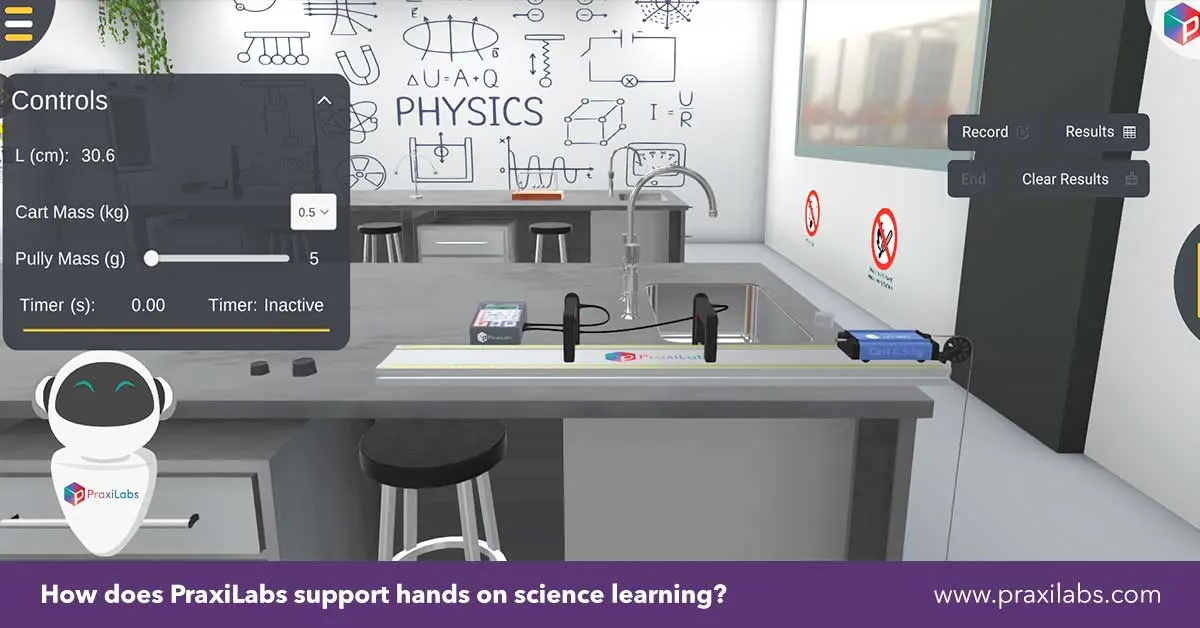
PraxiLabs is considered one of the leading companies regionally and globally in the field of digital education and hands on experiments in science, especially in scientific disciplines. Among its most prominent contributions are:
- Providing interactive virtual labs that simulate real laboratories in chemistry, physics, and biology.
- Enabling learning anytime and anywhere without the need for physical labs.
- Reducing the costs of equipment and maintenance compared to traditional laboratories.
- Providing accurate performance reports and analyses to track student progress.
- Easy integration with Learning Management Systems (LMS) within educational institutions.
In short, PraxiLabs contributes to making scientific education more interactive, safe, hands-on, and flexible within the modern digital education ecosystem.
Explore: Engaging science labs for STEM Experiments
What should you look for in a virtual lab platform?
Choosing the right virtual lab platform is essential for creating engaging, effective, and accessible science learning experiences. A strong platform should not only simulate experiments realistically, but also support curriculum goals, student interaction, and teacher assessment.
Here are the key features to look for when evaluating a virtual lab solution:
| Feature to Look For | Why It Matters |
| Curriculum Alignment | Ensures the virtual lab matches school or university learning objectives and standards. |
| Interactive 3D Simulations | Helps students actively perform experiments instead of only watching demonstrations. |
| User-Friendly Interface | Makes it easier for both students and teachers to navigate and use the platform efficiently. |
| Realistic Experiment Experience | Improves understanding by simulating real lab procedures, tools, and scientific outcomes. |
| Safety & Risk-Free Learning | Allows students to conduct dangerous or complex experiments safely. |
| Accessibility Anytime, Anywhere | Supports remote, hybrid, and self-paced learning on different devices. |
| Assessment & Reporting Tools | Helps teachers track student progress, performance, and lab completion. |
| STEM Subject Coverage | A strong platform should support subjects like biology, chemistry, physics, and mathematics. |
| Multilingual Support | Makes learning more inclusive for students from different language backgrounds. |
| Collaboration Features | Enables teamwork, discussion, and group experiments in virtual environments. |
| Cost-Effectiveness | Reduces expenses related to physical equipment, maintenance, and consumable materials. |
| Teacher Support & Training | Ensures educators can successfully integrate the platform into their teaching process. |
| Integration with LMS Platforms | Allows smooth connection with systems like Moodle, Blackboard, or Google Classroom. |
| Customizable Learning Paths | Helps educators adapt experiments and activities to different student levels. |
| Performance on Low-End Devices | Ensures accessibility for students with limited hardware or internet capabilities. |
Frequently Asked Questions
How do virtual labs support remote learning?
Virtual labs support remote learning by providing students with virtual lab simulations that enable them to understand the scientific concept and conduct their experiments anytime and anywhere in a safe virtual environment.
What are the limitations of lab experiments?
Lab experiments can be costly, time-consuming, and sometimes unsafe. They may also have limited equipment, restricted access, and reduced opportunities for students to repeat experiments. In some cases, complex or dangerous experiments are difficult to perform in traditional labs.