 PraxiLabs A virtual world of science


Last Updated on July 16, 2026 by Muhamed Elmesery
Whether in clinical diagnostics, pharmaceutical research, or academic settings, the ability to accurately identify bacteria is a fundamental skill in microbiology. Yet traditional lab constraints – limited equipment, safety risks, and restricted access – often prevent students from getting the hands-on practice they need. The bacterial identification virtual lab is changing that. By combining immersive 3D simulations with scientifically accurate workflows, virtual labs give students unlimited access to bacteria identification methods – anytime, anywhere.
Table of Contents
What is the bacterial identification virtual lab?
A bacterial identification virtual lab is a computer-based simulation that replicates a real diagnostic bacteriology laboratory environment, allowing students to identify and differentiate between bacterial species through an immersive, interactive 3D experience – all without the physical constraints of a traditional lab.
Unlike passive learning methods, virtual labs are built around active experimentation – students manipulate virtual instruments, receive immediate feedback, and can repeat any experiment as many times as needed. Virtual bacterial identification labs are widely used across microbiology, clinical diagnostics, public health, and pharmaceutical sciences.
The aim of the bacterial identification virtual lab:
The core objective of a virtual lab bacterial identification platform is to bridge the gap between theoretical microbiology knowledge and practical laboratory competence:
- Develop students’ ability to identify bacteria using standard diagnostic methods.
- Replicate real diagnostic workflows in clinical microbiology.
- Provide unlimited, safe, and cost-effective access to bacteriology experiments.
- Support mastery through repetition – at no additional cost or risk.
- Enable self-paced learning from any location or device.
A study conducted in Denmark confirmed that virtual laboratory simulation helps learners connect theory with practice, enhancing both procedural competence and student engagement.

Traditional vs modern techniques to identify bacteria:
| Criterion | Traditional Methods | Modern Methods |
| Basis | Phenotypic analysis | Molecular & protein analysis |
| Time Required | 2–5 days | Minutes to hours |
| Accuracy | Moderate | High |
| Sensitivity | Limited | Very high |
| Non-culturable Organisms | Cannot identify | Can identify |
| Cost | Low | Higher |
| Equipment | Basic (microscope, media) | Advanced (PCR, MALDI-TOF) |
| Examples | Gram staining, Biochemical tests, Culture-based | rRNA, PCR, MALDI-TOF MS, DNA hybridization |
| Best Use | Routine lab work | Research & rapid diagnostics |
Understanding the contrast between traditional and modern techniques to identify bacteria explains why bacterial identification virtual labs are designed the way they are.
Traditional identification methods:
Traditional microbial identification of bacteria relies mainly on phenotypic analysis:
- Morphological evaluation: Cell shape (cocci, rods, spirals), size, and arrangement under a microscope.
- Gram staining: Differentiating bacteria into Gram-positive and Gram-negative groups.
- Biochemical tests: Metabolic activities such as fermentation, oxidase, and indole production.
- Culture-based methods: Growing bacteria on selective media and observing colony morphology.
While widely used, these bacteria identification methods can take 2 to 5 days, are labor-intensive, and cannot identify organisms that resist in vitro cultivation.
Modern identification methods:
Modern molecular techniques to identify bacteria offer greater speed, accuracy, and sensitivity:
- rRNA gene sequencing: Species-level identification with high confidence.
- PCR (Polymerase Chain Reaction): Rapid detection of target bacteria.
- MALDI-TOF MS: Protein profiling that identifies bacteria within minutes.
- DNA hybridization and sequencing: Highly accurate taxonomic classification.
The most effective approach combines both traditional and modern methods – which is exactly what a comprehensive bacterial identification virtual lab is designed to reflect.
Discover the Virtual Interactive Bacteriology Laboratory of PraxiLabs
What are the four characteristics used to identify bacteria?
Laboratory identification of bacteria primarily relies on four essential criteria to achieve accurate classification:
- Morphology: Cell shape, size, and arrangement observed under a microscope
- Gram Staining: Differentiating bacteria into Gram-positive and Gram-negative groups based on cell wall structure
- Biochemical Tests: Evaluating metabolic activities such as fermentation, oxidase, and indole production
- Genetic Analysis: Molecular techniques including rRNA sequencing and PCR for species-level identification
Using bacterial identification virtual lab to solve identification accuracy issues:
The virtual bacterial identification lab directly addresses the gap between theoretical knowledge and practical execution:
- Unlimited Repetition: Experiments repeated indefinitely at no extra cost – students learn from mistakes and build genuine competence.
- Immediate Feedback: AI assistant Oxi alerts students to errors instantly, explains what went wrong, and guides them back on track.
- Safe Simulation: Hazardous procedures involving pathogens or toxic chemicals replicated with full scientific accuracy – and zero physical risk.
- Standardized Outcomes: Every student accesses the same high-quality simulation regardless of their institution’s physical resources.
Explore: Virtual Interesting Biology Experiments for College
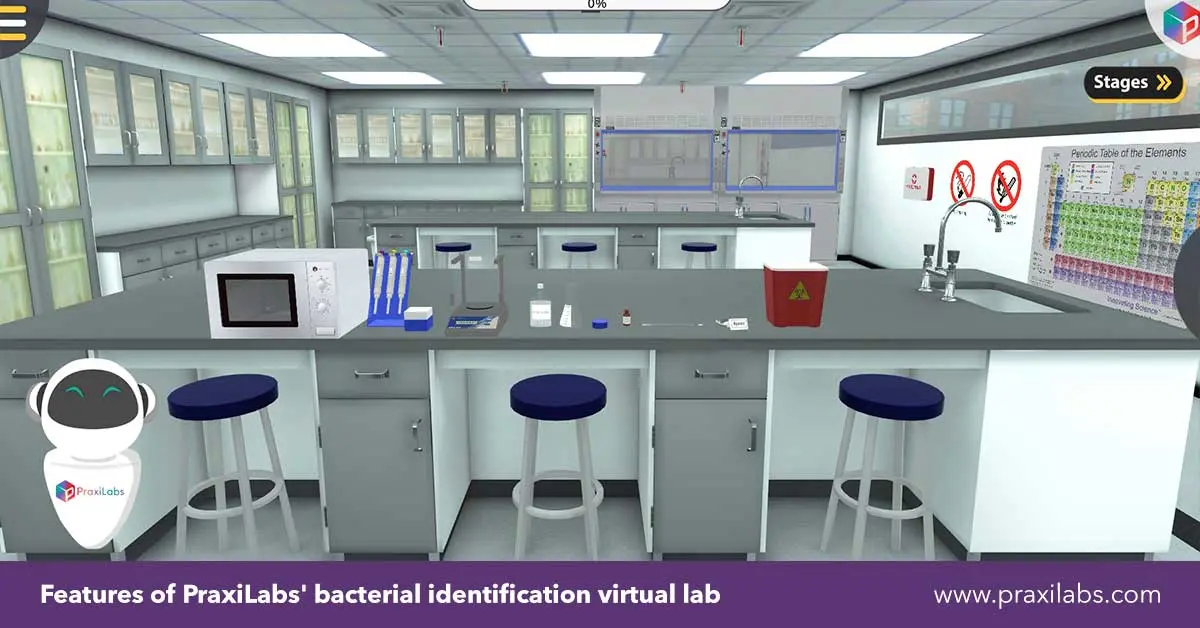
Features of PraxiLabs’ bacterial identification virtual lab:
Trusted by over 2.5 million users across 160+ countries and 1,000+ educational institutions, PraxiLabs is the leading bacteria identifier platform – going significantly beyond standard virtual lab solutions:
- Immersive 3D Lab Environment: Students manipulate virtual instruments and follow standardized bacteriology procedures in a realistic digital environment.
- AI Assistant Oxi: Real-time conversational guidance, personalized hints, model answers, and error alerts – adapting to each learner’s progress.
- Bilingual – Arabic & English: Full equal-quality access in both languages, especially valuable across the MENA region.
- Adaptive to All Learning Styles: Visual learners (65%) from multimedia content; auditory learners (30%) from voice-over guidance; kinaesthetic learners (5%) from virtual hands-on interaction.
- Beyond the Lab: Each simulation enriched with explanatory videos, textual references, and electronic manuals.
- LMS Integration in 24 Hours: Seamless setup with Moodle, Canvas, Blackboard, and Skolera – at no extra cost.
- Advanced Assessment Tools: Custom quizzes (SCQ, MCQ, True/False) with ILO alignment, difficulty levels, and randomization.
- AI-Driven Analytics: Automated reporting, at-risk student identification, and natural language queries for educators.
- 80% Improvement in Learning Retention through immersive, practice-centric simulations.
- Certified by the National eLearning Center of Saudi Arabia (No. Q2204263, valid through May 2027).
What are bacterial identification tests available at PraxiLabs?
PraxiLabs provides a comprehensive range of techniques to identify bacteria through five core simulations:
- Gram Staining: Guides students through slide preparation, heat fixation, and the full staining protocol – enabling differentiation of Gram-positive and Gram-negative bacteria and understanding of cell wall biochemistry.
- Oxidase Test: Teaches differentiation based on cytochrome c oxidase activity – essential for distinguishing Pseudomonads, Neisseria, Moraxella, Campylobacter, and Pasteurella species.
- Catalase Test: Students learn to determine catalase production through the biochemical process of hydrogen peroxide detoxification by aerobic bacteria.
- Indole Test: A key differentiator for identifying Enterobacteriaceae – including Escherichia coli – based on indole production from tryptophan.
- Urease Test: Identifies bacteria capable of hydrolyzing urea – critical for differentiating urease-positive pathogens.
| Feature | Traditional Lab | PraxiLabs Virtual Lab |
|---|---|---|
| Access | Scheduled sessions only | 24/7, any device, any location |
| Safety | Live pathogens & chemicals | Fully safe – no physical risks |
| Repetition | Limited by reagent costs | Unlimited at no extra cost |
| Feedback | Delayed, manual grading | Instant AI-powered feedback (Oxi) |
| Language | Usually one language | Fully bilingual – Arabic & English |
| LMS | Manual grade export | Native integration in 24 hours |
| Analytics | Limited real-time data | Full real-time dashboards |
| Cost | High operational costs | Up to 60% cost reduction |
Explore: Most Popular Microbiology Lab Simulations
Conclusion
The bacterial identification virtual lab is no longer supplementary – it is an essential component of modern microbiology education, PraxiLabs delivers this through +210 science simulations, AI assistant Oxi, full bilingual support, and partnerships with 1,000+ institutions worldwide, Ready to get started? Request a free demo at praxilabs.com.
Frequently Asked Questions
What are 3 methods used to identify bacteria?
The three main methods are: (1) Morphological observation – cell shape, size, and Gram staining; (2) Biochemical tests – oxidase, catalase, indole, and urease; and (3) Molecular techniques – rRNA sequencing and PCR. PraxiLabs simulates all three categories.
What is the test to identify bacteria?
No single test provides definitive identification of bacteria. The standard workflow starts with Gram staining, followed by biochemical tests (oxidase, catalase, indole, urease), and – where needed – molecular methods such as 16S rRNA sequencing or MALDI-TOF MS.
What is the importance of bacteria identification and isolation?
Accurate bacterial identification determines correct antibiotic treatment, supports outbreak containment, and drives pharmaceutical and environmental research, In education, mastering these bacteria identification methods is fundamental – making the bacterial identification virtual lab an essential part of modern science curricula.