 PraxiLabs A virtual world of science

Last Updated on August 12, 2026 by Muhamed Elmesery
An inertia virtual lab lets students test Newton’s first law step by step, without waiting for lab slots or fixing broken equipment. Physics students often struggle to picture inertia because textbook diagrams stay static on the page. A simulation changes that by letting learners push, pull, and stop virtual objects, then watch the results in real time. This kind of practice fits busy college schedules and works on almost any device with a browser. The sections below break down how the setup works, what students gain from it, and why colleges are adopting it for their physics courses.
Table of Contents
The Inertia virtual lab and how it works:
Most versions run inside a browser, so no downloads or lab coats are needed to get started. Students open a module, pick a scenario such as a moving cart or a spinning disk, then adjust the mass, force, or surface friction.
Getting into an experiment usually takes three steps:
- Choose an object and set its starting conditions.
- Apply a force or change a variable.
- Record the motion data and compare results.
Each simulation also includes visual cues, such as arrows that show force direction and magnitude, which make abstract vectors far easier to interpret than a static textbook diagram.
Because the inertia virtual lab logs every trial automatically, students can rerun a test as many times as needed to see how each variable changes the outcome.
Explore: Realistic Physics Simulation for Interactive Experiments

Benefits of an Inertia virtual lab for college students:
College students juggle tight schedules, and physical lab slots don’t always match their availability. An inertia virtual lab open around the clock removes that scheduling problem and adds a few more advantages:
- Unlimited repeat attempts without extra material costs.
- Instant feedback on measurements and calculations.
- Access from home, dorm, or library.
- Lower risk compared to handling physical weights and pulleys.
These advantages matter most for students juggling part-time jobs or long commutes, since a short gap between classes is often enough time to finish a full practice run.
Because each inertia simulation can be paused and reviewed, students revisit tricky sections instead of losing the thread partway through a physical demonstration. A recent study in Frontiers in Education found that students who repeated remote lab tasks scored higher on follow-up concept checks than those with a single physical attempt.
Core concepts covered in an Inertia virtual lab:
Before running any experiment, it helps to review what the simulation is actually testing. A typical module covers these core ideas:
- Newton’s first law and resistance to changes in motion.
- Mass as a measure of inertia.
- Moment of inertia for rotating objects.
- The difference between linear and rotational inertia.
These fundamentals carry over directly into later coursework in engineering and mechanics, where a solid grasp of inertia shapes how students approach more advanced dynamics problems.
A moment of inertia simulation lets students see how mass distribution around an axis changes rotational resistance, something a static textbook diagram can’t show in motion. Peer-reviewed research published by Wiley has linked this kind of interactive practice to stronger performance on rotational dynamics problems.
Explore: Laws of Motion Simulation Labs
What are the limitations of a traditional inertia lab?
Traditional inertia labs depend on physical carts, tracks, and timers that need regular calibration. Worn equipment produces inconsistent readings, and that alone can throw off a whole class’s results.
Other limits show up just as often:
- Lab time is fixed to a weekly slot.
- Class size limits how many students get hands-on turns.
- Setup and cleanup eat into actual experiment time.
- Damaged or missing parts delay the whole session.
Many institutions also face storage constraints for bulky lab equipment, which further limits how many stations a department can maintain at any given time.
A market analysis by Grand View Research points to rising equipment and maintenance costs as one reason institutions are shifting lab budgets toward digital alternatives. These limits are part of why many physics departments now pair a physical lab with an inertia virtual lab, so students get extra practice outside class hours.
Explore: Why Educational Simulations are Essential in Modern Education?

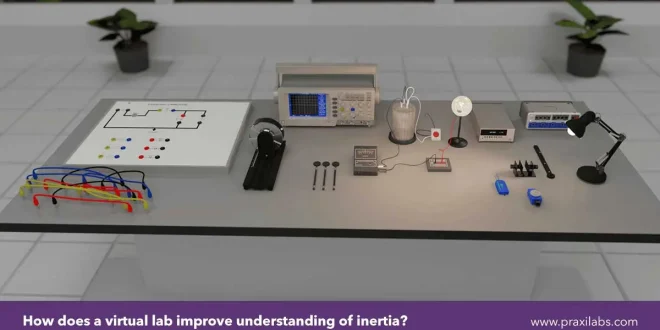
How does a virtual lab improve understanding of inertia?
A virtual lab improves understanding of inertia in several concrete ways:
- Watching a concept happen on screen builds a stronger mental model than reading a formula once.
- A virtual inertia setup lets students change one variable at a time to isolate cause and effect.
- Every attempt is logged automatically, giving instructors a clear view of where each student gets stuck.
- That data replaces waiting on a written report to reveal a gap.
Demand for tools like this keeps climbing. A market report by Technavio on virtual labs for STEM education projects a compound annual growth rate of 8.57% between 2026 and 2030, which points to more schools moving lab work online.
Why choose PraxiLabs for learning physics concepts like Inertia?
PraxiLabs runs its simulations inside a wider catalog covering physics, chemistry, and biology, so students don’t need separate tools for each subject. A few numbers give a sense of scale:
- Used by more than 2.5 million students across 160+ countries.
- Over 210 simulations spanning 20+ science branches.
- Cuts lab costs by 60% and improves retention by 80% compared to traditional methods.
- Backed by 11 global awards for EdTech innovation.
- Integrates with Moodle, Canvas, and Blackboard within 24 hours.
- Offers 24/7 support and bilingual access in Arabic and English.
An AI lab assistant called Oxi also guides students through each session, offering real-time hints when a measurement looks off. This kind of built-in support helps students catch small errors early, before they compound into a misunderstanding that carries over into an exam.
A short list of topics at PraxiLabs inertia virtual lab:
Students exploring inertia on the platform typically move through a handful of related experiment topics:
- Newton’s first law and resistance to motion.
- Mass, force, and acceleration relationships.
- Rotational inertia and axis of rotation.
- Friction’s effect on moving objects.
- Momentum and how inertia influences changes in motion.
Explore: Newton’s Second Law Simulation with PraxiLabs
Working through these topics inside the inertia virtual lab gives students a structured path from the basic definition of inertia to more advanced rotational problems.
FAQs
How supportive are virtual labs in education?
Virtual labs offer repeated, low-risk practice that builds stronger concept retention than a single physical session. They also remove scheduling and equipment limits entirely.
What is the future of virtual laboratories?
Demand keeps growing as institutions shift lab budgets toward digital tools, driven by rising equipment costs. AI-guided feedback and LMS integration point toward more adaptive labs.