 PraxiLabs A virtual world of science

Last Updated on May 25, 2026 by Muhamed Elmesery
Virtual labs are reshaping STEM education by turning traditional, resource-heavy experiments into interactive digital experiences.
As modern STEM teaching tools, they allow students to explore complex scientific concepts safely, flexibly, and at their own pace—without the limitations of physical lab space or equipment.
By bridging theory with hands-on practice, virtual labs make learning more engaging, accessible, and effective for today’s digital learners.
Table of Contents
What are stem teaching tools?
STEM teaching tools are educational technologies that support the learning and teaching of science, technology, engineering, and mathematics.
These tools include interactive simulations, augmented reality, virtual labs, 3D modeling, coding, and immersive digital platforms. They help students visualize what they study, experiment by themselves safely, and enhance critical thinking skills through hands-on and engaging learning experiences.
Integrated STEM teaching tools refer to the combination of engineering and technology concepts with science and mathematics education by using interactive tools such as virtual science labs. Consequently, we can say that the potential of STEM teaching tools meets all requirements to improve the quality of education.
How do modern STEM tools enhance student engagement?
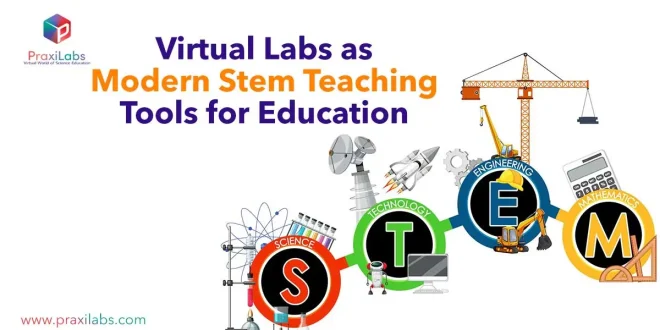
STEM-based education removes the traditional barriers between the four disciplines (science, technology, engineering, and mathematics) by integrating these subjects into one cohesive framework.
For a better understanding, in STEM education, the engineering component puts emphasis on the process and design of solutions instead of the solutions themselves. This approach allows students to explore math and science in a more personalized context, while helping them to develop critical-thinking skills that can be applied to all facets of their work and academic lives.
Modern STEM tools can help students learn math and science, especially when used alongside a variety of teaching methods. They are most effective when used to explain complex and abstract content, such as scientific mechanisms and the visualization of chemical compounds in chemistry or physics classes.
Using digital tools in STEM education provides an engaging and interesting way for students and learners to interact with science, while also increasing their access to practical science education.
Interactive virtual laboratories with gamification elements such as an immersive 3D universe, virtual and augmented reality, and mobile apps are the most frequently used digital tools that support STEM education.
Explore: Why Every University Should Use a STEM Virtual Lab?

Virtual labs: Five benefits for STEM education
Virtual labs are powerful STEM teaching tools that enhance both learning outcomes and student engagement. Here are seven key benefits:
-
Safe, Risk-Free Experimentation
Students can explore hazardous experiments—like chemical reactions, electrical circuits, or biological dissections—without exposure to danger. This encourages curiosity and allows them to learn from mistakes without real consequences.
-
Cost Efficiency & Resource Optimization
Traditional labs require expensive equipment, consumables, and maintenance. Virtual labs eliminate these costs while still delivering high-quality experimental experiences, making STEM education tools more scalable for institutions.
-
Deeper Conceptual Understanding
Through interactive simulations, students can visualize abstract concepts—like molecular structures, forces, or data trends—making complex theories easier to grasp and retain.
-
Unlimited Practice, Accessibility & Flexibility
Unlike physical labs with limited time and materials, virtual labs allow students to repeat experiments multiple times. This reinforces learning, builds confidence, and helps students achieve mastery through trial and error.
Learners and students can access experiments anytime, from anywhere, on different devices. This supports remote learning, self-paced study, and ensures equal access for students regardless of location or school resources.
-
Enhanced Engagement & Motivation
Gamified elements, interactive interfaces, and real-world scenarios make learning more enjoyable, increasing student participation and interest in STEM subjects.
Disciplines that benefit most from virtual simulations:
Several disciplines can benefit from virtual simulation for example, using virtual simulation in STEM education to teach and learn in the fields of science, technology, engineering, and mathematics.
The integration of these four educational disciplines aims to create an interest and a lifelong love of sciences in children from an early age, enabling them to become confident problem solvers in any area of life.
In conclusion, virtual simulations are most powerful in fields that rely on experimentation, risk, or complex systems such as:
- Science (Physics, Chemistry, Biology).
- Engineering & Technology.
- Medical & Health Sciences.
- Environmental Science.
- Mathematics.
- Business & Economics.
Explore: Interactive STEM Websites for Mastering Science Experiments
How do students engage through virtual labs?
Technology has brought about a significant transformation in the way STEM is learned—especially in science teaching strategies—where education no longer relies solely on theoretical explanations in the classroom, but increasingly depends on interactive digital tools that enhance understanding and practical experience.
Modern technologies such as virtual labs, scientific simulations, and virtual reality have contributed to enabling students to explore scientific concepts in a more interactive and realistic way.
Using technology such as virtual lab technology and realistic simulations adds great value to science by enabling safe, cost-effective, and repeatable study of complex, dangerous, or inaccessible systems.
The use of realistic simulations aims to help students understand complex physical principles and theories that may be difficult to study experimentally or theoretically in a physical lab.
For example:
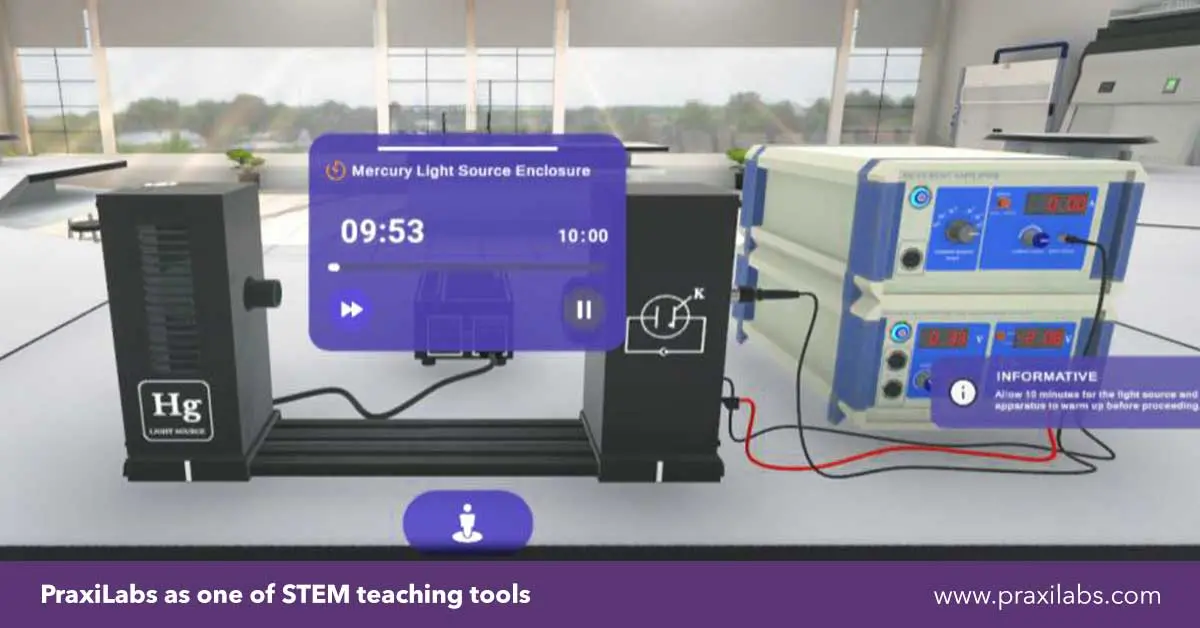
In a PraxiLabs simulation like the Amylase Test, students interact with lab tools, test how temperature affects enzyme activity, observe color changes, and analyze results—turning theory into a real experience.
PraxiLabs as one of STEM teaching tools:
PraxiLabs stands out as one of the most powerful STEM teaching tools—transforming abstract concepts into interactive, hands-on experiences that students can explore anytime, anywhere.
Here’s how engagement actually happens:
-
Hands-on, Immersive Experiments
Students enter a 3D virtual lab where they perform experiments step by step—mixing chemicals, using tools, and observing results as if they were in a real lab.
-
Game-like Interactive Experience
PraxiLabs adds hints, walkthroughs, and quizzes, making the lab feel like a game. This keeps students motivated and actively involved instead of passively learning.
-
Real-time Guidance & Feedback
With tools like “Oxi” the lab assistant and instant feedback, students get immediate corrections and support, helping them stay engaged and learn from mistakes instantly.
-
Active Exploration & Decision-Making
Students don’t just follow instructions—they test variables, observe outcomes, and draw conclusions, which builds deeper understanding and critical thinking.
-
Repetition & Mastery
They can repeat experiments unlimited times, track progress, and improve performance—keeping them continuously engaged in the learning process.
-
Collaboration & Discussion
Students can work together, share results, and solve problems collaboratively—just like real scientific teams.
Ready to elevate your STEM learning tools experience?
Contact us now and discover how PraxiLabs can bring your science curriculum to life with immersive virtual labs, real-time feedback, and unlimited experimentation.
Why does PraxiLabs deserve a closer look?
PraxiLabs goes beyond traditional virtual labs by creating a truly interactive and student-centered STEM learning experience. Here’s what makes it stand out:
- Transforms STEM learning into an immersive, hands-on experience.
- Uses 3D simulations aligned with curricula for real experimental practice.
- Encourages active learning through exploration and hypothesis testing.
- Bridges the gap between theory and practice for deeper understanding.
- Removes barriers like cost, safety risks, and limited lab access.
Real student voice
Here’s a testimonial adapted from a LinkedIn post by Salma H. Katary, a PharmD intern who participated in PraxiLabs’ usability testing:
“I had the opportunity to take part in a usability testing session with PraxiLabs, where I contributed to enhancing the user experience and navigation of their virtual labs. It was a rewarding experience to see how user feedback is genuinely valued and implemented.
PraxiLabs is making a real impact in digital education, and I’m especially grateful to Dr. Khadija El-Bedweihy for her continuous support and inspiring vision.”
Frequently Asked Questions
How do virtual labs support personalized learning?
Virtual labs support personalized learning by enabling students to conduct, repeat, and master scientific experiments at their own pace from any location. They tailor the experience through interactive 3D simulations, real-time feedback, and customized guidance, empowering students to learn safely and effectively
Are virtual labs as effective as traditional labs?
Virtual labs, such as those provided by PraxiLabs, are highly effective alternatives to traditional labs, often boosting learning retention by up to 80% and student performance by 60%. They provide, safe, engaging, and accessible alternatives that are, in many cases, as effective as physical labs for learning concepts