 PraxiLabs A virtual world of science

Last Updated on August 23, 2026 by Basem Ali
A virtual separation of mixtures lab lets a chemistry student practice filtration, distillation, and chromatography without waiting for a shared bench to open up. Textbook diagrams show these techniques as flat, static drawings, but a simulation lets a learner actually pour, heat, or filter a sample and watch the components split apart step by step. Because the workspace runs entirely online, a class doesn’t need to divide a handful of stations across dozens of students each week. The sections below cover what this kind of lab includes, why real labs fall short on their own, and how PraxiLabs brings the experience to students.
Table of Contents
What is a virtual separation of mixtures lab?
A virtual separation of mixtures lab is a browser-based simulation where a student combines two or more substances, then applies a chosen technique and watches the components split apart in real time, without needing a single piece of physical glassware.
- A digital beaker or flask that reacts realistically to pouring, heating, or shaking, mirroring how a real sample would behave under the same conditions.
- Adjustable variables like temperature, particle size, or solvent choice, so a student can test what happens when one factor changes at a time.
- Step-by-step prompts that adjust based on what a student tries next, rather than following a single fixed script for every learner.
- An automatic log of every measurement taken during the exercise, which a student can revisit later while writing up a lab report.
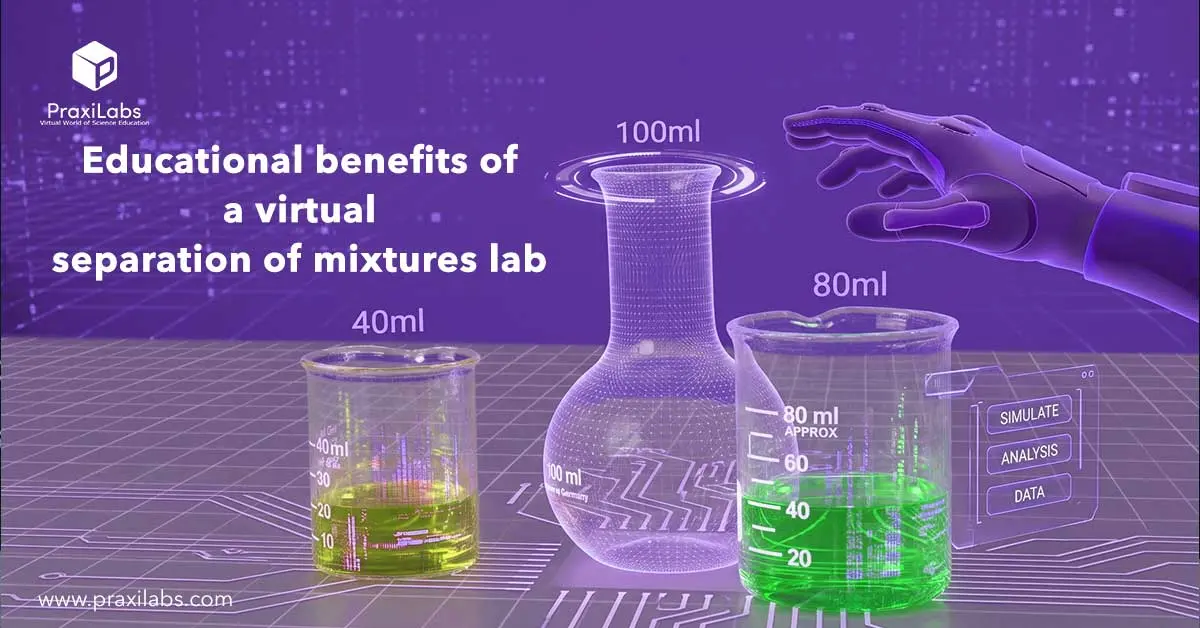
Educational benefits of a virtual separation of mixtures lab:
Running this kind of simulation before or after a physical session helps a technique stick, since a student can repeat it as many times as needed without wasting a single reagent or breaking a single flask.
- Removes the risk of handling heated glassware or volatile solvents, which matters most for younger students still learning basic lab safety.
- Cuts material costs since nothing needs replacing after a repeated attempt, unlike a physical trial that consumes fresh reagents every time.
- Lets a student rerun a virtual lab separating mixtures exercise until the result makes sense, instead of moving on with a half-formed understanding.
- Builds confidence before a student steps into a physical chemistry lab for the first graded practical of the term.
- Works on any device with a browser, from a dorm room or library, without needing specialized lab access.
- Gives instant visual feedback instead of a delayed written report that arrives days after the mistake was made.
- Reinforces the exact steps of a virtual separation of mixtures lab before a graded practical exam, when review time is limited.
Explore: 5 Examples for Inorganic Chemistry Virtual Lab
Why can separating mixtures study be difficult in real labs?
Real labs make it hard to practice every technique a virtual separation of mixtures lab covers, since equipment shortages and safety rules slow down how quickly a class moves between stations during a single period.
- Limited glassware means only a few students can run a distillation at once, so the rest of the class waits its turn.
- Heating and volatile solvents require close supervision, which caps how many groups an instructor can safely watch at the same time.
- A spill or broken flask can end a session early for the rest of the class, losing the practice time everyone had planned on.
- A clinical study published in JMIR Formative Research found that computer-based labs offered a viable, effective alternative when physical labs were inaccessible, improving outcomes compared with lecture-only instruction.
- A separation of mixtures virtual lab avoids this bottleneck entirely, since every student gets an unlimited personal station that never runs out of glassware.
Explore: Interactive Titration Online Simulation for Students
Separation techniques that students can practice in a virtual lab:
A virtual separation of mixtures lab typically walks a student through five core techniques that a general chemistry curriculum expects them to master before moving on to more advanced coursework.
- Filtration — separates an insoluble solid from a liquid using a porous barrier, such as filter paper or a mesh screen.
- Evaporation — recovers a dissolved solid by removing the liquid around it, often through gentle, controlled heating.
- Distillation — splits liquids with different boiling points through controlled heating and condensation.
- Chromatography — separates substances that travel at different speeds through a medium, revealing individual components as bands or spots.
- Decantation — part of PraxiLabs’ virtual lab mixtures and solutions collection, pours off a liquid layer while leaving a denser layer or settled solid behind.
How did PraxiLabs make separating mixtures more convenient?
PraxiLabs built its virtual separation of mixtures lab to remove the usual friction points, from equipment scheduling to reagent costs, that slow down a typical chemistry department.
- No need to order or replace chemical reagents between class sections, which saves both budget and prep time for teaching staff.
- Every mixture and solution virtual lab module comes preloaded with realistic reaction behavior, so results stay chemically consistent from one attempt to the next.
- A saved history lets a student resume a half-finished separation exactly where they left off, even after closing the browser.
- A market report from Verified Market Reports values the global virtual laboratories platform market at $2.5 billion in 2026, projected to reach $6.8 billion by 2033 at a 12.5% CAGR, a sign that more chemistry departments are shifting practical work online.
Explore the Virtual Chemistry Lab of PraxiLabs
What makes PraxiLabs different from other virtual labs platforms?
What sets PraxiLabs apart is depth: its virtual separation of mixtures lab sits inside a catalog of 210+ science simulations, not as a standalone product a school has to buy separately for one unit of the syllabus.
- A single account covers chemistry, physics, and biology instead of one subject at a time, cutting down on separate software subscriptions.
- Every mixtures and solutions virtual lab module shares the same interface, so a student doesn’t relearn navigation each semester or each new course.
- A peer-reviewed research review published by Wiley examines the merits, challenges, and implementation strategies behind using virtual labs to support experiential science learning.
- A case study in Frontiers in Education describes an interactive escape-room activity used to teach mixture separation concepts as part of a distance-education chemistry pilot.
- Bilingual access in Arabic and English, plus 24/7 support and LMS integration within 24 hours.
FAQs
What is a virtual lab in chemistry?
A virtual lab in chemistry is an online simulation where students run experiments digitally, testing reactions, techniques, and measurements without physical glassware or reagents.
What are the common types of mixtures?
Common mixtures include solutions, suspensions, and colloids, along with heterogeneous combinations like sand and water or homogeneous ones like saltwater.