 PraxiLabs A virtual world of science

Last Updated on August 20, 2026 by Muhamed Elmesery
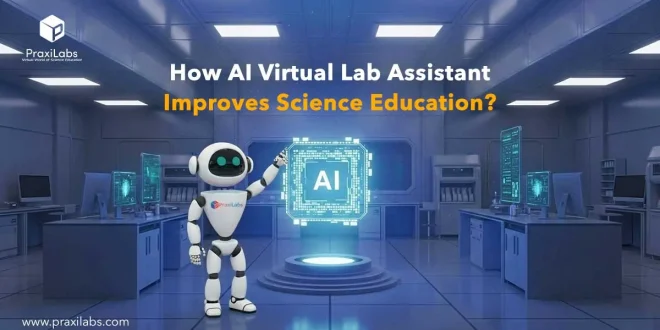
An AI virtual lab assistant works alongside students in real time, guiding them through science experiments instead of leaving them to interpret results alone. Traditional labs place all troubleshooting on one instructor, which delays feedback when a class runs large. Built-in AI guidance changes that by answering questions the moment they come up, right inside the workspace where an experiment is running. This kind of support scales evenly across a class instead of favoring whoever asks first. The sections below cover how the technology works, its benefits, and how PraxiLabs applies it inside virtual science labs.
Table of Contents
What is an AI virtual lab assistant?
An AI virtual lab assistant is a chat panel or voice prompt built directly into the simulation interface. Unlike a static FAQ page, it reads the exact values a student has entered, so its response matches the experiment in progress rather than offering a generic, one-size-fits-all reply.
- Answers conceptual questions mid-experiment, using the specific values a student has already entered instead of a generic textbook definition.
- Flags a measurement that looks off, comparing it against expected ranges before a student moves on to the next step.
- Suggests the next step when a student pauses too long.
- Stays invisible in the background as part of every AI virtual lab feature, running silently until a mistake is about to happen, then surfacing a short, specific hint.

Benefits of AI virtual lab assistant for science learning:
A student working alone at 11 p.m. still gets a response, since the assistant doesn’t run on office hours, unlike a teaching assistant reachable only during scheduled lab sessions.
- No wait time between a question and an answer, even during peak hours when dozens of students run the same experiment at once.
- Consistent guidance regardless of class size.
- A private space to ask a “basic” question without hesitation, since no classmate ever sees what was typed.
- Narrows the gap until an instructor is available, since this virtual lab AI runs beyond office hours.
Explore: 5 Benefits of Using a Virtual Learning System for Science Experiments
What is the role of AI in virtual labs?
Inside PraxiLabs, the AI virtual lab assistant plays a narrower, more practical role than a general-purpose chatbot, staying tied to the specific experiment on screen instead of drifting into unrelated topics.
- Keeps guidance scoped to the task instead of unrelated menus.
- Adjusts pacing automatically within the AI virtual lab environment, slowing down or speeding up per student.
- Matches findings from a teacher survey in Frontiers in Education showing AI-supported tools make lessons more interactive, with teachers reporting longer engagement once guidance was built directly into the simulation.
How are AI virtual lab assistants used in universities?
University labs use these tools mainly to close the coverage gap between a small teaching staff and a large lab section, a mismatch that grows as enrollment outpaces hiring budgets.
- Freshman-level courses with high enrollment and few teaching assistants, where one TA might otherwise cover well over a hundred students
- Remote or hybrid programs where a live instructor isn’t always online.
- Make-up sessions for students who missed a scheduled lab slot due to illness, travel, or a scheduling conflict with another course.
- Independent progress in lab-heavy majors, confirmed by peer-reviewed research published by Wiley on AI-guided virtual reality labs, which found fewer errors when guidance responded to student actions in real time.
- Early-warning tracking, where virtual lab AI transcripts flag which lab modules need revision.

How does virtual tech solve traditional lab problems?
According to a broader shift confirmed by a market analysis from Grand View Research, valuing the AI in education sector at $8.3 billion in 2025 with a 25.9% CAGR through 2033, a pace that outstrips most other categories of education technology spending:
- Traditional labs run into familiar obstacles that an AI virtual lab assistant helps close, from limited equipment to fixed scheduling that rarely shrinks as enrollment keeps climbing.
- Equipment never breaks or runs out, so a full class can run the same experiment. simultaneously without waiting for a shared station.
- A session isn’t capped by physical seats.
- Guidance is available outside scheduled class hours, including evenings and weekends when a physical lab building is locked.
Explore: 7 Reasons to Use Ed-Tech for Virtual Labs in Universities
How does PraxiLabs support AI in scientific research?
PraxiLabs builds its AI virtual lab assistant, Oxi, directly into every simulation rather than offering it as an add-on, so support is present from the very first click.
- Catches small errors, like a miscalculated variable or skipped step, before they reach a final report, giving a student the chance to correct course mid-experiment.
- Reduces repeated help requests reaching teaching staff over a semester, freeing up office hours for harder conceptual questions.
- Logs every interaction so instructors can review where a class collectively struggled, then adjust an upcoming lecture accordingly.
Explore PraxiLabs AI virtual lab assistant “Oxi”:
Oxi sits inside every PraxiLabs simulation, watching for the moment a student’s input doesn’t match expected values, flagging an inconsistent titration reading before a report is submitted, so an error gets caught while it’s still easy to fix.
- Used by 2.5 million-plus students learning across many science disciplines.
- Active across 160+ countries, spanning both university and secondary programs.
- 210+ science simulations spanning 20+ science branches.
- 60% lower lab costs versus traditional methods.
- 80% better retention versus traditional methods.
- 11 international EdTech awards.
- LMS integration with Moodle, Canvas, or Blackboard within 24 hours.
- 24/7 support with bilingual access in Arabic and English.
FAQs
How has AI helped with science?
AI speeds up data analysis, flags errors instructors might miss, and gives students round-the-clock guidance. It also lets labs scale beyond what one instructor can supervise.
How is AI used in labs?
AI monitors student input in real time, answers questions inside the workspace, and adjusts pacing based on how a student is progressing through an experiment.
What is the major benefit of virtual labs?
Unlimited, low-risk repetition. Students can rerun an experiment as many times as needed without added cost, equipment wear, or scheduling conflicts.