 PraxiLabs A virtual world of science

Last Updated on September 13, 2026 by Muhamed Elmesery
Thermodynamics can seem like a world of complex equations, abstract concepts, and difficult-to-visualize processes. But what if you could change the pressure of a gas, observe temperature changes, and experiment with heat transfer in real time—without stepping into a physical lab?
Interactive thermodynamics software makes this possible. Through virtual experiments and dynamic simulations, students can explore how thermodynamic systems behave and connect theoretical principles with practical results.
In this guide, we’ll explore three key thermodynamics concepts you can master through interactive simulations, making learning more engaging, visual, and hands-on.
Table of Contents
What is an interactive thermodynamics software?
Interactive thermodynamics software is a digital learning or simulation tool that allows students to explore thermodynamic concepts by interacting with virtual models, experiments, and real-time data rather than simply reading equations or watching demonstrations.
In education, interactive thermodynamic properties software is especially useful because it transforms thermodynamics from a formula-heavy subject into an active, visual learning experience, allowing students to test “what happens if…” scenarios and understand the relationship between different variables.
How does interactive thermodynamics software work?
Interactive thermodynamics software works by using virtual simulations to recreate real thermodynamic experiments and systems. Students can adjust variables such as temperature, pressure, volume, and heat, then instantly observe how these changes affect the system through animations, measurements, and graphs.
This allows learners to experiment, test predictions, and understand thermodynamic principles through hands-on practice rather than relying only on theoretical equations.
Top benefits of an interactive thermodynamics software:
Interactive thermodynamics software transforms complex concepts into hands-on, visual learning experiences. By combining simulations, experimentation, and real-time feedback, it helps students understand not only what happens in a thermodynamic system, but also why it happens.
- Makes complex concepts visual: Students can observe relationships between heat, temperature, pressure, volume, and energy through interactive simulations.
- Bridges theory and practice: Learners can apply thermodynamic equations and laws to virtual experiments instead of relying solely on textbook examples.
- Enables safe experimentation: Students can explore heat transfer, gas behavior, and energy conversion without the risks associated with physical laboratory equipment.
- Allows unlimited practice: Virtual experiments can be repeated multiple times, allowing learners to test different conditions and learn from their results.
- Provides instant feedback: Real-time measurements, calculations, graphs, and experimental results help students quickly identify and understand outcomes.
- Encourages active learning: Students interact with variables and make predictions, turning them from passive learners into active experimenters.
- Improves understanding of thermodynamic laws: Simulations make principles such as energy conservation, Boyle’s Law, specific heat, and the First Law of Thermodynamics easier to visualize and apply.
Explore: Thermodynamics Virtual Lab to Discover Advanced Concepts
How does a virtual lab simplify thermodynamics principles?
A virtual lab simplifies thermodynamics principles by turning complex equations and abstract concepts into interactive experiments that students can see, manipulate, and analyze.
Visualize abstract concepts: Students can see how heat, temperature, pressure, and volume interact instead of relying only on mathematical formulas.
Experiment with variables: Learners can change temperature, pressure, volume, or other parameters and immediately observe how the system responds.
Understand thermodynamic laws: Virtual experiments make concepts such as the First Law of Thermodynamics, entropy, and energy conservation more tangible.
Practice without physical limitations: Students can repeat experiments as many times as needed without worrying about equipment availability, materials, or laboratory safety.
Connect theory with practice: Virtual labs help students apply equations and theoretical principles to realistic experimental situations.
Receive immediate results: Graphs, measurements, and calculations allow learners to quickly evaluate their observations and understand cause-and-effect relationships.
Learn through exploration: Students can test different scenarios, make predictions, and discover how thermodynamic systems behave through hands-on interaction.
Concepts You Can Master Using Thermodynamics Software:
interactive thermodynamics online software such as PraxiLabs makes complex heat and gas concepts easier to understand through interactive virtual experiments. Instead of simply studying equations, students can manipulate variables, observe results, and connect theoretical principles with practical applications.
-
Specific Heat of Solids
The Specific Heat of Solids Virtual Lab helps students understand the concept of specific heat capacity—the amount of heat required to raise the temperature of a given mass of a substance by a specific amount.
Through the simulation, students can explore how different solid materials respond to heating and use experimental measurements to determine their specific heat. This makes it easier to understand the relationship between heat, mass, temperature change, and material properties.
Explore Specific Heat Virtual Lab for Solids
-
Boyle’s Law of Gases
The Boyle’s Law Simulation for an Ideal Gas allows students to investigate the relationship between pressure and volume when temperature remains constant.
By manipulating the volume of an enclosed gas and observing the corresponding pressure changes, learners can see Boyle’s Law in action:
P₁V₁ = P₂V₂
Explore: Boyle’s Law Simulation for an Ideal Gas
The interactive environment helps students understand that pressure increases as volume decreases, and vice versa, making the relationship much more intuitive than learning the equation alone.
-
Joule’s Experiment
Joule’s Experiment introduces students to the relationship between mechanical work and heat. The virtual experiment demonstrates how mechanical energy can be converted into thermal energy, helping learners explore one of the fundamental ideas behind energy conservation and the First Law of Thermodynamics.
By interacting with the virtual apparatus and observing the experimental results, students can better connect the theoretical concept of the mechanical equivalent of heat with an actual experimental setup.
Advantages of PraxiLabs’ interactive thermodynamics software:
- Hands-on virtual experiments: Explore thermodynamic concepts through realistic, interactive simulations.
- Safe learning environment: Practice experiments without the risks or limitations of physical laboratories.
- Better concept visualization: See how heat, energy, temperature, and other variables interact in real time.
- Learn at your own pace: Repeat experiments and review concepts whenever needed.
- Instant feedback: Observe experimental results and understand the impact of changing variables.
- Accessible anytime, anywhere: Conduct virtual experiments from any device with an internet connection.
- Cost-effective learning: Reduce the need for expensive laboratory equipment and consumables.
- Engaging student experience: Make complex thermodynamics topics more interactive and easier to understand.
Ready to make thermodynamics more interactive? Explore PraxiLabs’ virtual labs and give your students a hands-on learning experience—without the limits of a traditional laboratory.
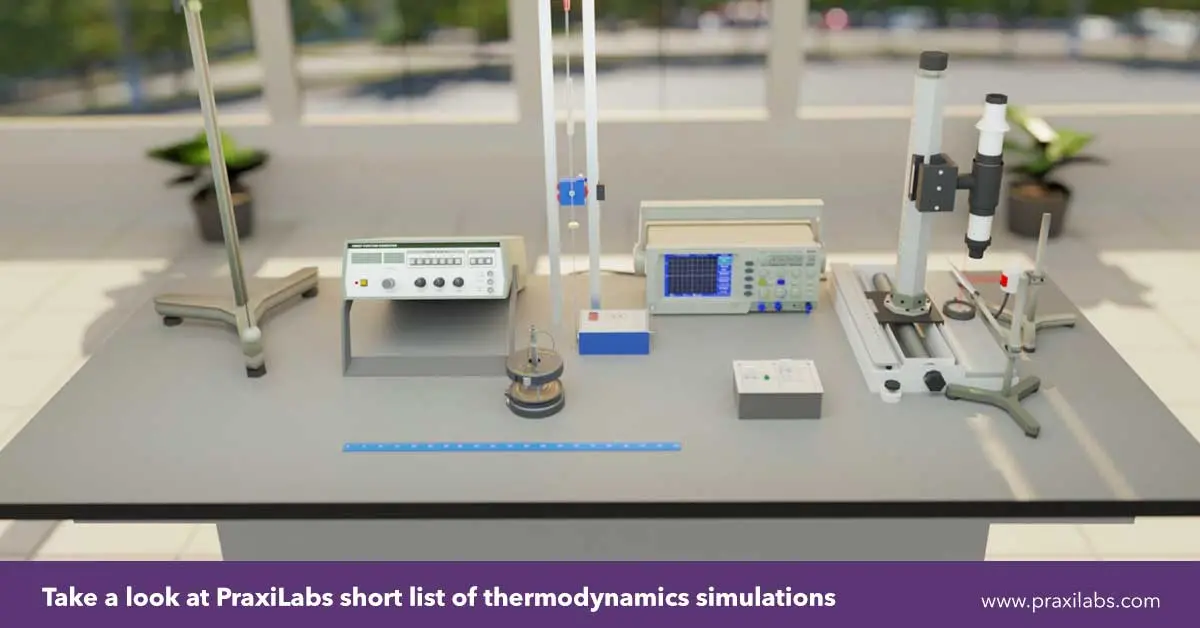
Take a look at PraxiLabs short list of thermodynamics simulations:
PraxiLabs thermodynamics simulations allow students to explore thermodynamics from different perspectives—from the thermal properties of solids to gas behavior and energy conversion. This hands-on approach helps transform difficult thermodynamic principles into visual, interactive, and repeatable learning experiences.
Solids – Specific Heat Virtual Lab
By the end of the specific heat experiment, student will be able to:
- Define the specific heat capacity through the specific heat capacity simulation.
- Set up a specific heat of solids experiment to determine the specific heat capacities of three samples of different metals.
- Apply the principle of conservation of energy to a mixture by using the specific heat virtual lab.
Boyle’s Law Simulation for an Ideal Gas
Let your students learn how to:
- Explain the relationship between the pressure exerted on an ideal gas and the volume it occupies at constant temperature by using the Boyle’s Law lab experiment.
- Set up an experiment (Boyle’s experiment) to study the pressure-volume relationship for an ideal gas.
- Learn how to use a gas law simulator.
Joule’s Experiment
Teach your students how to:
- State the principle of conservation of energy.
- Identify which types of energy were involved in the Joule heating experiment.
- Recognize how energy conversion takes place from electrical energy into heat energy within joule’s experiment in thermodynamics.
- Identify the different units used to measure energy in the calorimetry virtual lab.
- Determine the value of the mechanical equivalent of heat and the coil resistance in the virtual calorimetry lab.
FAQs
Are virtual labs cost effective compared to physical labs?
Yes, virtual labs are significantly more cost-effective than physical labs, cutting equipment and consumable expenses by up to 60%.
Physical labs require continuous restocking of chemicals, glassware, and biological specimens, alongside expensive maintenance. Virtual labs eliminate recurring material costs and hardware breakage.
Do virtual labs provide real-time results?
Yes, virtual labs provide real-time results and instant feedback as you adjust parameters and run experiments. Software algorithms calculate physical and chemical reactions immediately when you change variables.