 PraxiLabs A virtual world of science

Last Updated on September 7, 2026 by Muhamed Elmesery
An enzyme kinetics virtual lab lets students watch a reaction unfold in real time, adjusting variables like temperature, pH, and substrate concentration without touching a single test tube. Traditional enzyme labs run into cost, time, and safety limits that make repeated trials hard to fit into a single class period. A digital simulation removes that constraint, letting a student rerun the same reaction as many times as needed to see how each variable shifts the outcome, all from a laptop or tablet. This piece covers what the lab includes, the outcomes it targets, and how PraxiLabs brings enzyme kinetics to students studying biochemistry online.
Table of Contents
What is an enzyme kinetics virtual lab?
An enzyme kinetics virtual lab is a browser-based simulation where a student mixes an enzyme with its substrate, then tracks how fast the reaction proceeds under different conditions, without needing a physical bench or reagents.
- A digital enzyme and substrate pairing that reacts based on real biochemical rate laws, not a scripted outcome chosen in advance by the platform.
- Adjustable variables like temperature, pH, and substrate concentration, changed one at a time to isolate their true effect.
- Real-time graphs plotting reaction rate against time or substrate concentration as the trial runs on screen.
- Automatic data logging for every trial a student runs, saved for later review before a report is due.
- A comparison view that overlays two or more trials on the same graph to spot differences at a glance.

Learning outcomes of enzyme kinetics virtual lab:
By the end of a typical session, a student should walk away with a working grasp of how enzymes behave under changing conditions, not just a memorized definition tied to enzyme kinetics biochemistry from a textbook chapter they skimmed the night before.
- Understand how temperature, pH, and inhibitors affect enzyme activity over the course of a reaction, not just at a single point.
- Identify the substrate concentration where a reaction runs at its fastest measured rate before it plateaus.
- Describe the mechanism behind enzyme catalysis at a molecular level, not just a labeled diagram.
- Explain why activity drops sharply at extreme temperatures or pH levels outside the optimal range.
- Practice reading and plotting rate-versus-concentration data the way a formal lab report would require.
- Connect lab results back to the Michaelis-Menten model taught earlier in lecture, closing the loop between theory and data.
- Recognize how a competitive inhibitor’s effect on Vmax and Km differs from a non-competitive one.
Explore Enzyme Simulation Lab Concepts
Main variables to study the enzyme kinetics virtual lab:
A handful of variables drive every enzyme kinetics virtual lab experiment, and isolating each one is far easier on screen than in a shared physical lab.
- Temperature most enzymes have a narrow optimal range before activity starts to drop off.
- pH level shifting too far from optimal can denature the enzyme’s active site.
- Substrate concentration rate rises with concentration until the enzyme becomes saturated.
- Enzyme concentration more enzyme molecules generally means a faster initial reaction rate.
- Reaction time the window over which a rate measurement is taken affects the result.
- Ionic strength the salt concentration in solution can shift how an enzyme folds and behaves under test conditions.
- Cofactors many enzymes need a metal ion or coenzyme bound to the active site before they can catalyze a reaction at all.
- Inhibitors competitive or non-competitive molecules that slow the reaction, a topic a systematic review in Frontiers in Education notes is easier to isolate in a virtual setting than in a shared physical lab.
Explore: Biochemistry Virtual Lab for Students
How does virtual simulation help students understand enzyme activity?
Watching a reaction rate change in real time, then testing a new variable immediately after, builds faster intuition than memorizing a graph from a textbook. A virtual enzyme kinetics simulation lets a student test a hypothesis and see the result within seconds instead of days.
- Visual graphs replace abstract rate constants with a shape a student can actually see and interpret clearly, far more intuitively than a table of numbers.
- Immediate feedback shows the effect of a single changed variable at a time, isolated cleanly from the rest and easy to trace back to a cause.
- A peer-reviewed research article published by Wiley on virtual enzymology lessons found that an online kinetics simulator let students model enzymatic mechanisms and follow them through time, even without in-person lab access during widespread lockdowns.
Who can benefit from using an enzyme kinetics virtual lab?
An enzyme kinetics virtual lab serves more than one type of learner, from a first-year biology student to an instructor managing a large lecture section with limited bench space.
- Undergraduate biochemistry and biology students meeting a required lab component for their degree program.
- Instructors teaching large sections where physical bench space runs out quickly each semester as enrollment grows.
- Remote and online degree programs that don’t have access to a physical wet lab at all this term.
- High school students previewing college-level biochemistry concepts before formal enrollment.
- Self-taught learners exploring enzyme reaction kinetics independently outside a formal course structure.
- Researchers previewing the real-world application of enzyme kinetics before committing to a costly bench trial.
- Teaching assistants building demo material for a discussion section ahead of the graded lab session.
- Pre-med and pre-pharmacy students building a foundation for later coursework in pharmacology.
- Graduate teaching fellows preparing office-hour walkthroughs for students who missed the live session.
Explore: Virtual Labs on Frontiers in Biochemistry
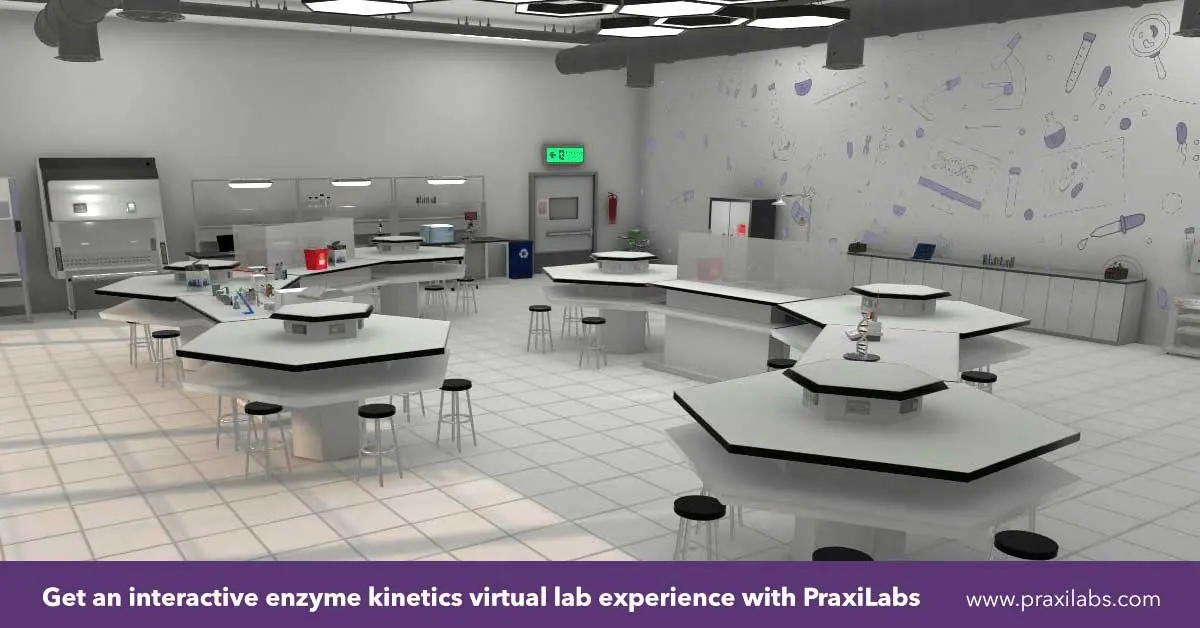
Get an interactive enzyme kinetics virtual lab experience with PraxiLabs:
PraxiLabs packages enzyme kinetics into a guided simulation alongside urease, amylase, catalase, coagulase, and oxidase tests within its broader biology catalog, so a student stays in one account for every biochemistry module.
- Used by 2.5 million-plus students across 160+ countries worldwide.
- 210+ science simulations spanning 20+ science branches, from biochemistry to physics and beyond.
- 60% lower lab costs and 80% better retention versus traditional in-person methods.
- Bilingual access in Arabic and English with 24/7 support available year-round.
- LMS integration with Moodle, Canvas, or Blackboard completed within 24 hours of setup.
- A guided enzyme kinetics simulation experience that walks a first-time user through their first full trial step by step.
- Access to related biology tests, including urease, catalase, coagulase, and oxidase simulations in the same account.
- A built-in question bank instructors can attach directly to the enzyme kinetics module for grading.
- Automated performance reports that track every student’s completions and attempts in real time.
- A shared class dashboard that flags which variable trips up the most students before the exam.
- A recent study published by Wiley notes that conventional enzyme kinetics experiments often require expensive equipment and reagents, a cost barrier that virtual alternatives can remove.
FAQs
What is the purpose of an enzyme kinetics lab?
The purpose is to teach how temperature, pH, and concentration affect reaction rate, and to connect hands-on data to the Michaelis-Menten model taught in lecture, closing the gap between theory and practice.
Can students calculate reaction rates in a virtual lab?
Yes, a virtual lab logs substrate and product levels over time, letting a student calculate initial reaction rates the same way real spectrophotometer data would, using the same formulas taught in class.