 PraxiLabs A virtual world of science

Last Updated on April 2, 2026 by Muhamed Elmesery
The rise of digital learning has transformed the way students explore science. Instead of only relying on traditional laboratories, students can now perform experiments, visualize complex concepts, and test scientific ideas through interactive simulation websites for students.
Websites such as PraxiLabs offer virtual labs that allow learners and students to explore subjects like physics, chemistry, and biology through engaging simulations. These platforms create safe, accessible environments where students can repeat experiments, analyze results, and deepen their understanding of scientific concepts anytime and anywhere.
Table of Contents
Benefits of simulation websites for students:
Simulation websites for students provide immersive, interactive, risk-free environments to practice complex skills, enhancing engagement and knowledge retention.
These platforms and websites provide 24/7 access to realistic, interactive scenarios, allowing learners to experiment, fail, and master concepts at their own pace, bridging the gap between theoretical knowledge and practical application.
Using science simulations for self-study:
The adoption of using science simulations software for students for self-study and for teaching conceptual understanding of science concepts is widely accepted by educators across the globe.
One study analyzed 1034 university students’ perceptions and experiences of using simulations for learning physics, chemistry, and biology subjects. This study provides an empirically driven exploration of the connection between tertiary students’ engagement and satisfaction with simulation-based learning and their learning styles.
The findings of this study revealed that the participants showed a very high level of engagement and satisfaction with the use of simulations for self-study and learning science concepts in the subjects of physics, chemistry, and biology. Their self-confidence and VAK (Visual (seeing), Auditory (hearing), and Kinesthetic (doing)) learning styles, particularly the kinesthetic style, were significant predictors of their engagement and satisfaction with the learning process.
The findings from this study have implications for researchers and practitioners interested in the effective adoption of computer simulations as a pedagogical approach in science education.

Why are virtual science labs becoming so popular?
Virtual science labs have brought about a radical transformation in the way education is delivered and received. Learning is no longer confined to traditional classrooms, but has become a flexible, continuous, interactive digital experience.
Here are the most prominent reasons of why virtual science labs are becoming so popular:
- Making learning available anytime and anywhere: Thanks to digital platforms and simulation websites, students can access educational content online without geographical or time restrictions, which has reinforced the principle of lifelong learning.
- Interactive learning instead of rote memorization: The use of interactive videos, virtual laboratories, augmented reality, and simulation websites for students has transformed the student from a passive recipient into an active participant in the educational process.
- Customizing the learning experience: Artificial intelligence and data analysis have contributed to designing personalized learning paths suitable for each student’s level, which has increased comprehension efficiency and the speed of understanding.
- Developing assessment and monitoring methods: Assessment tools have become electronic and immediate, with precise analytical reports that help teachers measure performance and make data-driven educational decisions.
- Reducing Costs and Increasing Efficiency: Modern technologies such as science simulation websites for students have reduced the need for expensive physical resources, such as printing or laboratory setup, while maintaining and even improving the quality of the educational experience.
- Supporting Remote Hands-On Education: Virtual labs and simulations provide safe environments to experiment with scientific concepts, enabling institutions to offer practical education without risks or high operational costs.
Explore: Integrating Virtual Environments in Education
Subjects students can explore through science simulators:
Science simulators allow students to explore a wide range of scientific subjects through interactive and safe virtual experiments. Platforms like PraxiLabs provide immersive 3D simulations that help learners understand complex concepts through practical experience.
- Physics: Students can study concepts such as motion, forces, oscillations, and electricity. For example, simulations like Forced Oscillations or Newton’s Second Law of Motion help visualize how forces affect object movement.
- Chemistry: Learners can perform experiments such as acid–base titration, determining chloride concentration using Mohr’s method, or studying reaction rates, allowing them to practice lab techniques without chemical risks.
- Biology: Simulations allow exploration of genetics, molecular biology, and cell processes. For instance, students can analyze genetic pathways or investigate DNA and enzyme-related experiments in a controlled virtual lab.
- General Laboratory Skills: Beyond subjects, students also learn essential lab skills such as using scientific instruments, recording observations, and analyzing experimental results.
These virtual simulations make science learning more interactive, accessible, and practical, enabling students to experiment repeatedly and better understand complex scientific phenomena.
Role of simulation websites for students in remote & hybrid education:
The primary role of simulation websites for students in remote & hybrid education is to provide a flexible and comprehensive learning experience that breaks the barriers of time and place.
The simulation websites for students are one of the most important tools for remote & hybrid education, and among their main benefits and objectives are:
- Providing students with access to exceptional educational tools.
- Helping students understand complex scientific concepts.
- Enabling remote learners to study the available educational materials and benefit from them for an unlimited period.
- Helping to attract students’ attention, making learning more interactive and engaging for them compared to theoretical study.
Explore: Virtual Chemistry Experiments Benefits for High Schools
Features of a good simulation platform:
Interactive Learning Environment:
Allows users to actively perform experiments and manipulate variables in real time.
Realistic Simulations:
Accurately models real-world scientific phenomena and lab procedures.
User-Friendly Interface:
Easy to navigate for students and educators without requiring advanced technical skills.
Accessibility:
Can be accessed anytime and from different devices, supporting remote learning.
Assessment and Feedback Tools:
Provides quizzes, reports, or instant feedback to track learning progress.
Scalability:
Supports many users simultaneously, making it suitable for classrooms and institutions.
Safety and Cost Efficiency:
Enables experimentation without the risks, materials, or costs of physical labs.
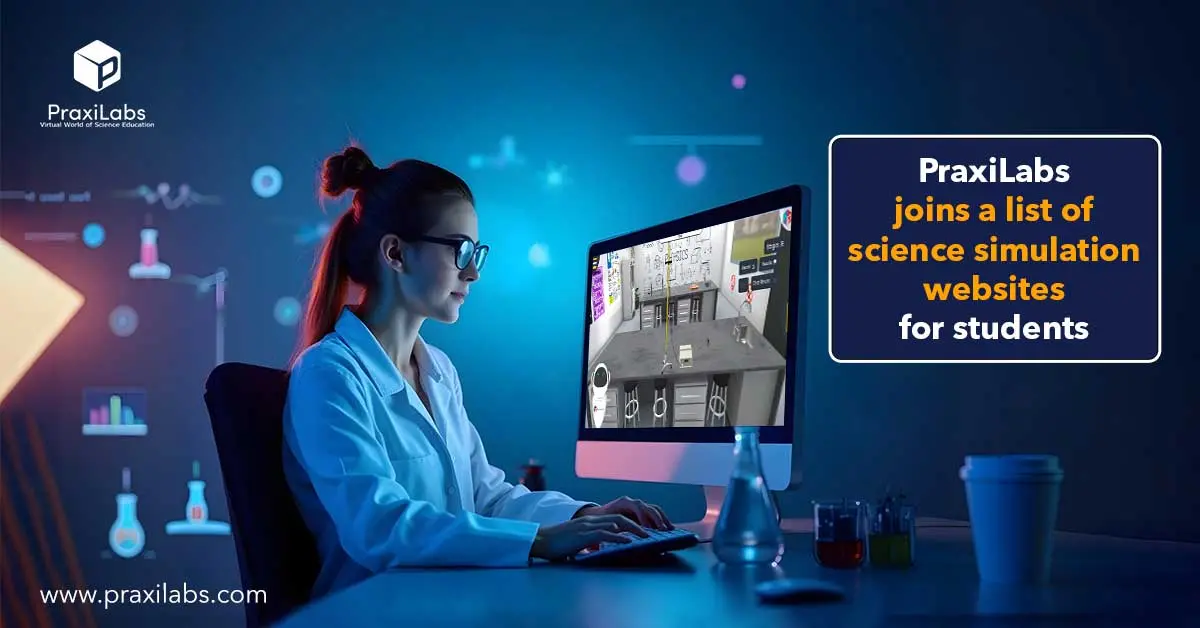
PraxiLabs joins a list of science simulation websites for students:
PraxiLabs is considered one of the leading companies regionally and globally in the field of digital education, and especially in scientific disciplines. Among its most prominent contributions are:
- Providing interactive virtual labs that simulate real laboratories in chemistry, physics, and biology.
- Enabling learning anytime and anywhere without the need for physical labs.
- Reducing the costs of equipment and maintenance compared to traditional laboratories.
- Providing accurate performance reports and analyses to track student progress.
- Easy integration with Learning Management Systems (LMS) within educational institutions.
PraxiLabs contributes to making scientific education more interactive, safe, and flexible within the modern digital education ecosystem.
Frequently Asked Questions
Can students use simulation websites without a mentor?
Yes, many simulation platforms are designed for independent learning. For example, PraxiLabs provides guided instructions, interactive steps, and built-in explanations, allowing students to perform experiments like acid-base titration or Newton’s second law of motion simulations on their own.
Do simulation platforms include science assessments?
Yes, most platforms include integrated assessments. PraxiLabs offers quizzes, instant feedback, and performance tracking after experiments.
Do colleges and universities use simulation platforms?
Yes, many higher education institutions use them to support or enhance lab learning. PraxiLabs is used by universities to deliver virtual experiments in physics, chemistry, and biology—especially for large classes or remote learning environments.