 PraxiLabs A virtual world of science

Last Updated on September 20, 2026 by Muhamed Elmesery
College science education is becoming increasingly interactive, and students are no longer limited to learning experiments from textbooks or watching demonstrations in crowded laboratories. A virtual library of simulation experiments gives students access to realistic digital experiments that they can perform, repeat, and explore from virtually anywhere.
From chemistry and physics to biology, virtual labs help bridge the gap between theoretical concepts and practical application. They also give colleges a flexible way to expand laboratory learning while providing students with more opportunities to practice essential experimental skills.
Table of Contents
What is a virtual library of simulation experiments?
A virtual library of simulation experiments is a digital collection of interactive laboratory simulations designed to recreate real-world experiments in a virtual environment.
Instead of relying exclusively on physical equipment, students can access simulated laboratory environments through a computer or other compatible device. They can interact with virtual instruments, manipulate variables, follow experimental procedures, observe results, and learn from their mistakes without the limitations of a traditional laboratory.
For college students, this approach can complement hands-on laboratory sessions by allowing them to:
- Review experiments before attending physical lab classes.
- Practice procedures repeatedly.
- Explore different experimental conditions.
- Visualize difficult scientific concepts.
- Learn at their own pace.
- Reinforce theoretical knowledge through practical application.
- Prepare for laboratory assessments and experiments.
A virtual library is particularly valuable because students can access multiple experiments from one digital environment rather than depending on the availability of a specific laboratory, instructor, or piece of equipment.
Features of a virtual library of simulation experiments:
An effective virtual science library should provide more than videos or static demonstrations. The most useful platforms allow students to actively perform experiments and make decisions throughout the learning process.
Key features include:
Interactive simulations
Students can interact with virtual lab equipment, materials, and experimental controls, making the learning experience more engaging than simply reading instructions.
Diverse experiment libraries
A comprehensive platform can bring together simulations covering multiple scientific disciplines, including chemistry, physics, and biology.
Realistic laboratory environments
High-quality simulations recreate laboratory procedures and equipment to help students develop familiarity with experimental workflows.
Repeatable practice
Students can repeat an experiment as many times as needed. This gives them an opportunity to identify mistakes, test different approaches, and strengthen their understanding.
Flexible access
Virtual experiments can be accessed outside of scheduled laboratory sessions, giving students greater flexibility in when and where they practice.
Immediate learning feedback
Digital simulations can help students understand the consequences of their actions and recognize errors during the learning process.
Safe experimentation
Students can explore experiments without the same physical risks associated with certain chemicals, equipment, or experimental procedures.
Together, these features make a virtual library a powerful complement to conventional laboratory education.
How do colleges benefit from investing in virtual learning tech?
For colleges and universities, virtual learning technology is not simply a replacement for traditional education. It can extend the capabilities of existing teaching and laboratory infrastructure.
One major advantage is scalability. Physical laboratories have limited space, equipment, and operating hours. A virtual environment can give a larger number of students access to experimental learning without requiring every student to use the same physical equipment at the same time.
Virtual learning technology can also help colleges:
- Extend practical learning beyond scheduled lab sessions.
- Support blended and hybrid learning models.
- Provide students with additional laboratory practice.
- Reduce dependence on physical equipment for introductory practice.
- Improve preparation before physical laboratory sessions.
- Support distance and remote learning.
- Standardize access to selected experiments.
- Give instructors additional resources for teaching complex concepts.
Most importantly, virtual laboratories can work alongside physical laboratories. Students can first practice procedures digitally and then apply their understanding during hands-on sessions.
How do virtual labs transform science classes?
Traditional science classes often separate theory from practice. Students may learn a scientific principle during a lecture and encounter its practical application days later in the laboratory.
Virtual labs can connect these two learning experiences.
For example, after learning a concept in class, students can immediately enter a simulation and experiment with relevant variables. They can observe what happens when conditions change and compare their results with their expectations.
This creates a more active learning experience.
Instead of asking, “What would happen if I changed this variable?” students can actually change it and observe the outcome.
Virtual labs can also encourage students to become more independent learners. Rather than waiting for an instructor to demonstrate every procedure, they can explore simulations, make predictions, test them, and learn from the results.
For instructors, simulations provide another way to demonstrate complex processes that may be difficult, expensive, time-consuming, or impractical to reproduce frequently in a physical classroom.
Improve students’ academic performance with practical experiments:
Understanding a scientific concept is often easier when students can connect it to an observable result.
A virtual library of simulation experiments helps create that connection by turning abstract concepts into interactive learning experiences.
Repeated experimentation can reinforce knowledge and help students develop a stronger understanding of:
- Scientific procedures.
- Cause-and-effect relationships.
- Experimental variables.
- Data interpretation.
- Problem-solving.
- Scientific reasoning.
- Laboratory safety.
- Experimental decision-making.
Virtual practice can also help students approach physical laboratory sessions with greater confidence. When they have already encountered the equipment, procedures, and experimental objectives in a simulated environment, the physical lab may feel less unfamiliar.
However, virtual labs should complement—not necessarily replace—hands-on laboratory education. Physical laboratories remain essential for developing tactile skills, handling real equipment, and experiencing the practical realities of scientific work.
The strongest learning model combines: theory + simulation + hands-on practice.
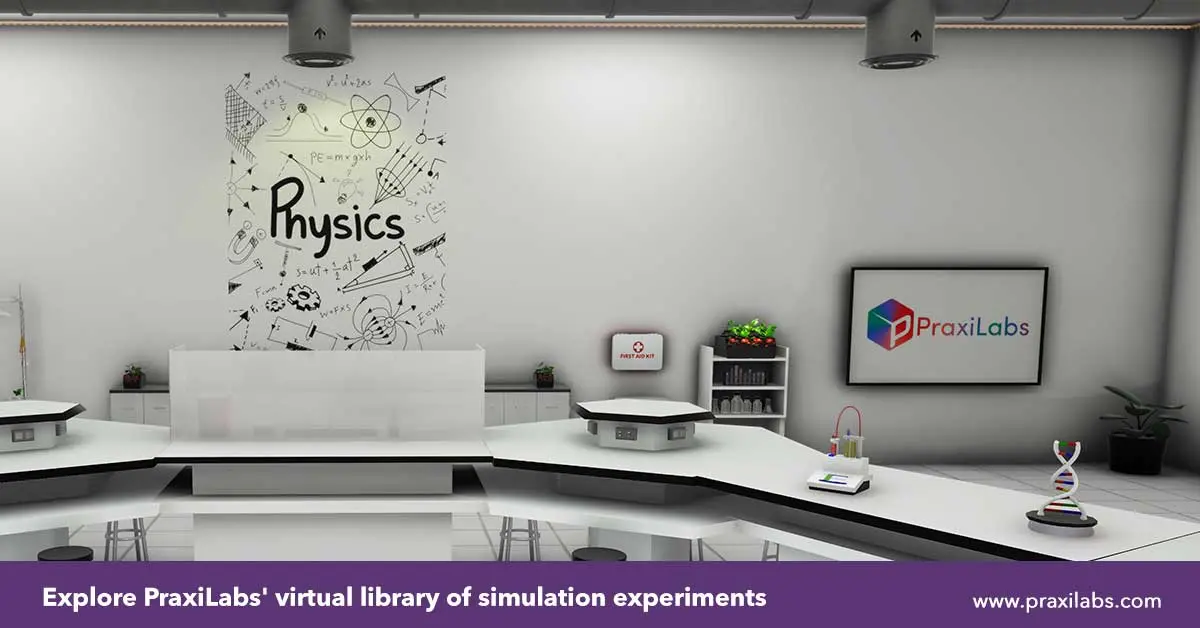
Explore PraxiLabs’ virtual library of simulation experiments:
PraxiLabs brings interactive virtual laboratory experiences into one accessible learning environment, helping students practice scientific experiments digitally and giving educational institutions a flexible resource for practical learning.
Our science experiment simulator online cover a broad range of scientific topics and allow learners to interact with simulated laboratory environments rather than simply watching demonstrations.
Students can use simulations to prepare for laboratory classes, reinforce concepts after lectures, and practice experimental procedures independently.
For colleges, PraxiLabs can provide an additional layer of practical learning that complements existing laboratory facilities and supports students beyond scheduled classroom hours.
For example, students can explore experiments such as:
Virtual physics experiments
- Speed of Sound: Explore the relationship between sound, frequency, wavelength, and propagation speed.
- Michelson Interferometer: Investigate light interference and explore the principles of the Michelson interferometer.
- Boyle’s Law: Examine the relationship between pressure and volume through an interactive experiment.
- Forced Oscillations: Study oscillatory motion and investigate how external forces affect an oscillating system.
- Specific Heat of Solids: Determine the specific heat capacity of solid materials through a simulated experiment.
Explore Advanced Virtual Physics Lab at PraxiLabs
Virtual experiments in chemistry
- HPLC Analysis: Learn how High-Performance Liquid Chromatography is used to separate and analyze chemical compounds.
- Acid-Base Titration: Practice titration procedures and explore acid-base reactions using virtual laboratory equipment.
- Sulphate Gravimetric Analysis: Learn how gravimetric analysis can be used to determine the amount of sulphate in a sample.
- NMR Analysis: Explore Nuclear Magnetic Resonance and its application in analyzing molecular structures.
Explore A World of Interactive 3D Virtual Chemistry Lab Simulations
Biology virtual experiments
- PCR: Simulate the Polymerase Chain Reaction and explore the steps involved in DNA amplification.
- DNA Microarray: Investigate gene expression and learn how DNA microarray technology can be used to analyze biological samples.
- 8-OHdG Assay: Explore an experimental method for assessing oxidative DNA damage.
- In Vitro Acid Phosphatase Assay for Cell Viability: Learn how acid phosphatase activity can be used as an indicator in cell viability studies.
Why choose PraxiLabs for simulation-based learning?
With PraxiLabs, colleges can give students opportunities to:
- Access interactive science experiments digitally.
- Practice experiments repeatedly.
- Learn through exploration and experimentation.
- Prepare for physical laboratory sessions.
- Reinforce concepts covered in lectures.
- Extend practical learning beyond campus.
- Support more flexible and student-centered learning.
Ready to take practical science learning beyond the physical laboratory? Explore PraxiLabs and give your students a smarter way to practice, experiment, and learn.
Join PraxiLabs’ global success and college partnerships:
The growing adoption of virtual laboratory technology demonstrates how educational institutions are looking for new ways to strengthen practical learning.
PraxiLabs has worked with educational institutions to integrate virtual laboratory experiences into science education, supporting colleges and universities that want to expand access to practical experimentation.
Its growing network of academic partnerships reflects the increasing role of simulation based learning in modern education.
- For colleges, partnering with a virtual laboratory provider can be an opportunity to complement existing facilities with digital resources that students can access beyond traditional laboratory schedules.
- For students, it means more opportunities to practice, experiment, make mistakes, and try again—all essential parts of learning science.
Give your students more opportunities to experiment and learn. Partner with PraxiLabs and bring interactive virtual labs to your college today.
FAQs
Who uses virtual labs?
Virtual labs are used by students, teachers, researchers, and educational institutions for safe and flexible practical learning.
What is the major benefit of a virtual lab?
The major benefit is providing hands-on experimental learning in a safe, accessible, and cost-effective digital environment.
Do virtual labs require special equipment?
No, virtual labs only require a compatible device, such as a computer or tablet, and an internet connection.