 PraxiLabs A virtual world of science

Last Updated on September 23, 2026 by Muhamed Elmesery
A forms of energy virtual lab lets students trigger an energy change, from a swinging pendulum losing height to gain speed, to a battery powering a bulb, and watch the transformation happen on screen. Textbook diagrams show these changes as static arrows on a page, but a simulation lets a learner actually cause the shift and see it unfold in real time. Traditional demonstrations often show one transformation at a time, leaving little room to compare several side by side. This piece covers what the lab includes, the concepts it targets, and how PraxiLabs brings energy transformations to life online.
Table of Contents
What is the forms of energy virtual lab?
A forms of energy virtual lab is a browser-based simulation where a student triggers an energy change, then watches it convert from one form to another step by step, without setting up a single physical apparatus or waiting for a shared station to free up.
- A digital setup where a student picks a starting energy type and a transformation to trigger on demand, no waiting required.
- Real-time visuals showing energy shift from potential to kinetic, or chemical to electrical, as it happens on screen.
- Adjustable variables like height, mass, or voltage that change the transformation’s outcome each time a trial runs.
- A types of energy virtual lab library covering mechanical, thermal, electrical, and chemical forms in one single account.
Key concepts covered in forms of energy virtual lab:
The module builds on ideas explained further in PraxiLabs’ own introduction to thermodynamics, covering how energy moves between objects and changes form along the way.
- Kinetic and potential energy, and how one converts into the other during motion, with any gap going to friction or heat.
- The law of conservation of energy, where total energy stays constant in a closed system at every stage.
- Thermal energy transfer through conduction, convection, and radiation, each with its own distinct mechanism and speed.
- Electrical energy conversion into light, heat, or mechanical motion inside a simple circuit diagram
- Chemical energy release during a reaction, such as inside a battery or a burning fuel source.
- An energy forms and changes simulation activity that ties every concept back to one worked example students can revisit.
- Sound energy as a form of mechanical vibration that travels through a medium like air or water molecules.
- Nuclear energy released during fission or fusion, briefly introduced alongside the more common everyday forms of energy.
Explore: Realistic Physics Simulation for Interactive Experiments
Benefits of exploring energy transformations through virtual experiments:
Exploring a forms of energy virtual lab instead of a single static diagram gives a student room to test a transformation more than once and compare results side by side.
- Repeats a transformation as many times as needed without setting up new equipment each time, at zero added cost to the department.
- Isolates one variable, like starting height or voltage, to see its exact effect on the final measured result.
- Removes the safety concerns tied to high-voltage or high-heat classroom demonstrations entirely, for every student in the room at once.
- Works on any device with a browser, so practice isn’t tied to a scheduled lab period at all during the term.
- A recent study published by Wiley developed computer simulation and animation modules for teaching work and energy in an engineering dynamics course, and found the intervention group outperformed the comparison group on a post-test.
Explore: Modern Physics Simulations for High School and University
Overcoming students struggle to understand forms of energy:
Struggling with a forms of energy virtual lab usually comes down to one issue: a student can recite the definition of potential or kinetic energy but can’t picture the transformation happening in real time.
- Confusing energy “loss” with energy actually disappearing, instead of converting to heat or sound along the way.
- Struggling to track energy through a multi-step transformation, like a roller coaster ride from top to bottom and back up again.
- Treating potential and kinetic energy as separate quantities rather than a constant, ongoing trade-off between the two forms.
- Misreading a graph that plots energy type against time or position during a full transformation sequence.
- A set of forms of energy science experiments built specifically to target this exact gap in student understanding directly.
- Peer-reviewed research published by Wiley tested computer simulation against traditional instruction for teaching Ohm’s law to 182 secondary students, and found the simulation group scored significantly higher on the post-test.
Explore: Why Educational Simulations are Essential in Modern Education?
Features of PraxiLabs’ forms of energy virtual lab:
PraxiLabs builds its forms of energy virtual lab around the same interactive engine used across its physics catalog, so the experience stays consistent from one topic to the next.
- Realistic transformation behavior tied to the exact values a student sets, not a pre-scripted result chosen ahead of time by the platform.
- Step-by-step guidance that adjusts based on what a student tries next in the simulation itself, without a fixed script.
- A types of energy experiments menu covering multiple starting scenarios within one guided, self-paced module.
- A closing summary that shows exactly how much energy converted at each stage of the transformation.
- A systematic review in Frontiers in Education found that virtual labs are increasingly built to accommodate different learning paces and styles, including students who need to repeat a concept several times before it clicks.
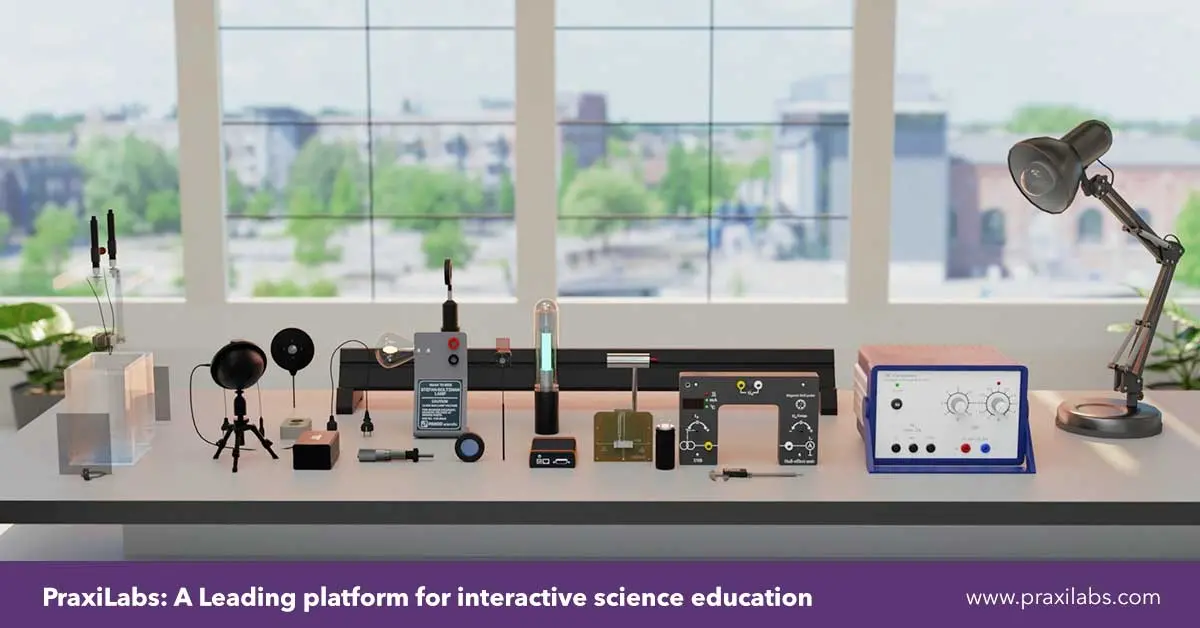
PraxiLabs: A Leading platform for interactive science education
Beyond its forms of energy virtual lab, PraxiLabs positions itself as a platform covering physics, chemistry, and biology in one account, used by millions of students worldwide.
- Used by 2.5 million-plus students across 160+ countries worldwide today.
- +210 science simulations spanning 20+ science branches, from mechanics to organic chemistry and beyond.
- 60% lower lab costs and 80% better retention versus traditional in-person methods overall.
- Bilingual access in Arabic and English with 24/7 support available every day of the week.
- LMS integration with Moodle, Canvas, or Blackboard completed within 24 hours of a request.
- 11 international EdTech awards recognizing the platform’s design and educational impact worldwide.
- A full slate of forms of energy experiments alongside dozens of other physics modules in the same account.
- Regular content updates based on curriculum feedback from partner schools and universities each term.
- A dedicated support team available to help onboard a new class within the first week of the semester.
FAQs
What are the forms of energy?
The main forms are kinetic, potential, thermal, electrical, chemical, and radiant energy. Each can convert into another form, while total energy in a closed system stays constant throughout the process.
Are virtual labs suitable for all educational levels?
Yes, virtual labs scale from basic concepts for younger students to advanced, multi-variable experiments for university-level coursework, adjusting complexity to match the course level and the learner’s pace.