 PraxiLabs A virtual world of science

Last Updated on September 27, 2026 by Muhamed Elmesery
What if students could practice complex experiments, make mistakes, repeat procedures, and build confidence—all without the limitations of a traditional laboratory?
That is the power of simulated practice learning. By recreating practical activities in a safe, interactive digital environment, simulation based learning gives students the opportunity to apply theoretical knowledge and develop practical skills before—or alongside—real-world laboratory practice.
For universities and science educators, virtual labs are making this approach more accessible than ever. Platforms such as PraxiLabs allow students to conduct interactive experiments, explore scientific concepts, and learn through hands-on digital experiences.
Table of Contents
What is simulated practice learning?
Simulated practice learning is an educational approach that uses simulations to recreate real-world tasks, experiments, processes, or environments. Instead of simply reading about a concept or watching an instructor demonstrate it, students actively interact with a simulated environment and practice applying what they have learned.
In science education, this can involve virtual experiments that reproduce laboratory procedures, equipment, measurements, and experimental outcomes. Students can follow procedures, manipulate variables, observe results, and repeat experiments to reinforce their understanding.
Rather than asking students to memorize the steps of an experiment, simulated practice learning allows them to actually practice those steps. This makes learning more active, experiential, and engaging.
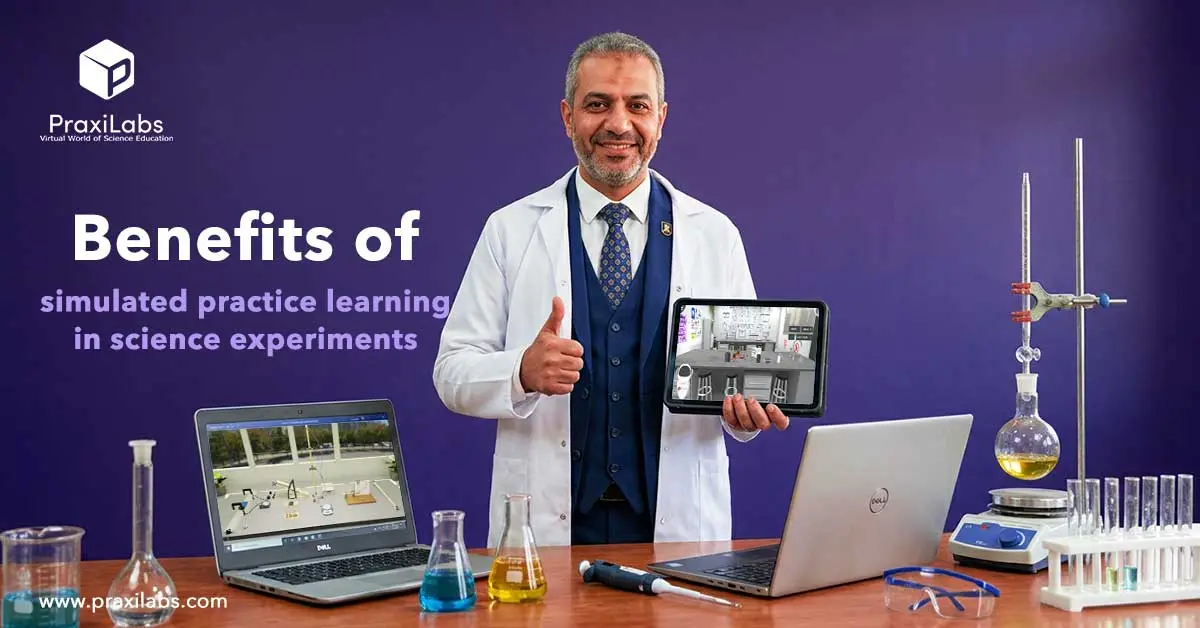
Benefits of simulated practice learning in science experiments:
Science education depends heavily on experimentation and practical application. However, traditional laboratories can sometimes be limited by equipment availability, class size, safety requirements, time constraints, and laboratory costs.
Simulated practice learning can complement traditional laboratory instruction by providing students with additional opportunities to practice.
-
Provides a safe environment for experimentation
Students can practice procedures and explore different outcomes without exposing themselves to the risks associated with certain laboratory activities.
This is particularly valuable when students encounter an experiment for the first time.
-
Allows students to repeat experiments
In a physical laboratory, repeating an experiment may require additional materials, preparation, and laboratory time. learning simulations allow students to repeat activities as many times as needed.
Repetition helps students reinforce procedures and understand why different outcomes occur.
-
Connects theory with practice
Students may understand a scientific principle from a textbook but struggle to visualize how it works experimentally.
Interactive simulations help turn abstract concepts into practical experiences by allowing students to see the relationship between variables, procedures, and results.
-
Encourages active learning
Instead of passively receiving information, students interact directly with the learning environment.
They make decisions, manipulate experimental variables, observe results, and learn from their actions.
-
Supports learning outside the laboratory
Virtual simulations can be accessed outside of scheduled laboratory sessions, giving students additional opportunities to practice and prepare for practical classes.
-
Helps instructors support different learning needs
Students do not always learn practical procedures at the same pace. Simulated practice learning gives learners the flexibility to review procedures and repeat activities according to their individual needs.
Explore: Advantages of Simulation Based Learning in Classrooms
How does simulated learning increase students’ confidence?
Confidence develops through practice, a student who encounters a laboratory procedure only once may remember the theory but still feel uncertain when asked to perform it independently. Simulation provides a space where students can practice before working in a real laboratory environment.
For example, students can become familiar with experimental procedures, equipment, measurements, and expected outcomes through a virtual experience. If they make an incorrect choice, they can learn from the result and try again.
This creates a practice-feedback-repeat cycle:
Practice → Make mistakes → Receive feedback → Adjust → Repeat → Build confidence
As students become more familiar with procedures, they may feel better prepared to participate in hands-on laboratory sessions.
Simulated learning can therefore function as a valuable preparation stage between learning scientific concepts and performing practical experiments.
Deliver better simulated practice learning with virtual labs:
Virtual labs take simulated practice learning beyond static videos and demonstrations.
A well-designed virtual lab creates an interactive environment where students can engage with experiments rather than simply observe them.
With learning simulation software for virtual labs, learners can:
- Explore scientific experiments interactively.
- Follow laboratory procedures step by step.
- Manipulate experimental variables.
- Observe simulated results.
- Practice procedures repeatedly.
- Connect theoretical concepts with practical applications.
- Learn at their own pace.
- Prepare for physical laboratory sessions.
For educators, virtual labs can also complement existing laboratory curricula. They can be incorporated into classroom activities, laboratory preparation, homework, revision, or blended learning models.
The goal is not necessarily to replace every physical laboratory experience. Instead, virtual labs can extend practical learning opportunities and help students arrive at physical laboratory sessions better prepared.
Explore: How Do Virtual Teaching Techniques Transform Science Education?
Shifting to simulated practice learning in universities:
Universities are increasingly exploring technology-enhanced approaches to practical education because students need more flexible and engaging ways to develop applied skills.
For science-related programs, simulated practice learning can support students before, during, and after laboratory sessions.
A university could use simulations to:
Before the lab:
Students familiarize themselves with the experiment, procedures, and equipment.
During the learning process:
Students reinforce concepts by interacting with simulated experiments alongside classroom instruction.
After the lab:
Students repeat experiments, review concepts, and practice procedures independently.
This creates a more continuous learning experience rather than limiting practical education to a fixed laboratory session.
For universities managing large student cohorts, simulation can also provide an additional layer of practical learning without requiring every student to access physical laboratory equipment at the same time.
The result is a more flexible model of practical education that combines physical experimentation, digital simulation, instructor guidance, and independent practice.
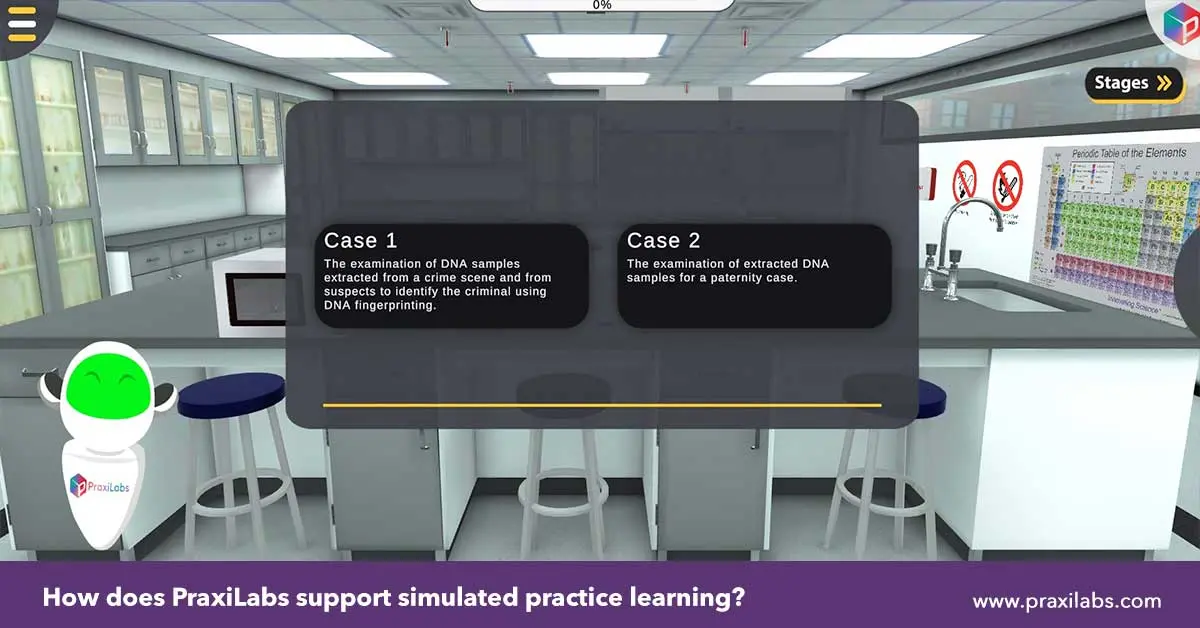
How does PraxiLabs support simulated practice learning?
PraxiLabs as a science practical simulator provides immersive simulations designed to help students explore scientific experiments and concepts in an interactive digital environment. Instead of simply reading experimental instructions, students can engage with virtual laboratory activities and learn through exploration and practice.
PraxiLabs covers a range of science disciplines, including chemistry, biology, and physics, making it suitable for different university and higher education contexts.
Educators can use PraxiLabs to help students:
- Practice experiments in an interactive environment.
- Reinforce concepts covered in lectures.
- Prepare for physical laboratory sessions.
- Repeat experiments for better understanding.
- Explore scientific concepts through hands-on digital activities.
- Extend practical learning beyond scheduled laboratory hours.
By combining simulation with curriculum-based learning, PraxiLabs helps institutions create more opportunities for students to practice, explore, and learn by doing.
Ready to make practical science learning more interactive?
Give your students more opportunities to experiment, practice, and build confidence—inside and outside the traditional laboratory.
Join the growing network of PraxiLabs partners:
The impact of simulated practice learning becomes even greater when educators and institutions work together to make practical education more accessible.
Join a growing global network of educational institutions that are using PraxiLabs to enhance science education through immersive virtual laboratory experiences. PraxiLabs’ partners span universities, schools, and educational organizations across Egypt, Saudi Arabia, the UAE, the USA, the UK, Italy, Romania, Nigeria, the Philippines, Singapore, Spain, Sri Lanka, Bulgaria, Canada, Mexico, Oman, and Kosovo.
The network includes renowned institutions such as
- Cairo University.
- Ain Shams University.
- Al-Azhar University.
- Alexandria University.
- King Saud University.
- King Faisal University.
- King Khalid University.
- Ulster University.
- Universitat Politècnica de València.
- the University of Science and Technology of Southern Philippines.
Alongside numerous schools and educational organizations. By partnering with PraxiLabs, educational institutions can become part of an expanding community committed to making practical science learning more accessible, interactive, and engaging. .
Ready to take the next step?
Join the growing network of PraxiLabs partners and bring engaging, interactive simulated practice learning to your students.
Partner with PraxiLabs today and transform the way your students experience science!
FAQs
What is the purpose of simulation in teaching?
Simulation helps students practice concepts and procedures in a safe, interactive environment, allowing them to learn through experimentation without the risks or costs of a physical lab.
Is simulation-based learning expensive?
Not necessarily. While developing or adopting simulation technology may require an initial investment, it can reduce recurring costs associated with equipment, materials, maintenance, and laboratory resources.
What are the limitations of simulation?
Simulations cannot fully replace hands-on experience. They may lack the physical interaction of real experiments and depend on reliable technology, devices, and internet access.