 PraxiLabs A virtual world of science

Last Updated on May 17, 2026 by Muhamed Elmesery
In today’s rapidly evolving education landscape, going virtual in school is no longer just an option—it’s a necessity for creating engaging science learning experiences.
By leveraging interactive tools and virtual simulation labs like PraxiLabs, schools can move beyond traditional teaching methods and offer students hands-on experimentation in a safe, flexible, and immersive environment.
Virtual learning empowers students to explore scientific concepts actively, repeat experiments without limitations, and develop a deeper understanding—making science not only easier to grasp, but far more exciting to learn.
Table of Contents
Why do schools need transitioning to virtual technology?
Schools need to transition to virtual technology to overcome the limitations of traditional learning methods such as:
- Limited space and scalability, students with disabilities or those in remote locations may face difficulties accessing physical labs and lectures, limiting inclusive learning opportunities.
- Low student engagement in conventional learning methods.
- Lack of flexibility for remote or self-paced learning.
- High construction and maintenance costs for physical laboratories, as they require expensive instruments, reagents, and devices.
- Hazardous materials and safety risks, as students deal with exposure to toxic substances, which may increase the risk of lab accidents.
By integrating virtual technology, students will be able to learn faster and more deeply, as virtual learning program promotes a self-paced learning culture and a more flexible learning lifestyle.
Explore: Integrating Virtual Environments in Education
How to go virtual in school for engaging learning?
Going “virtual” in school isn’t just about putting lessons online—it’s about redesigning learning so students actively participate, experiment, and collaborate. Done right, it can be far more engaging than traditional classrooms.
Here’s how to go virtual in school effectively:
-
Start with Interactive, Not Passive Content
Uploading PDFs or recorded lectures won’t engage students. Instead, focus on:
- Live polls and quizzes during lessons.
- Interactive presentations.
- Short, bite-sized videos instead of long lectures.
-
Use Virtual Labs for Hands-On Learning
One of the biggest challenges in virtual learning is replacing physical experiments. That’s where virtual simulations labs come in.
Platforms like PraxiLabs allow students to:
- Perform experiments safely.
- Repeat procedures without limits.
- Visualize complex scientific concepts.
-
Gamify the Learning Experience
Gamification increases motivation and participation:
- Add points, badges, and leaderboards.
- Turn lessons into challenges or missions.
-
Train Teachers for Digital Delivery
Technology alone isn’t enough. Teachers need to:
- Master online engagement techniques.
- Use storytelling and visuals.
- Ask more open-ended questions.
-
Personalize the Learning Journey
Not all students learn at the same pace. Use:
- Adaptive platforms that adjust difficulty.
- Recorded lessons for revision.
- Flexible deadlines when possible.
We can say that virtual learning and schools going virtual become engaging when it shifts from content delivery to experience design. The most successful schools treat it as an opportunity—not a limitation—to create interactive, personalized, and immersive education.
Explore: Virtual Labs as Lab Safety Interactive Solutions
Advantages of integrating AI technology in schools:
Far from being a threat to the teaching workforce, AI technology in schools will be a major advantage to educators and students.
Schools can benefit from the power of artificial intelligence by integrating it with existing digital lab environments that support STEM education. These artificially intelligent powered systems will be able to take over manual tasks like monitoring student progress and grading assignments, allowing teachers to spend more time interacting with students and focusing on their individual educational needs.
According to university of San Diego, the benefits of artificial intelligence in education include:
- Personalization: “It can be overwhelmingly difficult for one teacher to figure out how to meet the needs of every student in his/her classroom. … AI systems easily adapt to each student’s individual learning needs and can target instruction based on their strengths and weaknesses.”
- Tutoring: AI systems can “gauge a student’s learning style and pre-existing knowledge to deliver customized support and instruction.”
- Grading: Sure, AI can help grade exams using an answer key; but it can also “compile data about how students performed and even grade more abstract assessments such as essays.”
- Feedback on course quality: For example, if many students are answering a question incorrectly, “AI can zero in on the specific information or concepts that students are missing, so educators can deliver targeted improvements in materials and methods.”
- Meaningful and immediate feedback to students: Some students may be shy about taking risks or receiving critical feedback in the classroom, but “with AI, students can feel comfortable making the mistakes necessary for learning and receiving the feedback they need for improvement.”
Much of the potential envisioned for AI in education centers on reducing the time spent by teachers on tedious tasks to free up time for more meaningful ones.
Conducting scientific experiments remotely has become increasingly possible thanks to modern educational technologies such as simulation platforms, which allow virtual online school students to perform and analyze scientific experiments from anywhere while benefiting from valuable scientific insights.
Virtual high school lab simulations for science experiments offer several advantages that make them highly valuable in modern education:
- Safe experimentation: Students can conduct complex or hazardous scientific experiments without any risk.
- Cost efficiency: Relying on virtual simulations spares institutions the expense of expensive laboratory equipment, maintenance, and consumables.
- Accessibility: Students can access experiments anytime and from anywhere.
- Visualization of complex concepts: Simulations help students see microscopic or abstract processes that are difficult to observe in physical labs.
For example, platforms like PraxiLabs allow students to perform interactive experiments in physics, chemistry, and biology in virtual school lab with step-by-step guidance and immediate feedback.
Challenges of going virtual in schools:
- Limited access to technology: Not all students have reliable devices or internet connections.
- Digital literacy gaps: Teachers and students may need training to use platforms effectively.
- Assessment difficulties: Ensuring fair and accurate evaluation in a virtual setting is challenging.
- Reduced social interaction: Students miss out on face-to-face collaboration and communication.
- Technical issues: Connectivity problems and software glitches can disrupt learning.
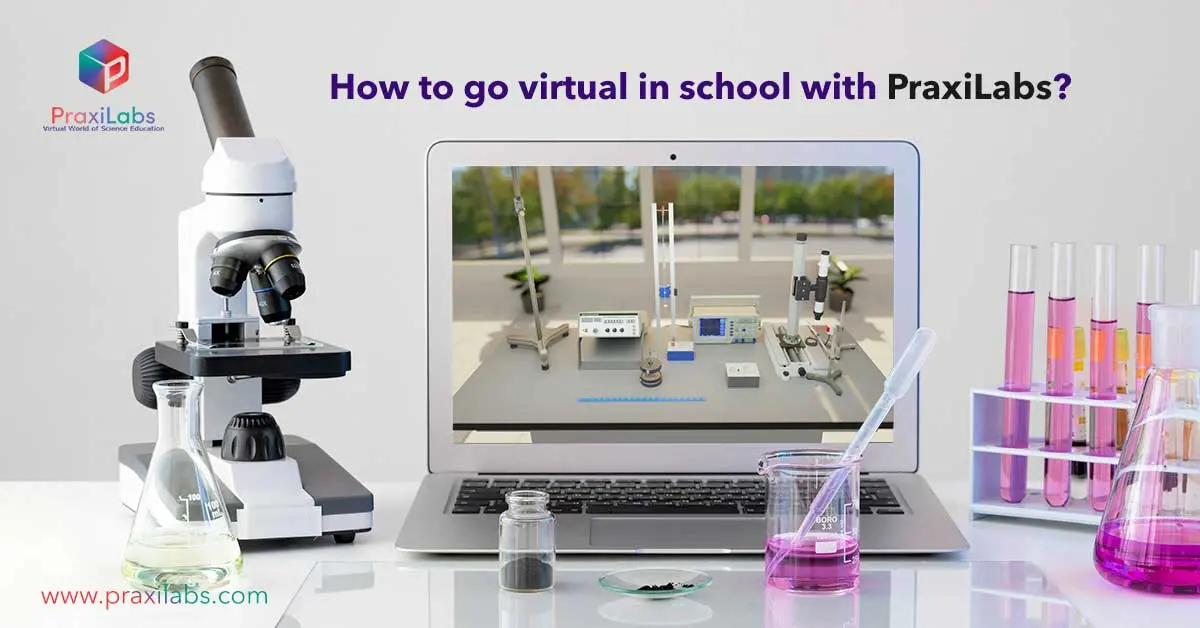
How to go virtual in school with PraxiLabs?
Going virtual in schools with PraxiLabs is about transforming science learning into an interactive, hands-on digital experience rather than simply moving content online.
Schools can seamlessly adopt it by integrating virtual learning labs into their curriculum, enabling students to perform experiments anytime, anywhere, while teachers guide and track progress in real time.
This approach enhances engagement, improves understanding of complex concepts, and ensures safe, cost-effective experimentation. Key steps to integration:
- Integrate virtual simulation labs directly into science lessons (Biology, Chemistry, Physics).
- Replace or support physical lab sessions with interactive simulations.
- Allow students to perform experiments anytime with unlimited practice.
- Enable teachers to monitor performance and provide instant feedback.
- Enhance safety by eliminating risks from chemicals and equipment.
- Reduce costs while maintaining high-quality practical learning.
- Support blended learning for a more flexible and engaging experience.
Experience science virtual learning with PraxiLabs:
PraxiLabs provides immersive 3D simulations and virtual science labs for schools that allow students to conduct scientific experiments as if they were in a physical laboratory. Instead of merely studying theoretical formulas, students can actively test ideas, analyze results, and better understand how physical laws work in practice.
One of the main advantages of PraxiLabs is interactive learning. Students can adjust experimental conditions—such as force, speed, voltage, or resistance—and observe how these changes immediately affect the results. This hands-on approach enhances conceptual understanding and encourages scientific inquiry.
PraxiLabs offer a wide range of scientific experiments covering the most important academic disciplines, allowing students to explore science in an interactive and safe way.
Notable fields include:
Chemistry:
Providing chemical scientific experiments in areas such as:
- Detection of basic radical (inorganic chemistry).
- Organic chemistry.
- Detection of acidic radicals (inorganic chemistry).
- General chemistry.
- Analytical chemistry.
- Electrochemistry.
Physics:
Provides physical scientific experiments in fields such as:
- Heat and thermodynamics experiments.
- Mechanics.
- Properties of matter.
- Electricity.
- Magnetism.
- Modern physics.
- Wave experiments.
Biology:
Provides biological scientific experiments in fields such as:
- Physiology.
- Cell culture.
- Biochemistry.
- Toxicology.
- Bioenergy.
- Molecular biology.
- Immunology.
- Microbiology.
Don’t miss the chance to develop the learning experience within your institution — try it now, and discover how virtual science labs can enhance students’ understanding and confidence.
Frequently Asked Questions
What is an example of virtual education?
An example of virtual education is an online science class where students use virtual lab platforms like PraxiLabs to conduct experiments, attend live sessions, and interact with simulations instead of being in a physical classroom.
Is virtual learning effective for students?
Yes, virtual learning can be highly effective when designed well. It offers flexibility, interactive tools, and personalized learning experiences, which can improve engagement and understanding—especially when supported by platforms that simulate real-world practice.