 PraxiLabs A virtual world of science


Last Updated on November 8, 2026 by Muhamed Elmesery
Remote research labs give scientists and students a way to run real experiments without needing to be physically present in a shared laboratory space. For universities juggling limited bench space, equipment costs, and growing enrollment, this shift isn’t just convenient, it’s often what makes expanded research and teaching programs possible at all, especially as enrollment grows faster than physical facilities can expand. This article looks at what these labs actually are, the benefits they bring to universities, and how PraxiLabs fits into that picture.
Table of Contents
What are virtual remote research labs?
Remote research labs are digital environments that let researchers and students carry out real experimental procedures without needing physical access to a shared facility.
- Simulated equipment, reactions, and instruments.
- Guided or open-ended experimental design.
A virtual research lab specifically relies on software simulations rather than remotely operated physical equipment, which is the model most universities use for teaching and early-stage research training.
Why the distinction matters
Choosing between a fully simulated setup and a remotely operated physical instrument affects both cost and the kind of research questions students and researchers can realistically explore.
Who typically uses each model
Simulated platforms tend to serve teaching labs and early training, while remotely operated physical instruments are more common in advanced research settings with dedicated technical staff.

How do remote research labs work without physical access?
Remote research labs work by replacing physical presence with structured digital interaction, whether that means controlling a real instrument from a browser or manipulating a fully simulated one.
- Log in through a browser or LMS-linked portal.
- Select an experiment and review the procedure.
- Manipulate variables and run the simulation..
- Record and export results automatically.
An online research lab typically walks users through each step, tracking variables and results the same way a lab notebook would, so there’s no ambiguity about what actually happened during a session.
A recent automation review found that funding and staffing limits already slow the adoption of automated, remotely accessible research equipment in many university labs, which is part of why lightweight simulation-based alternatives have become popular.
Lower stakes for getting started
Because a simulated setup doesn’t require specialized funding approval or dedicated technical staff, departments can pilot a remote-friendly experiment far faster than they could justify a full automation investment.
A clear audit trail
Digital logs also make it easier to review exactly what a student changed and when, which is useful both for grading and for troubleshooting a procedure that didn’t go as planned.
Main benefits of remote research labs for universities:
Universities adopting remote research labs report benefits well beyond simple convenience, touching budgets, safety, and the pace of research itself.
- Lower costs for materials, equipment, and space.
- Safer handling of hazardous procedures.
- Broader access for students and researchers off campus.
For many departments, an online research lab isn’t a replacement for physical facilities so much as an extension of them, covering gaps that a single shared lab space can’t.
Fewer scheduling bottlenecks
When a lab exists digitally, dozens of students or researchers can use it at once instead of waiting in shifts for a handful of physical benches to free up.
Continuity during disruptions
Because nothing depends on being on campus, coursework and research projects can continue through weather closures, travel restrictions, or building maintenance without losing a term’s worth of progress.
Easier budgeting from year to year
With fewer physical consumables to reorder and less equipment to replace after wear, department heads can plan lab budgets with fewer year-to-year surprises.
What can virtual labs provide to science researchers?
Beyond teaching, virtual labs increasingly support early-stage research work, particularly tasks that involve repetition, data collection, or testing before committing physical resources.
- Repeatable testing without consuming materials.
- Faster iteration on experimental design.
- Consistent data logging across attempts.
- Training for new lab members before hands-on work.
- Shared access across multiple research sites.
A virtual research lab lets a team model a procedure repeatedly before running it for real, catching design flaws early. This is exactly why more universities are adding remote research labs to existing research infrastructure, not treating them as a teaching-only tool.
A recent platform market analysis found that virtual laboratory platforms are increasingly used by both researchers and students, since they eliminate the need for physical lab setups for exploratory work.
A lower-risk way to test early ideas
Researchers can rule out weak approaches in simulation before committing grant funding or scarce reagents to a direction that might not pan out.
Useful for collaboration across sites
Because the same simulation runs identically wherever it’s opened, collaborators at different campuses can review the same procedure and results without shipping samples or equipment between locations.
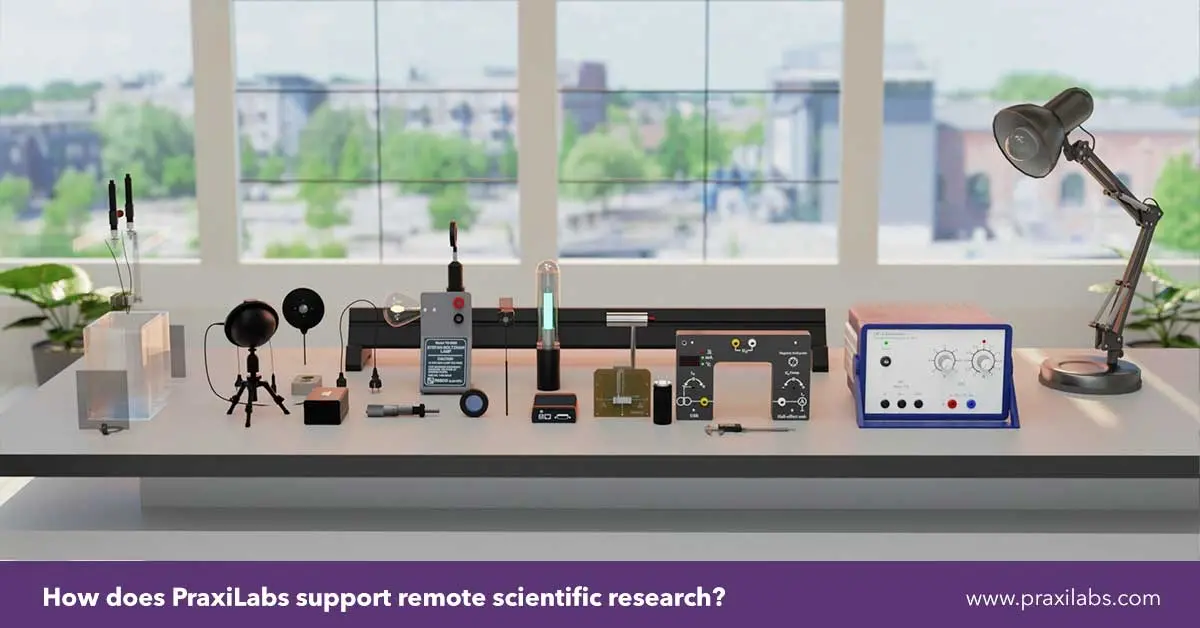
How does PraxiLabs support remote scientific research?
PraxiLabs supports remote research labs by giving universities a ready-built platform instead of custom software built from scratch.
- 210+ ready-to-use science simulations.
- Coverage across 20+ branches of biology, chemistry, and physics.
- AI-powered lab assistant “Oxi” for real-time guidance.
- Bilingual access in Arabic and English.
- Integration with LMS platforms like Moodle and Canvas.
- Round-the-clock technical support for institutions.
A virtual lab review published by Wiley found that flexibility and scalability are consistently reported advantages of virtual labs, provided the underlying simulations are well designed and properly integrated into coursework.
Designed around real course structures
Rather than existing as a standalone add-on, PraxiLabs is meant to slot into a semester’s existing sequence of experiments, so instructors don’t need to redesign a course around it.
Backed by measurable outcomes
Institutions using the platform have reported measurable gains, including a documented 60% reduction in lab-related costs and an 80% improvement in student retention of practical concepts.
PraxiLabs: Hands-on virtual labs for seamless science learning
Even though the platform runs entirely in a browser, PraxiLabs experiments are built to feel hands-on rather than passive, closer to lab work than to a slideshow.
- Step-by-step guided procedures with immediate feedback
- Realistic manipulation of instruments and materials
This hands-on design is central to how these platforms stay credible with faculty who judge rigor by what students actually do, not just what they read.
Built for consistency across sections
Every student sees the same equipment behavior and the same guided steps, which removes the variation that comes from different instructors running the same experiment by hand.
A track record across many institutions
PraxiLabs already supports more than 2.5 million active users across 160+ countries, giving adopting universities a platform that has been tested well beyond a single campus or region.
FAQs
How do remote labs work?
Remote labs work by giving users browser-based access to guided or simulated experiments, removing the need to be physically present in a shared facility.
What is the purpose of Virtual labs?
Virtual labs let students and researchers practice real experimental procedures safely and repeatedly, without the cost or risk of physical materials.