 PraxiLabs A virtual world of science


Last Updated on November 18, 2026 by Muhamed Elmesery
Balancing chemical equations is a fundamental chemistry skill that helps students understand how atoms are conserved during chemical reactions. However, mastering this concept can be challenging without enough practice and visual support.
A balancing chemical equations virtual lab can help students connect theoretical knowledge with practical learning through interactive activities and simulations.
In this guide, we’ll explore the benefits of virtual labs, the main types of chemical reactions students encounter, and how simulations can improve accuracy and simplify complex equations. We’ll also explain how PraxiLabs’ virtual chemistry experiments can complement equation-balancing lessons and create more engaging learning experiences.
Table of Contents
What Is a Balancing Chemical Equations Virtual Lab?
A balancing equations virtual lab is a digital learning environment that helps students understand how chemical equations represent reactions and why the number of atoms of each element must remain equal on both sides.
This principle follows the law of conservation of mass, which states that matter is conserved during a chemical reaction. Atoms rearrange to form new substances, but the total number of atoms of each element remains unchanged.
For example, the formation of water is represented by this balanced equation:
2 H2 + O2 → 2 H2O
The equation shows that two hydrogen molecules react with one oxygen molecule to produce two water molecules. Both sides contain four hydrogen atoms and two oxygen atoms.
A virtual balancing chemical equations lab may provide interactive tools for adjusting coefficients and checking atom counts. Broader virtual chemistry lab, meanwhile, help students explore chemical reactions and apply related concepts during experimental learning.
Benefits of a Balancing Chemical Equations Virtual Lab for Students:
Virtual chemistry activities can make abstract concepts easier to understand and help students develop essential scientific skills.
- Better conceptual understanding: Students connect chemical formulas with reactants, products, and the conservation of atoms.
- Active learning: Interactive activities encourage learners to investigate chemical concepts instead of relying entirely on memorization.
- Independent practice: Students can review concepts and repeat exercises at their own pace.
- Stronger problem-solving skills: Balancing equations requires logical thinking, systematic counting, and attention to detail.
- Connection between theory and practice: Virtual chemistry experiments help students relate chemical principles to experimental procedures.
When combined with dedicated equation-balancing exercises, virtual experiments can support a more comprehensive approach to chemistry education.
Key Types of Chemical Reactions in Virtual Labs:
Learning to balance chemical equations becomes more meaningful when students can also identify and classify the reactions they represent.
Although PraxiLabs does not provide a standalone balancing and classification simulation, students can practice these skills through classroom exercises and use relevant virtual chemistry experiments to reinforce their understanding.
-
Synthesis Reactions
A synthesis reaction occurs when two or more substances combine to form one product.
Example:
2 H2 + O2 → 2 H2O
Students can identify the reaction as a synthesis reaction, then verify that both sides contain four hydrogen atoms and two oxygen atoms.
-
Decomposition Reactions
A decomposition reaction occurs when one compound breaks down into two or more simpler substances.
Example:
2H2O2 → 2H2O + O2
Students can classify the reaction and count the atoms on both sides to confirm that the equation is balanced.
-
Single-Replacement Reactions
In a single-replacement reaction, one element replaces another element in a compound.
Example:
Zn + 2HCl → ZnCl2 + H2
This equation helps students practice balancing zinc, hydrogen, and chlorine atoms while identifying the reaction type.
-
Double-Replacement Reactions
Double-replacement reactions involve the exchange of ions between two compounds.
Example:
AgNO3 + NaCl → AgCl + NaNO3
Students can recognize the exchange of ions and verify that the equation is balanced.
-
Combustion Reactions
Complete combustion of a hydrocarbon in oxygen typically produces carbon dioxide and water.
Example:
CH4 + 2O2 → CO2 + 2H2O
This example helps students practice balancing equations containing carbon, hydrogen, and oxygen.
How Can Students Practice Balancing and Classifying Equations?
Students can follow a simple process:
- Identify the reactants and products.
- Determine the type of reaction when possible.
- Count the atoms of each element on both sides.
- Adjust coefficients without changing chemical formula subscripts.
- Recount the atoms to confirm that the equation is balanced.
This approach combines two important learning objectives: balancing chemical equations and recognizing common reaction types.
Explore: How Chemistry Reaction Simulator is Linking Theory to Learning?
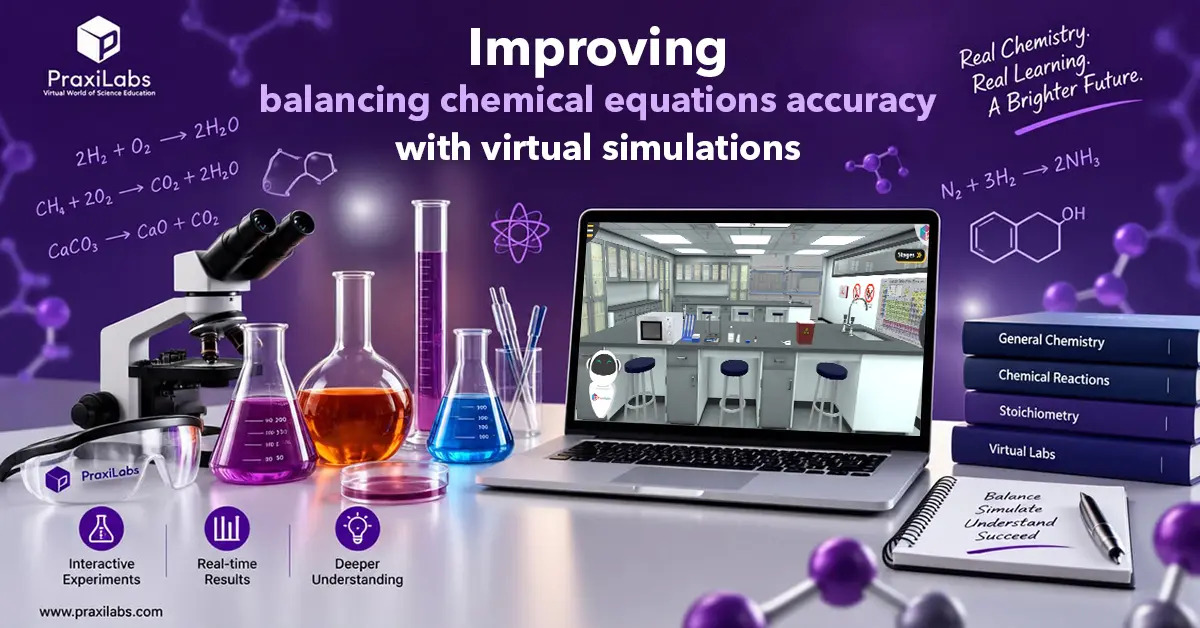
Improving Accuracy in Balancing Chemical Equations with Virtual Simulations:
Accuracy depends on understanding chemical formulas and applying the law of conservation of mass correctly.
A balancing chemical equations simulation designed specifically for this purpose may offer interactive coefficient adjustments, atom-count displays, or immediate feedback. Students using other virtual chemistry environments can complement their experimental learning with separate equation-balancing exercises.
To improve accuracy, students should identify each element, count its atoms on both sides, adjust the coefficients systematically, and verify the final equation. They should never change subscripts because doing so changes the identity of a chemical substance.
For example, the balanced equation for methane combustion is:
CH4 + 2O2 CO2 + 2H2O
Checking the equation reveals one carbon atom, four hydrogen atoms, and four oxygen atoms on each side.
A balancing chemical equations simulator can help learners practice these steps directly, while virtual chemistry experiments reinforce their understanding of the reactions and concepts behind the equations.
How Can Virtual Labs Simplify Complex Chemical Equations?
Virtual labs can help students approach complex chemistry topics by connecting abstract concepts with structured learning activities.
Visual learning: When visual models are available, they can help students understand how atoms rearrange during reactions.
Step-by-step practice: Teachers can introduce chemical formulas, atom counting, coefficients, and reaction classification progressively.
Experimental context: Virtual chemistry experiments help learners connect symbolic equations with the procedures used to investigate chemical reactions.
Flexible learning opportunities: Digital experiments can supplement classroom teaching when physical laboratory access is limited by equipment availability, scheduling, or other constraints.
Combining these activities with simulation balancing chemical equations exercises can help students build confidence before moving to more advanced chemistry topics.
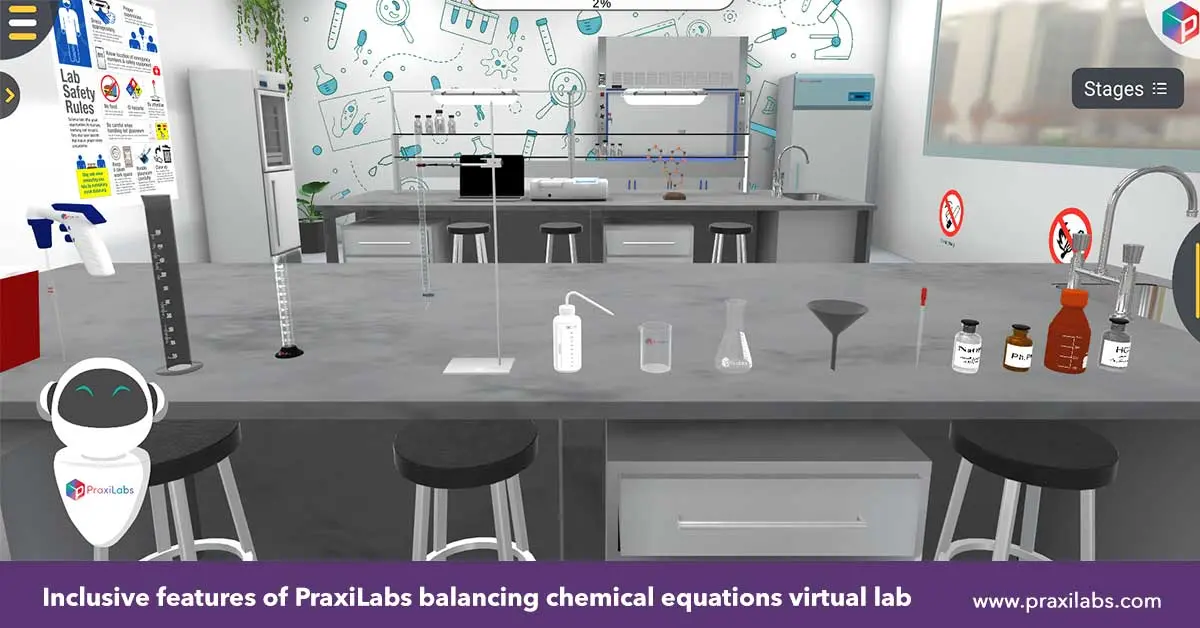
Inclusive Features of PraxiLabs Balancing Chemical Equations Virtual Lab:
PraxiLabs’ virtual chemistry experiments can complement lessons on chemical reactions by connecting theoretical principles with experimental learning (balancing chemical equations interactive simulations).
Interactive Chemistry Learning
Virtual experiments provide digital environments for exploring available chemistry activities and relating scientific concepts to practical procedures.
Opportunities to Explore Experiments
Students can study experimental steps and the outcomes represented by available simulations, reinforcing their understanding of chemical processes.
Flexible Access to Digital Experiments
Virtual laboratories can supplement in-person instruction by making selected experimental activities available in a digital environment.
Supporting Different Teaching Approaches
Educators can integrate virtual experiments into demonstrations, guided lessons, and independent study. For equation balancing, these activities can be combined with dedicated exercises that teach students to balance and classify reactions.
FAQs
Can I have a chemistry lab at-home?
Yes! By using a virtual chemistry lab you can perform your experiments easily from your home anywhere and anytime without any limitations. All you need is to sign up at a trusted platform that provides virtual chemistry labs such as PraxiLabs.
Why are virtual labs useful for chemistry study?
Because they provide safe, flexible, and immersive virtual environments that enable students to learn easily without any risks and in peace. These virtual environments are transforming traditional lab limitations into new opportunities, enhancing student engagement and improving learning outcomes.