 PraxiLabs A virtual world of science

Last Updated on October 26, 2026 by Muhamed Elmesery
Adapting science experiments for remote learning has become a practical necessity for universities balancing flexible schedules with rigorous hands-on instruction. When students can’t reach a physical lab, the challenge isn’t whether practical work matters, but how to preserve its value outside campus walls, without cutting corners on academic quality. This article looks at what gets lost when experiments move online, the benefits of building experiments specifically for remote settings, and how a platform like PraxiLabs helps departments adapt without compromising academic rigor.
Table of Contents
Why shouldn’t practical learning stop outside the university lab?
Practical work builds skills that lectures alone can’t teach, including hands-on troubleshooting, careful observation, and comfort with real experimental variables. Adapting science experiments for remote learning keeps these skills part of the curriculum even when students can’t be physically present.
- Confidence handling equipment and procedures independently.
- A direct connection between theory and observable results.
When practical work stops at the classroom door, students lose more than lab time. They lose the chance to build instincts that come only from direct engagement with remote science experiments, whatever form those experiments take.
A skill gap, not just a scheduling gap
Instructors often notice the difference in later coursework, when students who missed hands-on practice struggle more with interpreting data or explaining unexpected results in follow-up assignments.
Skills that outlast the course
Many of these habits carry into internships and later research work, where nobody is standing by to explain what went wrong the first time an experiment doesn’t behave as expected.
Limitations of remote learning for studying science experiments:
Adapting science experiments for remote learning isn’t automatic. Simply recording a demonstration or assigning a written procedure leaves gaps that in-person labs normally fill.
- No physical feedback from handling real equipment.
- Limited ability to troubleshoot unexpected results.
- Fewer opportunities for spontaneous instructor guidance.
- Inconsistent access to reliable internet or devices.
These gaps explain why early attempts at remote instruction often felt like a downgrade. A recent practical work review found that access and funding barriers already limit lab-based instruction well before remote learning enters the picture, making thoughtful redesign essential for any remote experiments a department plans to offer.
Redesign, not just relocation
Treating a physical experiment as something to simply film or narrate rarely works. The experiment usually needs to be rebuilt around what a screen and a mouse can actually simulate.
Where recorded demonstrations fall short
A recorded video can show a reaction happening, but it can’t respond when a student changes a variable, which is exactly the kind of interaction that builds real understanding.
Explore: How Remote Lab Environment is Breaking Science Experiment Barriers?
Benefits of adapting science experiments for remote learning:
Done well, adapting science experiments for remote learning can expand access without lowering academic standards.
- Access for students regardless of location or mobility.
- Unlimited repetition without extra material costs.
- Consistent experiment quality across every section taught.
These benefits explain why more departments are treating remote-friendly design as a core part of curriculum planning, not an afterthought added during emergencies. This kind of practical learning keeps students engaged even when circumstances change.
Planning ahead instead of reacting
Departments that design experiments for remote use from the start avoid the scramble that comes with adapting materials on short notice during disruptions or scheduling conflicts.
A more predictable budget
Because materials, glassware, and reagents aren’t purchased or replaced each term, departments gain a more predictable lab budget that isn’t tied to enrollment swings or breakage.
How do virtual labs improve remote science learning?
Virtual labs are one of the most direct ways institutions are adapting science experiments for remote learning, replacing static instructions with fully interactive simulations.
- Realistic manipulation of virtual equipment and materials.
- Immediate feedback after every action taken.
- Guided procedures that mirror real lab steps.
- Safe repetition of hazardous or delicate reactions.
- A consistent experience regardless of student location.
This interactivity is what separates virtual labs from passive alternatives like recorded demonstrations, giving remote experiments the same rigor students would get on campus.
Learning that adjusts to the student
Because a simulation doesn’t run out of materials, students who need more time or another attempt can simply try again, something a shared physical lab rarely allows.
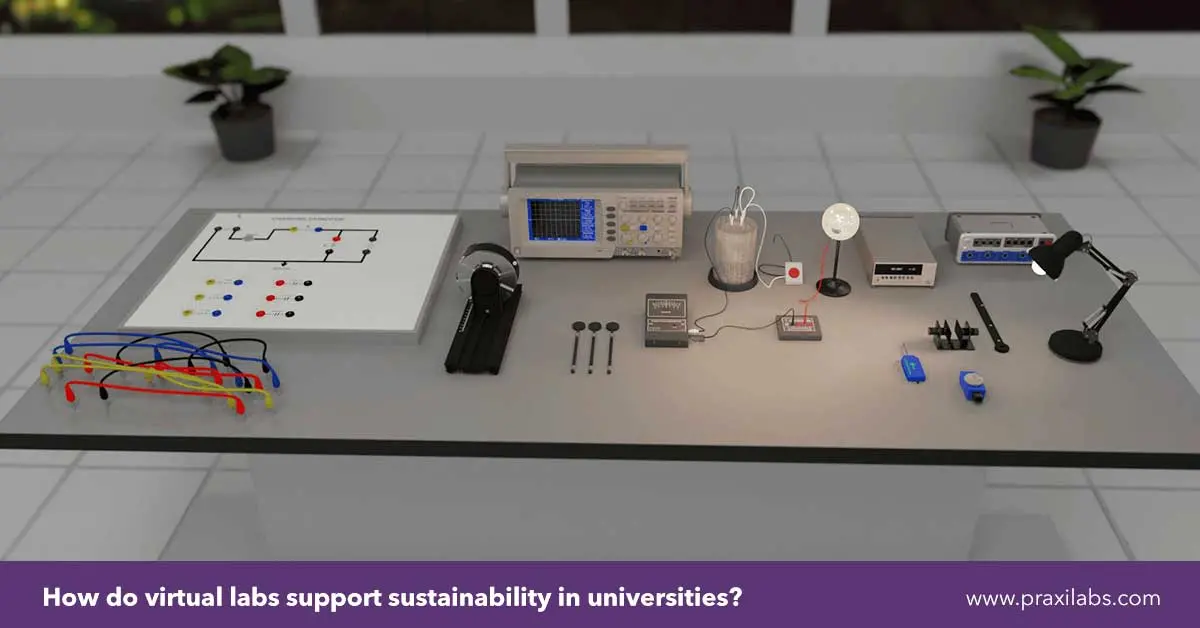
How do virtual labs support sustainability in universities?
Adapting science experiments for remote learning also has a sustainability angle that often gets overlooked in conversations about access and convenience.
- No chemical reagents purchased, used, or disposed of.
- No single-use lab consumables like gloves or pipette tips.
A recent lab sustainability overview found that research laboratories worldwide are increasingly looking for ways to conserve energy and resources. Virtual labs sidestep that resource use entirely, since every reaction happens in software rather than glassware.
Sustainability without sacrificing rigor
Departments don’t have to choose between environmental goals and academic quality. A well-built simulation can meet learning objectives while producing no physical waste at all.
Adapting science experiments for remote learning with PraxiLabs:
PraxiLabs was built specifically around adapting science experiments for remote learning, rather than retrofitting physical lab content after the fact.
- 210+ ready-to-use science simulations.
- Coverage across 20+ branches of biology, chemistry, and physics.
- AI-powered lab assistant “Oxi” for real-time guidance.
- Bilingual access in Arabic and English.
- Integration with LMS platforms like Moodle and Canvas.
- Round-the-clock technical support for institutions.
This breadth means departments aren’t limited to a handful of introductory experiments when they move practical coursework online.
Built to fit existing course structures
Because PraxiLabs integrates with the LMS platforms departments already use, instructors don’t need to rebuild their course structure around a separate, standalone tool.
How can educators assess student performance with PraxiLabs?
Assessing hands-on skills remotely is one of the biggest concerns instructors raise when moving labs online, and it’s a fair one.
- Custom quizzes linked directly to each experiment.
- Automated grading of quiz responses.
- Progress tracking across an entire class roster.
- Performance data available immediately after each session.
An academic achievement study on undergraduate chemistry students found that virtual lab use was linked to measurable gains in academic achievement compared to traditional instruction alone. Pairing that kind of outcome with built-in tracking tools gives instructors a clearer, ongoing view of progress instead of a single end-of-term grade.
FAQs
What subjects use virtual labs?
Virtual labs support remote science experiments across biology, chemistry, and physics, from cell biology to circuit design and titration.
Are virtual labs as effective as real labs?
Virtual labs can match real labs for building conceptual understanding and repeatable practice, though physical labs still offer unique tactile equipment experience.