 PraxiLabs A virtual world of science

Last Updated on October 21, 2026 by Muhamed Elmesery
Teaching physics involves more than explaining equations and theories. Students need opportunities to visualize abstract concepts, conduct experiments, interpret results, and connect theoretical principles to real-world applications.
As artificial intelligence (AI) continues to transform education, physics educators can now use AI tools to make these learning experiences more interactive, personalized, and accessible. From AI-powered learning assistants to virtual laboratories, these technologies can complement traditional teaching methods while helping students build stronger conceptual and practical skills.
In this article, we will explain more about the role of AI tools for teaching physics in higher education.
Table of Contents
What are AI tools for teaching physics?
AI tools for teaching physics are digital technologies that use artificial intelligence to support instruction, learning, experimentation, assessment, or student engagement. They can help educators explain complex concepts, generate learning materials, answer student questions, analyze learning performance, and provide guided support during practical activities.
For physics education, AI becomes particularly valuable when combined with simulations. Instead of relying exclusively on physical equipment, students can interact with simulated experiments, change variables, observe outcomes, and repeat procedures in a controlled digital environment.
AI lab assistants take this approach further by providing students with contextual guidance while they work through laboratory activities.
Benefits of interactive AI tools for teaching physics:
Interactive AI tools can enhance physics education in several ways:
- Make abstract concepts easier to visualize: Simulations and interactive models can help students understand concepts such as forces, motion, electricity, magnetism, and thermodynamics.
- Provide immediate support: AI assistants can guide students when they encounter difficulties instead of requiring them to wait for instructor assistance.
- Encourage active learning: Students can experiment with variables, test hypotheses, and learn from different outcomes.
- Support personalized learning: AI can provide explanations or guidance based on a student’s questions and learning needs.
- Increase access to experimentation: Virtual environments allow students to practice experiments without being limited by laboratory schedules, equipment availability, or physical resources.
- Save instructors’ time: AI-powered tools can handle routine questions and provide structured guidance, allowing educators to focus on higher-value teaching and mentoring.
Explore: Realistic Physics Simulation for Interactive Experiments
Which AI tools can physics educators use?
Physics educators can incorporate different types of AI-powered tools depending on their teaching objectives. These include:
- AI tutoring and conversational assistants.
- AI-powered content-generation tools.
- Adaptive learning platforms.
- Automated assessment systems.
- AI-supported virtual laboratories.
However, not every AI tool is designed specifically for experimental physics education. General-purpose AI can explain a physics equation, for example, but it cannot replace the experience of conducting an experiment.
This is where the combination of AI + virtual laboratory simulation becomes especially useful. Students can learn the underlying concept, perform a simulated experiment, observe results, and receive AI-supported guidance within the same learning environment.
How can AI technologies facilitate learning physics concepts?
Physics students often struggle when they cannot connect mathematical equations with physical phenomena. AI technologies can help bridge this gap by making learning more interactive.
For example, when studying a physics experiment, students can receive explanations of the underlying principles, guidance on experimental procedures, and support in interpreting their observations. Interactive simulations also allow students to manipulate experimental variables and see how changes affect the results.
This creates a more exploratory learning experience. Rather than simply memorizing formulas, students can investigate why a particular result occurs and connect theoretical knowledge with practical experimentation.
AI can also support students outside of scheduled laboratory sessions, giving them additional opportunities to review concepts and practice their understanding.
Creating smarter university physics labs using AI:
University physics laboratories face several challenges, including limited equipment, large numbers of students, scheduling constraints, and the need to provide sufficient opportunities for practical practice.
AI-powered virtual labs can complement physical laboratories by giving students a safe and accessible environment for experimentation.
With virtual simulations, students can repeat experiments, modify parameters, make observations, and explore different scenarios without consuming physical materials or risking damage to laboratory equipment.
Adding an AI lab assistant makes the experience more responsive. Instead of simply following predetermined instructions, students can interact with an intelligent assistant for contextual guidance throughout their learning journey.
Explore: Why online physics simulator important for universities?
How can an AI lab assistant support university physics labs?
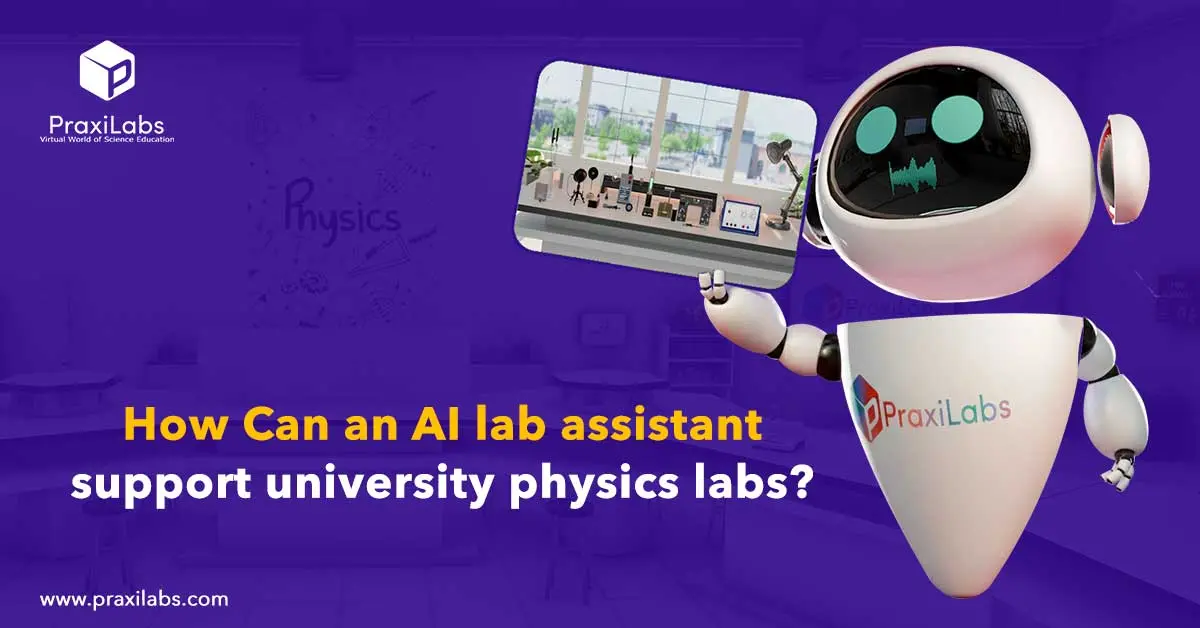
Oxi, PraxiLabs’ AI Lab Assistant, is designed to bring AI-powered support into the virtual laboratory experience.
Rather than replacing the instructor, Oxi acts as an additional layer of support for students as they explore simulated experiments. It can help learners navigate their laboratory activities, understand experimental concepts, and get guidance when they have questions during the learning process.
For physics education, this can be particularly valuable when students are working with concepts that require both theoretical understanding and practical interpretation.
For example, while completing a virtual physics experiment, a student may need clarification about an experimental step, the meaning of an observation, or the scientific concept behind the procedure. An AI lab assistant can provide contextual support at the point where the student needs it.
This creates a more guided, interactive, and student-centered laboratory experience while allowing instructors to devote more attention to deeper discussion, analysis, and assessment.
Explore: How AI Virtual Lab Assistant Improves Science Education?
How does PraxiLabs use AI to support physics teaching?
PraxiLabs combines 3D virtual laboratory simulations with AI-powered assistance to create a more engaging approach to practical science education.
Its virtual labs allow students to conduct simulated experiments in an interactive environment, while OXI adds an AI-powered layer that can support students during their laboratory activities.
For physics educators, this means students can gain practical exposure to experiments while having access to digital guidance beyond the traditional instructor-led laboratory session.
The approach can complement classroom teaching by giving students additional opportunities to:
- Explore physics experiments virtually.
- Practice procedures before entering a physical laboratory.
- Repeat experiments and investigate different outcomes.
- Connect theoretical concepts with practical applications.
- Receive AI-supported guidance during laboratory activities.
By combining simulation and AI, PraxiLabs helps institutions move beyond simply digitizing laboratory content toward creating more interactive learning experiences.

Join over 2.5M users worldwide who trust PraxiLabs:
AI is reshaping how educators approach teaching and learning, and physics laboratories are no exception. The combination of AI-powered assistance and virtual experimentation can give students more opportunities to explore concepts, practice procedures, and learn through experimentation.
With PraxiLabs and its AI Lab Assistant Oxi, universities can provide students with a smarter digital environment for learning physics while complementing traditional classroom and laboratory instruction.
Join over 2.5 million users worldwide who trust PraxiLabs and discover how AI-powered virtual labs can enhance your physics teaching experience.
FAQs
What is the best way to learn physics?
The best approach combines learning core concepts with problem-solving, experiments, simulations, and regular practice. Interactive virtual labs can also help students visualize physics principles and explore how changing variables affects results.
Which online platform is best for physics?
The right platform depends on the learner’s goals. For practical, experiment-based physics learning, PraxiLabs provides interactive virtual lab simulations that allow students to perform experiments, manipulate variables, and observe results in a digital environment.