 PraxiLabs A virtual world of science

Last Updated on October 28, 2026 by Muhamed Elmesery
Science experiments are essential for turning theoretical concepts into practical understanding. However, providing students with regular access to well-equipped laboratories can be expensive for universities and educational institutions.
From laboratory equipment and chemicals to maintenance, safety measures, and consumable materials, the cost of hands-on experimentation can quickly add up. This makes finding inexpensive science experiments and cost-effective laboratory solutions an important priority for institutions looking to expand practical learning without continuously increasing their budgets.
Virtual laboratories offer one promising approach. By allowing students to conduct simulated experiments in a digital environment, institutions can provide repeatable practical experiences while reducing their dependence on physical resources.
Table of Contents
Why can some science experiments be expensive?
Traditional science experiments often require significant investments before students even begin conducting experiments. Universities need to purchase and maintain laboratory equipment, provide sufficient quantities of chemicals and consumables, and ensure that laboratory spaces meet safety requirements.
The costs can become even higher when experiments involve specialized instruments or materials that require regular replacement, calibration, or controlled storage.
Common factors that increase the cost of science experiments include:
- Laboratory equipment: Advanced instruments can require substantial upfront investment.
- Consumable materials: Chemicals, biological samples, glassware, and other supplies may need continuous replenishment.
- Equipment maintenance: Laboratory instruments require maintenance, calibration, and occasional replacement.
- Safety requirements: Institutions need appropriate protective equipment and safety infrastructure.
- Limited equipment availability: Universities may need multiple sets of equipment to accommodate large student groups.
- Experiment repetition: Students need opportunities to repeat experiments, which can increase material consumption.
- Laboratory space: Maintaining specialized laboratory facilities involves ongoing operational costs.
As a result, institutions need to balance two priorities: giving students meaningful practical experiences while managing the cost of laboratory education.
Benefits of applying inexpensive science experiments in universities:
Making science experiments more affordable can help universities expand practical learning opportunities rather than limiting experimentation to a small number of laboratory sessions.
Cost-effective or inexpensive science experiments can provide several benefits:
Increase access to practical learning
Lower-cost experiments make it easier to give more students opportunities to practice scientific concepts rather than relying primarily on lectures and theoretical explanations.
Enable repeated practice
When experiments consume fewer physical resources, students can have more opportunities to repeat procedures, test different variables, and learn from mistakes.
Support larger student cohorts
Affordable practical-learning solutions can help institutions accommodate larger numbers of students without having to purchase an equivalent amount of physical equipment for every learner.
Reduce pressure on laboratory resources
When some experiments can be performed virtually, physical laboratories can be reserved for activities that specifically require hands-on equipment and materials.
Encourage experimentation beyond scheduled lab sessions
Digital experiments can give students additional opportunities to practice outside traditional laboratory hours, supporting more flexible learning.
Ultimately, the goal is not simply to make experiments cheaper. It is to make practical science education more accessible, scalable, and sustainable.

Why do institutions need cost-effective teaching solutions?
Universities today face growing pressure to deliver high-quality education while managing limited resources. Increasing student enrollment, rising laboratory costs, and the need to modernize teaching methods can make traditional approaches difficult to scale.
Cost-effective teaching solutions can help institutions address these challenges by optimizing how existing resources are used.
Instead of replacing physical laboratories entirely, universities can adopt a blended approach that combines traditional laboratory instruction with digital learning technologies.
This approach allows institutions to:
- Optimize the use of expensive laboratory equipment.
- Reduce unnecessary consumption of chemicals and other materials.
- Give students additional opportunities to practice.
- Support remote and hybrid learning.
- Improve access to practical science education.
- Scale practical learning to larger student populations.
- Introduce students to digital scientific tools used in modern education and research.
The result is a more flexible model in which technology complements—not necessarily replaces—the physical laboratory.
Explore: Integrating Ed-Tech in Higher Education
How do virtual labs limit science experiment expenses?
Virtual labs simulate laboratory environments digitally, allowing students to perform experiments without consuming physical laboratory materials during every learning session.
Instead of requiring a new set of materials for every student or experiment, a virtual laboratory can provide repeated access to the same digital experiment.
This can reduce several recurring expenses associated with traditional experimentation.
For example, virtual labs can help reduce the need for:
- Repeated purchases of consumable materials.
- Multiple sets of expensive laboratory equipment.
- Physical laboratory space for every practice session.
- Equipment replacement caused by frequent student use.
- Additional materials required when students repeat an experiment.
- Costs associated with experiments that are difficult, hazardous, or resource-intensive to perform physically.
More importantly, virtual labs can make experimentation scalable. A single digital experiment can be accessed by many students without requiring the institution to purchase a separate physical setup for every learner.
How does virtual tech reduce costs without affecting the learning experience?
Cost reduction only matters if it does not come at the expense of educational quality.
Modern virtual laboratory technology can reproduce key stages of an experiment in an interactive digital environment. Students can follow procedures, manipulate variables, observe outcomes, and develop an understanding of experimental processes.
Rather than simply watching a demonstration, students can actively interact with simulated laboratory environments.
Virtual technology can support learning by providing:
- Interactive experimentation: Students actively perform procedures rather than passively viewing content.
- Repeatable practice: Experiments can be repeated without consuming additional physical materials.
- Immediate accessibility: Students can access experiments from compatible devices without always being physically present in a laboratory.
- Safe experimentation: Students can explore procedures that may involve hazardous materials or equipment within a controlled virtual environment.
- Self-paced learning: Students can revisit procedures and concepts according to their individual learning needs.
- Consistent experiences: Digital simulations can provide students with standardized experimental procedures and environments.
This makes virtual labs particularly valuable as a complement to hands-on laboratory education. Students can build familiarity with procedures and concepts virtually before applying their knowledge in a physical laboratory.
Explore: The Effect of Virtual Laboratory on Student Performance
Why is PraxiLabs an Ideal Alternative for Inexpensive Science Experiments?
PraxiLabs provides interactive virtual simulations designed to help educational institutions deliver practical science learning digitally.
Instead of requiring students to depend exclusively on physical laboratory resources, PraxiLabs gives institutions access to a growing library of simulated experiments across major scientific disciplines.
The platform can support practical learning in chemistry, physics, and biology, allowing students to explore experiments in an interactive 3D environment.
With PraxiLabs, institutions can:
- Provide students with repeatable virtual experiments.
- Reduce dependence on consumable laboratory materials for practice.
- Give larger groups of students access to practical simulations.
- Support learning beyond scheduled laboratory sessions.
- Allow students to practice procedures before entering physical labs.
- Complement existing laboratory facilities with digital resources.
- Support remote, blended, and technology-enhanced learning.
For universities looking for low cost science experiments, the value of virtual labs goes beyond reducing individual experiment costs. They provide a scalable way to expand practical learning while making better use of existing physical laboratory resources.
Explore PraxiLabs’ Virtual Science Experiments:
PraxiLabs offers simulations covering a wide range of scientific concepts and laboratory procedures.
- Physics experiments can help students explore concepts such as mechanics, electricity, thermodynamics, optics, and magnetism.
- Chemistry experiments can provide opportunities to practice analytical, inorganic, organic, and physical chemistry procedures in a controlled digital environment.
- Biology experiments can introduce students to laboratory techniques and biological processes through interactive simulations.
By combining these digital experiences with traditional laboratory teaching, universities can create a more flexible practical-learning ecosystem.
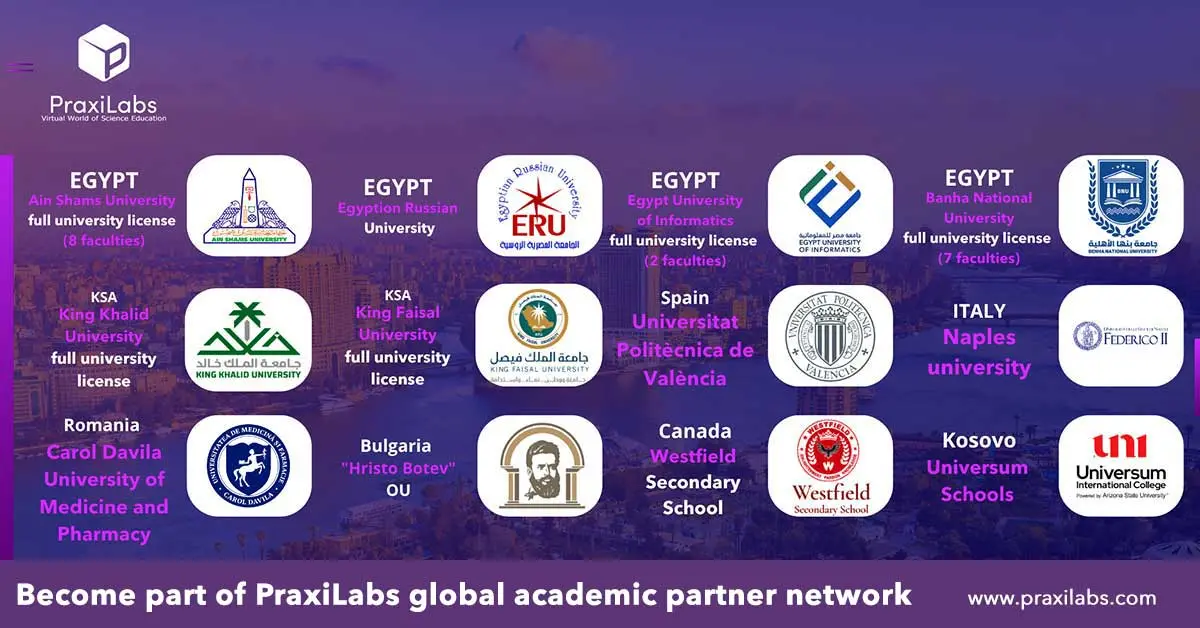
Become part of PraxiLabs global academic partner network:
PraxiLabs supports educational institutions around the world with interactive virtual science laboratory solutions. Its client portfolio includes universities, schools, and educational organizations across multiple countries and regions.
Some of PraxiLabs’ featured clients and partners include:
Middle East
- United Arab Emirates Ministry of Education – all public schools.
- Education Pathways, UAE.
- King Saud University, Saudi Arabia.
- King Faisal University, Saudi Arabia.
- King Khalid University, Saudi Arabia.
- AlRayan Schools, Oman.
Egypt
- Ain Shams University.
- Banha National University.
- Al Azhar University.
- Alexandria University.
- Cairo University.
- Galala University.
North America and Europe
- D’Youville University, USA.
- LaMoille High School, USA.
- Ulster University, UK.
- EGraduate College, UK.
- Naples University, Italy.
- Carol Davila University of Medicine and Pharmacy, Romania.
- Universitat Politècnica de València, Spain.
- Westfield Secondary School, Canada.
- Universidad Autónoma de San Luis de Potosí, Mexico.
Asia and Africa
- Covenant University, Nigeria.
- AMA University, Philippines.
- De La Salle Andres Soriano Memorial College, Philippines.
- University of Science and Technology of Southern Philippines.
- BroadTech Pte Ltd, Singapore.
- Kotelawala Defence University, Sri Lanka.
These partnerships demonstrate how virtual laboratories can support science education across different educational settings, from universities and medical institutions to schools and public education systems.
Pick the Best Virtual Plan or You
FAQs
Can students perform experiments remotely?
Yes. Students can perform virtual experiments remotely using digital lab simulations, allowing them to explore procedures, manipulate variables, and observe results from home.
Are virtual science labs affordable?
Virtual science labs can be a cost-effective alternative or complement to physical labs by reducing the need for expensive equipment, materials, and laboratory facilities.