 PraxiLabs A virtual world of science

Last Updated on October 11, 2026 by Muhamed Elmesery
As universities continue to embrace digital transformation, simulation-based learning is becoming a powerful way to enhance practical education. From making complex concepts easier to understand to giving students more opportunities to practice, simulation and learning solutions can complement traditional teaching and improve the overall learning experience.
In this article, we explore the key benefits of simulation and learning solutions in universities and how virtual labs such as PraxiLabs can help institutions deliver more interactive, flexible, and effective practical education.
Table of Contents
What Is Simulation-Based Learning?
Simulation-based learning is an educational approach that uses digital simulations to recreate real-world processes, environments, and practical experiences in a controlled learning setting. Instead of relying exclusively on lectures or physical equipment, students can interact with simulated scenarios, test different variables, practice procedures, and observe outcomes.
In higher education, simulation-based learning is particularly valuable for subjects that require hands-on practice. Students in science, engineering, medicine, and other STEM disciplines can use simulations to connect theoretical concepts with practical applications while learning in a safe and flexible environment.
Unlike passive learning methods, simulations encourage students to experiment, make decisions, learn from mistakes, and repeat activities until they understand the underlying concept. This makes learning more interactive and gives students greater opportunities to develop practical skills before applying them in real-world environments.
Key Benefits of Simulation and Learning Solutions:
Universities are increasingly adopting simulation and digital learning solutions to complement traditional teaching methods. Some of the most important benefits of simulation-based learning include:
-
Make complex concepts easier to understand
Simulations can transform abstract theories into interactive experiences. Instead of simply reading about a scientific principle, students can manipulate variables and immediately see how changes affect the results.
-
Provide safe practical learning
Students can perform experiments and practice procedures without the risks associated with certain chemicals, equipment, or laboratory conditions. This allows them to focus on understanding the process while minimizing safety concerns.
-
Enable unlimited practice
Unlike physical laboratories, digital simulations can often be accessed repeatedly. Students can repeat an experiment, try different approaches, and learn from unsuccessful attempts without consuming additional laboratory materials.
-
Improve student engagement
Interactive learning encourages students to actively participate rather than simply receive information. The ability to explore, experiment, and receive immediate feedback can make learning more engaging.
-
Support different learning needs
Simulation-based learning can complement lectures, demonstrations, laboratory sessions, and independent study. Students can use simulations before class to prepare, during class to reinforce concepts, or afterward to review difficult topics.
-
Optimize educational resources
Digital simulations can help universities supplement their existing laboratories and educational resources. They can provide students with additional opportunities for practice without requiring every learning activity to take place in a physical lab.
Explore: 5 Reasons Why Virtual Learning Solutions Became Essential
How Do Simulation Learning Solutions Improve Teaching Efficiency?
Simulation-based learning does not replace instructors—it gives them additional tools to make practical education more efficient.
Traditional laboratory teaching can involve significant preparation, equipment setup, material consumption, safety procedures, and time spent troubleshooting technical issues. Digital simulations can simplify many of these challenges by providing students with ready-to-use virtual environments.
For instructors, this means they can spend more time explaining scientific concepts, analyzing results, answering questions, and guiding students through the learning process rather than focusing exclusively on laboratory logistics.
Simulation solutions can also help instructors demonstrate processes that may be difficult to perform repeatedly in a physical classroom. A virtual experiment can be paused, repeated, or adjusted to demonstrate how different variables influence the outcome.
Most importantly, simulations create opportunities for learning beyond scheduled laboratory hours. Students can continue practicing independently, giving instructors a way to extend practical learning beyond the limited time available on campus.
How Do Simulated Experiments Increase Students’ Confidence?
Confidence develops through practice—and simulation-based learning gives students more opportunities to practice before facing real-world situations.
A student performing an experiment for the first time in a physical laboratory may be concerned about making mistakes, damaging equipment, using the wrong procedure, or obtaining unexpected results. These concerns can sometimes prevent students from experimenting freely.
A virtual environment provides a lower-pressure setting where students can explore and learn from mistakes.
For example, students can repeat a simulated experiment several times, change experimental parameters, compare results, and identify what went wrong. With each attempt, they become more familiar with the procedure and develop a stronger understanding of the concepts behind it.
This repeated practice can help students enter physical laboratory sessions with greater confidence because they have already encountered the procedure virtually.
Explore: Why Educational Simulations are Essential in Modern Education?
Support Digital Transformation in Higher Education with Virtual Labs
Digital transformation in universities goes beyond moving lectures and assignments online. It also involves creating more flexible, accessible, and technology-enabled practical learning experiences.
Virtual laboratories are an important part of this transformation.
A virtual lab recreates laboratory activities within an interactive digital environment, allowing students to perform simulated experiments using a computer or other compatible device. This can help universities expand practical learning opportunities while complementing their existing physical laboratories.
Virtual labs can support universities by:
- Providing students with additional opportunities to practice outside laboratory hours.
- Making practical activities more accessible for students learning remotely or through blended programs.
- Allowing students to repeat experiments without consuming physical materials.
- Supporting preparation before physical laboratory sessions.
- Creating interactive digital resources that complement lectures and textbooks.
- Helping institutions integrate technology into STEM education.
This makes virtual laboratories particularly relevant as universities continue developing blended, hybrid, and digitally supported learning environments.
Explore: A Virtual Learning Environment for Modern Education
Maximize the Benefits of Simulation and Learning Solutions with PraxiLabs:
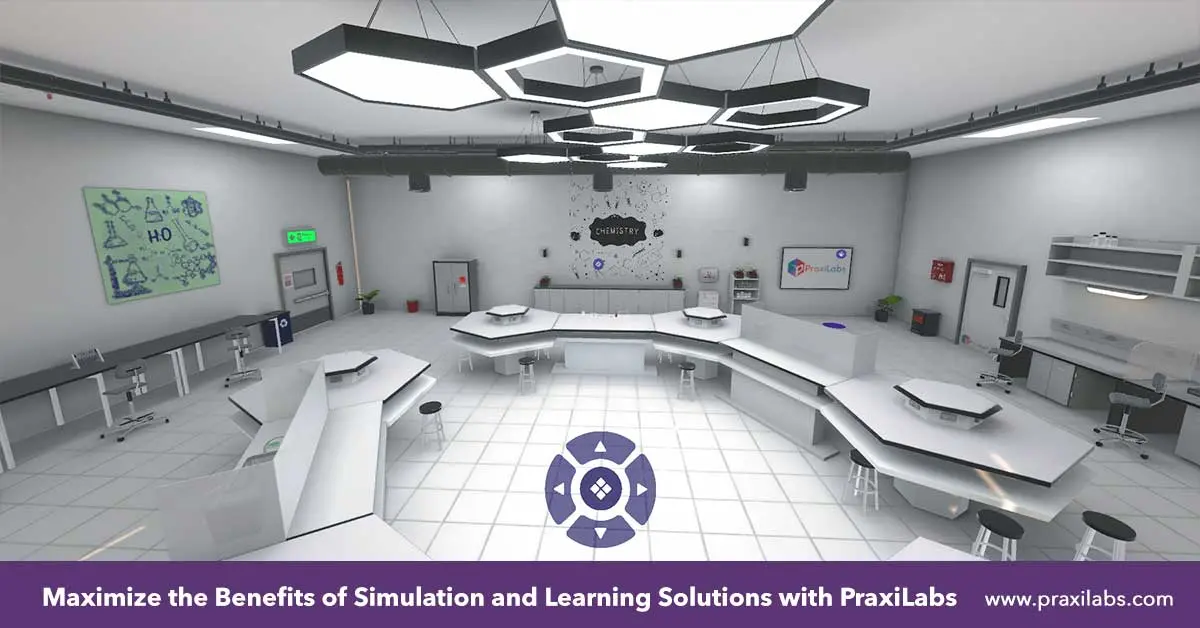
PraxiLabs provides interactive 3D virtual laboratory simulations designed to help educational institutions deliver engaging practical learning experiences.
With PraxiLabs, students can explore simulated laboratory environments and perform experiments virtually, allowing them to connect theoretical knowledge with practical application.
The platform covers a range of chemistry, physics, and biology experiments, giving universities a way to incorporate simulation-based practical learning across multiple STEM disciplines.
For example, students can use simulations to practice experimental procedures, manipulate variables, observe results, and repeat activities as needed. This supports a more active learning experience while giving educators an additional resource for classroom teaching and independent student practice.
PraxiLabs can be used to prepare students before physical laboratory sessions, reinforce concepts after class, or provide additional practical experiences when access to a physical laboratory is limited.
By combining traditional instruction with interactive virtual experiments, universities can create a more flexible learning model that supports both teaching efficiency and student engagement.
Explore Success Stories from Universities Using PraxiLabs:
The value and effectiveness of simulation based learning becomes even clearer when universities integrate virtual labs into their existing educational environments.
PraxiLabs has worked with universities and educational institutions to support the integration of virtual laboratory experiences into STEM education. Its growing network includes institutions such as Cairo University, Ain Shams University, Al-Azhar University, Alexandria University, Benha University, Mansoura University, and universities in Saudi Arabia.
These partnerships demonstrate how virtual laboratory technology and elearning solutions can be incorporated into different higher-education environments to provide students with additional opportunities for interactive practical learning.
Rather than viewing virtual laboratories as a replacement for traditional laboratory education, universities can use them as a complementary learning solution—preparing students for physical experiments, reinforcing laboratory concepts, and extending practical learning beyond the classroom.
As higher education continues to embrace digital transformation, simulation learning offers universities an opportunity to make practical education more accessible, flexible, interactive, and student-centered. With solutions such as PraxiLabs, institutions can give students more opportunities to experiment, practice, and build confidence while supporting instructors with powerful digital teaching resources.
FAQs
Is simulation-based learning expensive?
Not necessarily. While initial setup can require investment, simulation-based learning can reduce long-term costs by minimizing the need for physical equipment, consumables, maintenance, and repeated laboratory setups.
What skills does simulation learning teach?
Simulation learning develops practical skills such as problem-solving, critical thinking, decision-making, data analysis, experimentation, and applying theoretical knowledge in realistic scenarios.