 PraxiLabs A virtual world of science

Last Updated on November 25, 2026 by Muhamed Elmesery
Chemical bonding explains how atoms interact to form molecules and compounds. However, understanding electron sharing, electron transfer, and molecular interactions can be challenging when students rely only on textbook diagrams. A chemical bonding virtual lab can help bridge this gap by connecting visual learning, chemical theory, and practical experimentation.
This guide explores how virtual labs support chemical bonding education, the concepts students can investigate, types of chemical bonding in chemistry, and how PraxiLabs’ interactive chemistry simulations can complement this learning process.
Table of Contents
What Is a Chemical Bonding Virtual Lab?
A chemical bonding virtual lab is a digital learning environment that uses interactive models or simulations to explain how atoms interact and how these interactions influence chemical structures and properties.
Students can explore concepts such as ionic and covalent bonding, electron distribution, molecular polarity, and the relationship between molecular structure and reactivity.
For example, understanding why water is a polar molecule requires more than memorizing that its bonds are polar. Students must also connect the unequal sharing of electrons with the molecule’s geometry.
Virtual visualizations can help explain these relationships, while related chemistry experiments allow students to investigate the reactions and properties of real substances.
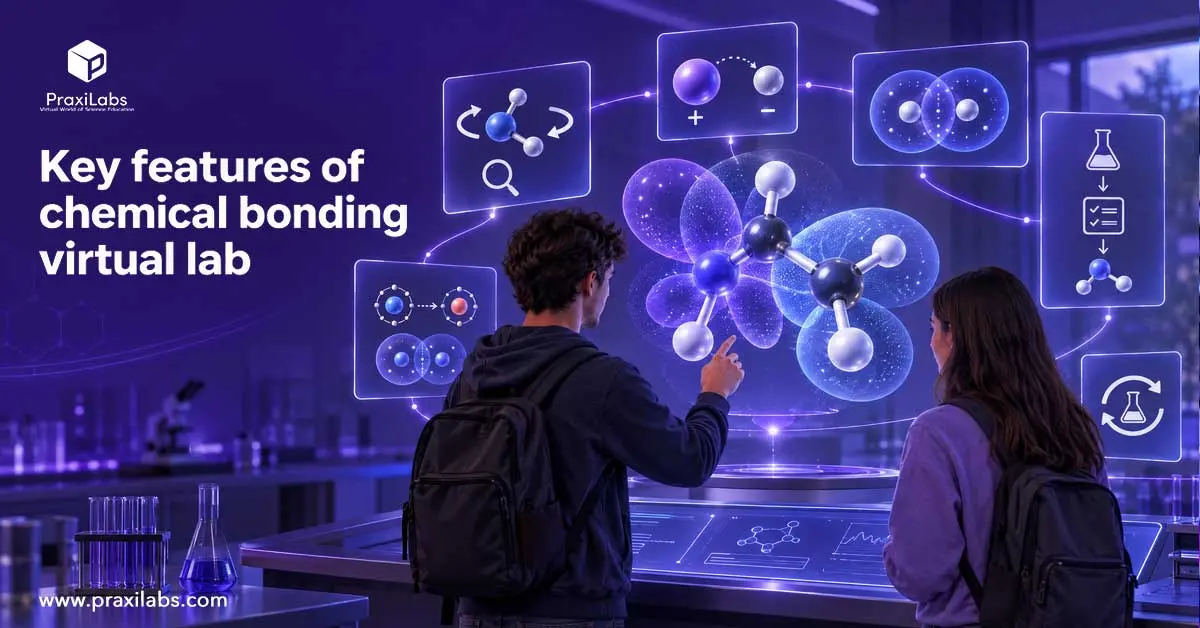
Key Features of a Chemical Bonding Virtual Lab:
An effective virtual lab should encourage students to investigate chemical principles rather than simply memorize definitions.
- Visual learning: Molecular models and diagrams help students understand abstract concepts that cannot be observed directly.
- Interactive exploration: Guided activities encourage students to make predictions, examine outcomes, and explain their observations.
- Repeatable practice: Students can revisit supported experiments and review procedures at their own pace.
- Guided instructions: Tutorials and laboratory manuals help learners follow experimental steps and connect them with scientific concepts.
- Flexible access: Online simulations provide additional practice opportunities beyond scheduled laboratory sessions.
These features can help instructors connect theoretical explanations with practical learning, particularly when students need additional support understanding complex chemical concepts.
Types of Chemical Bonds to Explore Through Virtual Labs:
Chemical bonding concepts help explain the structures and properties of substances. Virtual models such as virtual lab determining bond types can introduce these concepts, while related chemistry experiments can reinforce their practical significance.
| Type of Bond | How It Works | Example | What Students Learn |
| Ionic Bonding | Electrostatic attraction between oppositely charged ions formed through electron transfer. | Sodium chloride (NaCl) | How electron transfer forms ions and contributes to the properties of ionic compounds.. |
| Covalent Bonding | Atoms share electron pairs. | Water (H₂O) and oxygen (O₂) | How electron sharing, molecular geometry, and polarity influence molecular properties. |
| Metallic Bonding | Metal ion cores are held together by attraction to delocalized electrons. | Copper (Cu) | How metallic bonding explains electrical conductivity, thermal conductivity, and malleability. |
| Hydrogen Bonding | Attraction between a suitably bonded hydrogen atom and another electronegative atom. | Water (H₂O) | How intermolecular interactions influence properties such as water’s relatively high boiling point. |
Comparing these interactions helps learners connect atomic structure, molecular arrangement, and observable material properties by using simulations such as determining bond types virtual lab.
How Do Virtual Labs Provide a Safe Environment for Bonding Experiments?
Although chemical bonding is a microscopic concept, experiments used to investigate related chemical reactions and properties may involve hazardous reagents, specialized equipment, or careful handling procedures.
chemical bonding virtual labs provide a controlled digital environment where students can practice simulated procedures without directly handling the chemicals or equipment represented in the activity.
Key benefits include:
- Reduced exposure to simulated laboratory hazards: Students can practice simulated procedures without direct contact with the chemicals involved.
- Repeatable activities: Learners can revisit experiments to reinforce their understanding.
- Preparation for practical sessions: Virtual practice can familiarize students with procedures before they enter a physical laboratory.
- More focused instruction: Teachers can discuss expected outcomes and address misconceptions before practical work begins.
Virtual labs complement rather than eliminate the need for physical experiments, laboratory safety training, and hands-on skill development.
Understanding Chemical Bonding Through Interactive Experiments:
Chemical bonding becomes more meaningful when students connect atomic-level concepts with observable chemical behavior.
Instructors can use chemical bonding virtual lab or related experiments to demonstrate how molecular structure, functional groups, and chemical reactions contribute to the properties of substances.
PraxiLabs offers several virtual chemistry experiments that can support this broader learning approach.
| PraxiLabs experiment | Connection to chemistry learning |
| Synthesis of Aspirin | Helps students investigate organic synthesis and the chemical transformation of functional groups. |
| Esterification | Demonstrates how reactants form an ester, connecting molecular structure with chemical reactivity. |
| Tests for Carboxyl and Hydroxyl Groups | Helps students identify functional groups and relate molecular composition to characteristic chemical reactions. |
| Flame Test | Connects atomic energy transitions with the characteristic colors produced by different elements. |
| IR Analysis | Helps students interpret molecular vibrations and characteristic absorption bands to investigate functional groups. |
These examples illustrate how existing chemistry experiments can reinforce concepts related to molecular structure, chemical interactions, and reactivity. They are not dedicated virtual lab chemical bonding simulations, and their relevance depends on the learning objectives and experimental content.
For the best results, instructors can ask students to predict an experimental outcome, complete the virtual procedure, and explain their observations using the appropriate chemical principles.
What Does Research Say About Virtual Chemistry Labs?
Research provides evidence that virtual laboratories can improve chemistry learning when integrated effectively into instruction.
A 2024 quasi-experimental study published in JMIR Formative Research examined 60 undergraduate chemistry students assigned to physical laboratory, virtual laboratory, or lecture-only groups.
The average post-test scores were:
| Learning approach | Mean score |
| Physical laboratory | 62.6 |
| Virtual laboratory | 55.5 |
| Lecture only | 43.7 |
The virtual laboratory group significantly outperformed the lecture-only group (P = .001). The difference between the virtual and physical laboratory groups was not statistically significant (P = .07). However, this finding does not prove that the two approaches are equivalent in every setting.
The study supports using virtual laboratories to improve practical chemistry learning, particularly when physical laboratory access is limited. It did not specifically test chemical bonding simulations.
Discover Our Individual Learners & Institutions Plans
How Does PraxiLabs Improve Accessibility in Science Education?
Limited laboratory space, equipment costs, and scheduling constraints can restrict students’ opportunities to practice scientific procedures.
PraxiLabs helps educational institutions expand access to science practice through interactive virtual laboratory simulations across chemistry, biology, and physics.
Its chemistry library includes experiments in:
- Organic chemistry.
- Inorganic chemistry.
- Analytical chemistry.
Examples such as esterification, aspirin synthesis, flame tests, and IR analysis allow instructors to incorporate guided experimental practice into their courses.
These simulations can complement lessons on:
- chemical structure.
- functional groups.
- molecular interactions.
- reaction mechanisms.
Students can revisit supported activities, review laboratory procedures, and connect theoretical concepts with experimental observations.
For institutions teaching chemical bonding, PraxiLabs provides a way to strengthen broader chemistry instruction through related experiments rather than a standalone chemical bonding lab experiment.
Explore PraxiLabs’ Virtual Chemistry Lab to discover interactive experiments that help students practice scientific procedures, reinforce essential concepts, and prepare for physical laboratory work.
FAQs
What is chemical bonding in simple words?
Chemical bonding refers to the attractive force that holds atoms together to form molecules and compounds.
How do virtual chemistry labs work?
Virtual chemistry labs use interactive simulations to let students perform experiments online, manipulate variables, observe chemical reactions, and analyze results in a safe, controlled environment without requiring physical lab equipment.