 PraxiLabs A virtual world of science

Last Updated on November 11, 2026 by Muhamed Elmesery
What if students could practice laboratory experiments before entering the physical lab? Virtual practice simulations provide interactive digital environments where learners can explore procedures, manipulate variables, repeat experiments, and analyze results.
For universities, they extend practical learning beyond scheduled lab sessions, helping students prepare for experiments, reinforce scientific concepts, and develop practical skills.
In this blog post, we’ll explore how virtual practice simulations work, how they complement physical labs, best practices for virtual learning and how PraxiLabs’ virtual labs support flexible, interactive science learning.
Table of Contents
What are virtual practice simulations and how do they work?
Virtual practice simulations are interactive digital environments that recreate practical activities, laboratory procedures, or scientific experiments. They allow students to interact with simulated equipment, follow experimental steps, manipulate variables, and observe outcomes without requiring access to a physical laboratory for every practice session.
Unlike a conventional video demonstration, a virtual simulation gives learners an active role in the learning process. Students can interact with the experiment and explore how changing different conditions affects the results.
A typical virtual lab simulation may allow students to:
- Explore a realistic digital laboratory environment.
- Interact with virtual scientific equipment.
- Follow experimental procedures step by step.
- Adjust variables and experimental conditions.
- Observe experimental outcomes.
- Repeat procedures to reinforce understanding.
- Connect theoretical concepts with practical applications.
This makes virtual practice simulations particularly valuable in science education, where understanding often depends on seeing how scientific principles operate in an experimental setting.
PraxiLabs uses interactive virtual laboratories to help students engage with simulated science experiments. Rather than limiting practical learning to the time available in a university laboratory, educators can incorporate virtual experiments into preparation, classroom activities, revision, and independent study.
Explore: Interactive Science Simulations and The Future of STEM Learning
How can students scale scientific skills with realistic simulations?
Practical scientific skills develop through practice. However, physical laboratories can involve constraints related to equipment availability, laboratory capacity, scheduling, materials, and safety.
Virtual practice simulations can provide students with additional opportunities to practice scientific concepts and procedures.
Practice experiments repeatedly
Students can repeat virtual experiments without consuming physical laboratory materials. Repetition gives learners more opportunities to become familiar with procedures and understand the relationship between experimental steps and outcomes.
Develop scientific problem-solving
Interactive simulations can encourage students to think about experimental decisions. By changing variables and observing results, learners can explore cause-and-effect relationships and develop analytical thinking.
Learn from mistakes
A virtual environment can provide students with a practical space to explore procedures and understand the consequences of incorrect steps. This can make experimentation less intimidating and encourage students to learn through exploration.
Strengthen experimental analysis
Scientific practice involves more than performing an experiment. Students must also understand observations, measurements, and results.
Virtual practice simulations can support this process by helping learners connect experimental actions with the outcomes they observe.
Together, these capabilities can make virtual simulations a useful addition to traditional approaches to practical science education.
How should universities combine virtual simulations with physical labs?
The most effective use of virtual laboratory simulations does not necessarily mean replacing physical laboratories. Instead, universities can combine virtual and physical lab experiences to create a more comprehensive practical learning model.
A blended laboratory approach can use virtual simulations at three key stages.
Before the physical laboratory
Students can complete a virtual simulation before attending their scheduled laboratory session. This gives them an opportunity to become familiar with the experiment, equipment, terminology, and sequence of procedures.
When students enter the physical lab with some prior exposure to the experiment, the laboratory session can focus more directly on hands-on application and scientific discussion.
During laboratory instruction
Educators can use virtual simulations as a visual teaching aid when explaining complex procedures or scientific concepts.
The simulation can help students visualize an experimental process before performing it with physical equipment.
After the physical laboratory
Virtual simulations can also support revision. Students can return to an experiment after class to review difficult concepts, revisit procedures, or reinforce what they learned during the physical session.
This creates a continuous learning cycle:
Learn → Simulate → Practice → Perform → Analyze → Review
By combining both environments, universities can extend practical learning beyond the physical laboratory while preserving the value of hands-on experimentation.
Explore: Advantages of Simulation Based Learning in Classrooms
Support independent learning through virtual practice simulations:
Not every student learns at the same pace. Some learners may understand a procedure quickly, while others need additional practice before they feel confident.
Virtual practice simulations support independent learning by allowing students to revisit experiments and scientific concepts outside of scheduled class time.
Students can use virtual labs for virtual learning best practices to:
- Prepare for upcoming laboratory sessions.
- Review experiments after class.
- Practice challenging procedures.
- Reinforce theoretical concepts.
- Explore scientific relationships independently.
- Study at a pace that suits their learning needs.
This flexibility can be particularly useful when laboratory access is limited by schedules or capacity.
For educators, virtual simulations can also become part of broader learning activities. Instructors may incorporate simulations into pre-lab preparation, homework, revision activities, or supplementary learning.
As a result, practical science learning can continue beyond the physical laboratory and scheduled teaching hours.
Explore: Why Educational Simulations are Essential in Modern Education?
Take your students to the next level of learning with PraxiLabs:
Students need more than theoretical explanations to develop a meaningful understanding of science. They need opportunities to explore, practice, experiment, and apply concepts.
That is where PraxiLabs can become an important part of your university’s practical learning strategy.
PraxiLabs provides interactive virtual laboratory simulations that allow students to engage with science experiments in a digital environment. With virtual experiments across disciplines such as chemistry, physics, and biology, educators can give students additional opportunities to practice and reinforce scientific concepts.
PraxiLabs can be integrated into different points of the learning journey:
- Before the lab: Prepare students for upcoming experiments.
- During instruction: Demonstrate experimental concepts interactively.
- After the lab: Reinforce learning through additional practice.
- Outside class: Give students opportunities for independent experimentation and revision.
This makes PraxiLabs more than a digital alternative to a laboratory demonstration. It can serve as a supplementary practical learning environment that helps universities expand how and when students engage with laboratory-based science education.
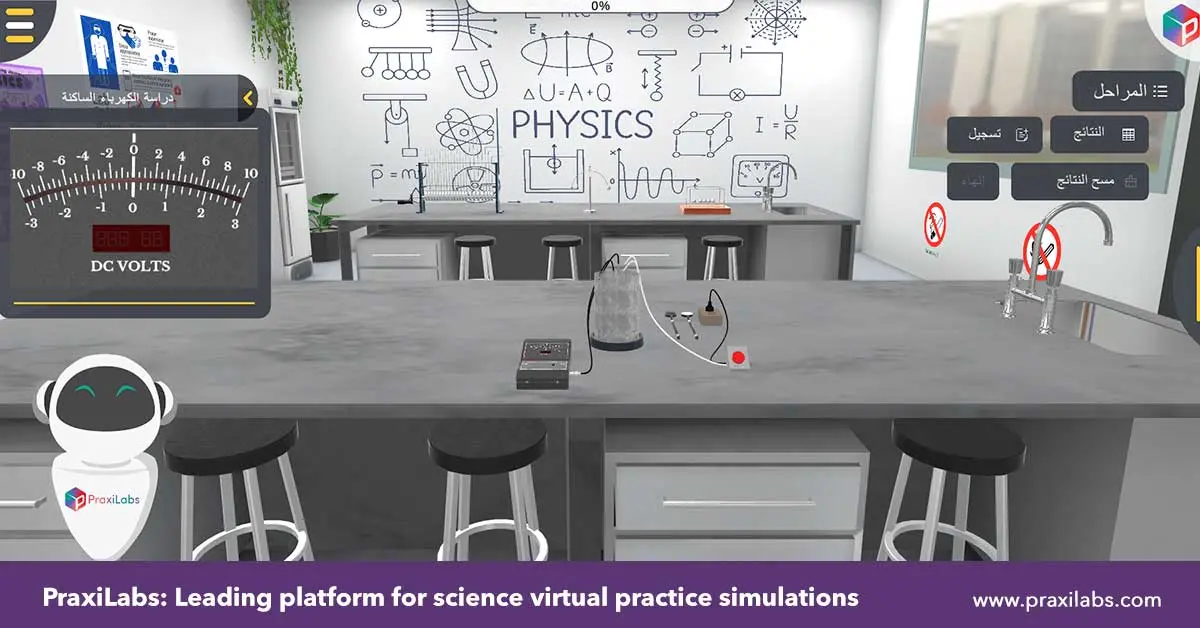
PraxiLabs: Leading platform for science virtual practice simulations
PraxiLabs is a virtual laboratory platform designed to support interactive science education through simulated experiments.
Its virtual labs give students opportunities to interact with scientific experiments in a digital environment while helping educators extend practical learning beyond traditional laboratory sessions.
The platform can support universities looking to enhance practical science education, especially biology, chemistry, and online physics practical simulator through:
- Interactive laboratory experiences
Students actively interact with simulated experiments rather than simply consuming passive learning content.
- Flexible practical learning
Virtual experiments can be incorporated into classroom instruction, pre-lab preparation, revision, and independent study.
- Repeated practice
Students can revisit simulations to reinforce concepts and become more familiar with experimental procedures.
- Blended learning
Universities can combine virtual simulations with physical laboratory experiences to create a more flexible practical learning model.
- Scalable science education
Virtual labs can provide additional opportunities for practical learning without requiring every practice activity to take place in a physical laboratory.
With PraxiLabs, students can move from simply learning scientific concepts to interacting with them, practicing them, and applying them through virtual experiments.
FAQs
What are virtual simulations?
Virtual simulations are interactive digital environments that recreate real-world experiments, processes, or scientific phenomena, allowing students to explore and learn safely without physical equipment.
Which science subjects benefit from virtual simulations?
Virtual simulations are useful across science subjects, including physics, chemistry, biology, environmental science, and more, by providing hands-on-style learning experiences in a digital environment and educational practices in simulation scale.