 PraxiLabs A virtual world of science

Last Updated on November 22, 2026 by Muhamed Elmesery
Chemical equilibrium is a fundamental chemistry concept, but understanding how reversible reactions behave under changing conditions can be challenging without practical experimentation. A chemical equilibrium virtual lab allows students to investigate these processes through interactive simulations, observe how reactions respond to changes, and connect theoretical principles with experimental results.
For universities, virtual labs also offer a flexible way to expand practical learning opportunities while supporting curriculum objectives.
In this blog post, we explore how chemical equilibrium simulations work, which concepts students can investigate, how they simplify equilibrium constant analysis, and how virtual laboratories can contribute to evidence-based academic quality and accreditation efforts.
Table of Contents
What Is a Chemical Equilibrium Virtual Lab?
A chemical equilibrium virtual lab is a digital learning environment that simulates experiments involving reversible chemical reactions and equilibrium conditions. Instead of relying exclusively on physical laboratory equipment and chemical reagents, students interact with simulated reaction systems to observe how reactants and products behave as experimental conditions change.
Chemical equilibrium occurs when the forward and reverse reactions proceed at equal rates. At this point, the concentrations of reactants and products remain constant over time, although both reactions continue to occur at the molecular level.
Virtual laboratories help students explore this dynamic process by manipulating variables, observing simulated outcomes, and analyzing experimental data.
For example, students may investigate how changing the concentration of a reactant affects an equilibrium system or how temperature influences the position of equilibrium. These activities make abstract chemical principles more accessible and encourage students to develop scientific reasoning skills.
How Does a Chemical Equilibrium Virtual Lab Work?
A chemical equilibrium experiment virtual lab uses interactive models to represent chemical reactions and their responses to experimental changes. Depending on the simulation, students can adjust reaction conditions, collect data, and compare their observations with theoretical predictions.
A typical learning activity involves the following steps:
- Select a reaction: Choose a reversible chemical reaction and review its balanced chemical equation.
- Establish initial conditions: Examine the initial concentrations of reactants and products, along with relevant experimental variables.
- Modify experimental conditions: Change concentration, temperature, pressure, or volume when applicable to the simulated system.
- Observe the response: Monitor changes in concentrations, reaction behavior, or visual representations of the equilibrium state.
- Analyze the results: Compare observations with Le Chatelier’s principle and calculate relevant equilibrium quantities when the activity provides the necessary data.
For instance, students can study the equilibrium reaction:
N₂(g) + 3H₂(g) ⇌ 2NH₃(g)
This reaction demonstrates how changes in pressure, temperature, and reactant concentrations can influence equilibrium under appropriate conditions.
By repeating simulations with different starting conditions, students can test hypotheses, identify patterns, and understand why an equilibrium system responds differently to different disturbances.
Which Chemical Equilibrium Concepts Can Be Explored Virtually?
A chemical equilibrium virtual lab can support several important topics in general and physical chemistry, depending on the experiments and features available.
Dynamic chemical equilibrium
Students investigate why reactant and product concentrations remain constant at equilibrium even though the forward and reverse reactions continue. Visual representations can help clarify the difference between a static system and a dynamic equilibrium.
Le Chatelier’s principle
Students explore how equilibrium systems respond to changes in concentration, pressure, volume, and temperature. Simulations make it possible to compare different disturbances and predict the direction in which a reaction shifts.
Equilibrium constants (Kc and Kp)
Students learn how equilibrium constants describe the relationship between reactant and product concentrations or partial pressures at a given temperature. Depending on the activity, they can calculate equilibrium constants and compare the results of different systems.
Concentration changes and equilibrium position
Students can investigate how adding reactants or removing products influences an equilibrium system, helping them distinguish changes in equilibrium position from changes in the equilibrium constant.
Explore: How is Chemistry Reaction Simulator Linking Theory to Learning?
How Do Virtual Simulations Simplify Equilibrium Constants Analysis?
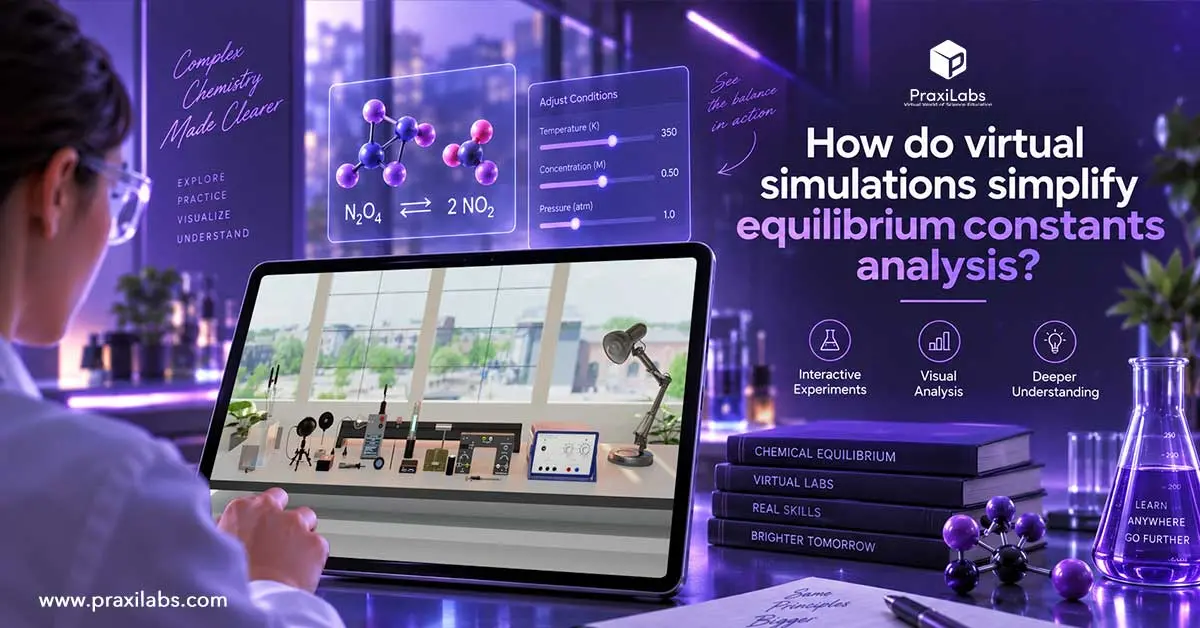
Equilibrium constant calculations can be challenging because students must understand balanced chemical equations, equilibrium concentrations, and the mathematical relationships between reactants and products.
For a general reaction:
aA + bB ⇌ cC + dD
The concentration-based equilibrium constant is expressed as:
Kc = [C]^c[D]^d / ([A]^a[B]^b)
Here, the concentrations represent equilibrium concentrations, and the exponents correspond to the stoichiometric coefficients in the balanced equation.
Virtual simulations can make this analysis more manageable in several ways:
- Visualizing concentration changes: Students can observe how reactant and product concentrations evolve as the system approaches equilibrium, connecting numerical data with chemical behavior.
- Practicing calculations repeatedly: Students can investigate multiple scenarios without preparing a new physical experiment each time, giving them more opportunities to practice setting up equilibrium expressions and interpreting results.
- Comparing experimental conditions: By analyzing different equilibrium states at the same temperature, students can investigate how concentrations may change without changing the equilibrium constant for a given reaction.
- Connecting theory with evidence: Students can compare their predictions with simulated observations and use the results to explain why an equilibrium system responds in a particular way.
These benefits are consistent with research on virtual chemistry education. A 2023 study, reported improvements in students’ scientific literacy test results following inquiry-based activities using a virtual laboratory. The findings support the potential value of structured virtual experiments for helping students interpret evidence and apply chemical concepts.
Virtual simulations do not eliminate the need to understand the underlying mathematics. Instead, they give students additional opportunities to connect calculations, observations, and chemical theory.
Explore: Interactive Chemistry Simulations for Students and Educators
How Do Virtual Labs Support Academic Accreditation for a University?
Academic accreditation requires institutions to demonstrate that their educational programs meet applicable standards for curriculum quality, student learning, assessment, and continuous improvement. Virtual laboratories can contribute to these efforts when they are integrated into a well-designed teaching and assessment strategy.
Supporting measurable learning outcomes
Chemical equilibrium online simulations can be incorporated into learning activities aligned with course outcomes, such as predicting equilibrium shifts, calculating equilibrium constants, and interpreting experimental data. Instructors can assess these outcomes through quizzes, laboratory reports, and structured assignments.
Expanding access to practical learning
Virtual labs provide additional opportunities for students to practice scientific concepts when physical laboratory access is limited by scheduling, equipment availability, or resource constraints. This can help institutions deliver more flexible learning experiences.
Strengthening assessment and feedback
When paired with suitable assessment tools, virtual activities can help instructors identify conceptual misunderstandings and evaluate students’ progress. Student performance data and laboratory reports can contribute to course-level evaluation and improvement.
Encouraging consistent learning experiences
Simulations can provide students across different classes or learning environments with access to the same experimental scenarios. This can support consistent instruction while allowing faculty to adapt activities to specific course objectives.
Contributing to continuous improvement
Institutions can review assessment results, student feedback, and course performance to determine whether virtual laboratory activities are achieving their intended outcomes and where instructional changes may be needed.
A systematic literature review published in Computers and Education Open in 2021 examined research on virtual chemical laboratories. It found that virtual labs can produce better learning outcomes than passive instructional approaches in several contexts, while results in comparisons with hands-on laboratories vary. The review also highlighted the value of combining virtual experiments with traditional laboratory instruction.
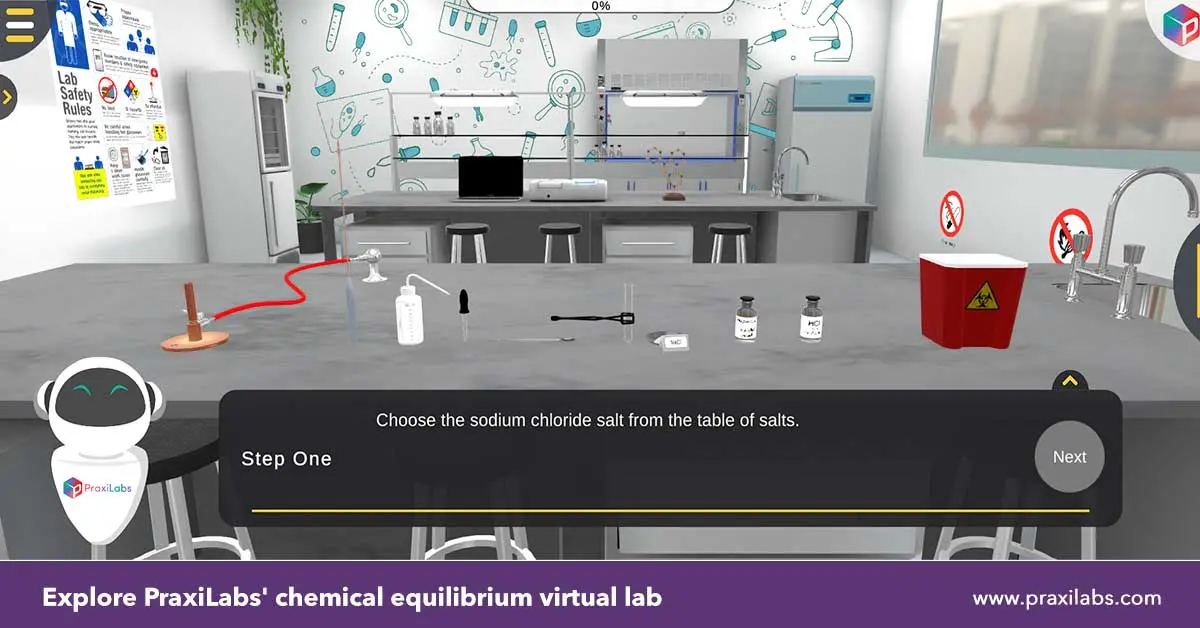
Explore PraxiLabs’ Chemical Equilibrium Virtual Lab:
Give students more opportunities to connect chemical theory with practical investigation through PraxiLabs’ virtual science laboratories.
PraxiLabs offers interactive virtual laboratory experiences designed to support science education and help learners explore scientific concepts in a simulated environment. Integrating virtual experiments into chemistry courses can provide additional opportunities for students to investigate reactions, practice analytical thinking, and strengthen their understanding of challenging concepts.
For educators and academic leaders, virtual laboratories can also complement existing teaching methods and support the development of flexible, technology-enhanced learning experiences.
Whether you are looking to enrich chemistry instruction, provide additional practice opportunities, or enhance your institution’s digital learning resources, PraxiLabs can help you bring interactive science learning into your educational programs.
FAQs:
How do virtual labs improve student engagement?
Virtual labs provide interactive, and immersive 3D virtual environments that enable students to visualize scientific concepts, interact with experiments, and analyze the results. These labs transform passive learners into active participants.
Are virtual labs suitable for remote learning?
Of course yes! Virtual labs enable students to perform their experiments online at their own pace away from any hazards in an immersive 3d virtual environment. These labs provide access to interactive science simulations from any location.