 PraxiLabs A virtual world of science

Last Updated on May 20, 2026 by Muhamed Elmesery
In today’s rapidly evolving education landscape, students need more than textbooks and static explanations—they need experiences that bring learning to life. This is where digital simulations step in, transforming abstract concepts into interactive, hands-on discovery.
From exploring complex reactions in Chemistry to visualizing forces in Physics and understanding living systems in Biology, simulations empower students to actively engage with what they learn.
Platforms like PraxiLabs are leading this shift, enabling safe, accessible, and immersive experimentation anytime, anywhere. In this blog, we’ll uncover the 7 key benefits of digital simulations for students—and why they are becoming essential in modern education.
Table of Contents
What is a digital simulation in education?
A digital simulation is a computer-based tool which is immersive and interactive helping students to predict and experiment in a safe and risk free environment.
It allows learners to engage in experiential learning, manipulate variables, and receive immediate feedback, enhancing understanding, skill development, and critical thinking. These simulations are often called virtual labs, virtual reality, augmented reality or computer-based modeling.
Top benefits of digital simulations for students:
Digital simulations are transforming how students learn—especially in science and technical subjects—by making abstract ideas tangible and interactive. Here are the top 7 benefits of digital simulations for students:
-
Safe Experimentation Environment
Students can conduct experiments without the risks associated with real labs—no chemical spills, broken equipment, or safety hazards. This is particularly valuable in fields like Chemistry and Physics.
-
Enhanced Concept Understanding
Simulations turn complex theories into visual, interactive experiences. Instead of memorizing formulas, students see concepts in action—making learning more intuitive and long-lasting.
-
Increased Student Engagement
Interactive elements—like dragging, testing, and instant feedback—keep students actively involved, unlike passive learning methods. Platforms like PraxiLabs are designed to boost engagement through immersive virtual simulation lab.
-
Accessible Anytime, Anywhere
Students can access simulations from any device, eliminating the need for physical lab presence. This flexibility supports remote and hybrid learning environments.
-
Cost-Effective Learning
Schools save on lab equipment, maintenance, and materials. Simulations provide a scalable solution without compromising educational quality.
-
Repeatable Learning Experiences
Students can repeat experiments as many times as needed to fully grasp the concept—something not always feasible in traditional labs due to time or resource limits.
-
Supports Personalized Learning
Simulations allow students to learn at their own pace, explore different scenarios, and receive immediate feedback—catering to individual learning styles and needs.
Explore: Digital Lab Platform for Virtual Experiments and Practical Learning
How does interactivity increase students engagement?
According to research, which demonstrated the impact of integrating interactive molecular model simulations on students’ understanding and academic performance during chemistry instruction, particularly for concepts related to chemical bonding.
The research found that the combination of interactive digital simulations for students and molecular models provides students with a valuable exploratory learning environment where they can learn various chemistry concepts.
In addition, the study provided supporting evidence for the integration of interactive simulations into the teaching-learning process in chemistry.
The results of the present study reveal a significant positive impact of the integration of simulations with molecular models on students’ understanding.
How do virtual labs safely turn curiosity into action?
Virtual lab safely turns curiosity into action by giving students an interactive space to explore scientific concepts through hands-on experimentation without the risks of traditional labs.
They allow learners to test ideas instantly, make mistakes, repeat experiments, and receive real-time feedback in a completely safe environment.
Platforms like PraxiLabs encourage students to ask questions, investigate outcomes, and engage in active discovery while eliminating concerns like hazardous materials, damaged equipment, or limited lab resources. This creates a more confident, flexible, and inquiry-driven learning experience that transforms curiosity into meaningful understanding.
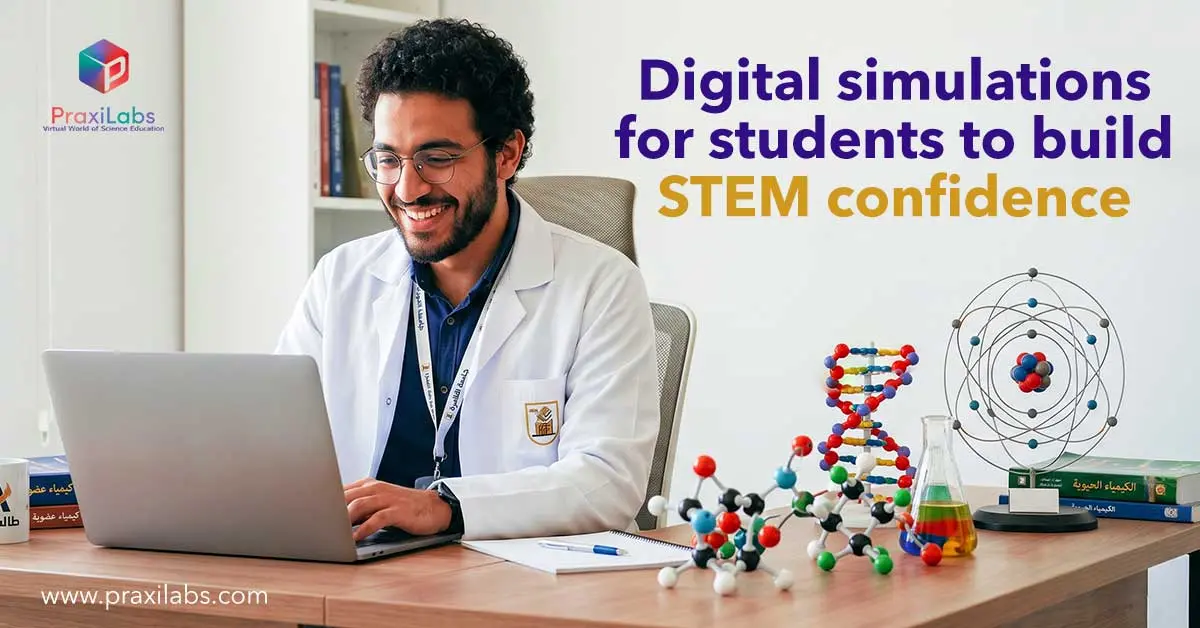
Digital simulations for students to build STEM confidence:
Digital simulations for students are one of the most important and widely used e-learning techniques. They are 3D immersive and interactive simulations of experiments and activities that typically take place in physical laboratory settings.
In science education, they simulate the equipment, tools, tests, and procedures used in various science branches such as chemistry, physics and biology, and this enables students to perform science experiments online, from their personal devices anytime and anywhere without the costs and limitations of a physical lab
Digital simulations use software and computer models to replicate the equipment, procedures, and experiments that would typically be conducted in a physical lab.
Students can interact with these labs by performing experiments, collecting data, analyzing results, and drawing conclusions, all within the simulated environment.
Virtual digital simulations aim to provide an immersive and interactive learning experience that closely mirrors the hands-on nature of traditional labs, while offering the advantages of accessibility, cost-effectiveness, and safety.
Explore: Top 7 Benefits of Digital Chemistry Lab for Colleges
Why choosing PraxiLabs for science simulations?
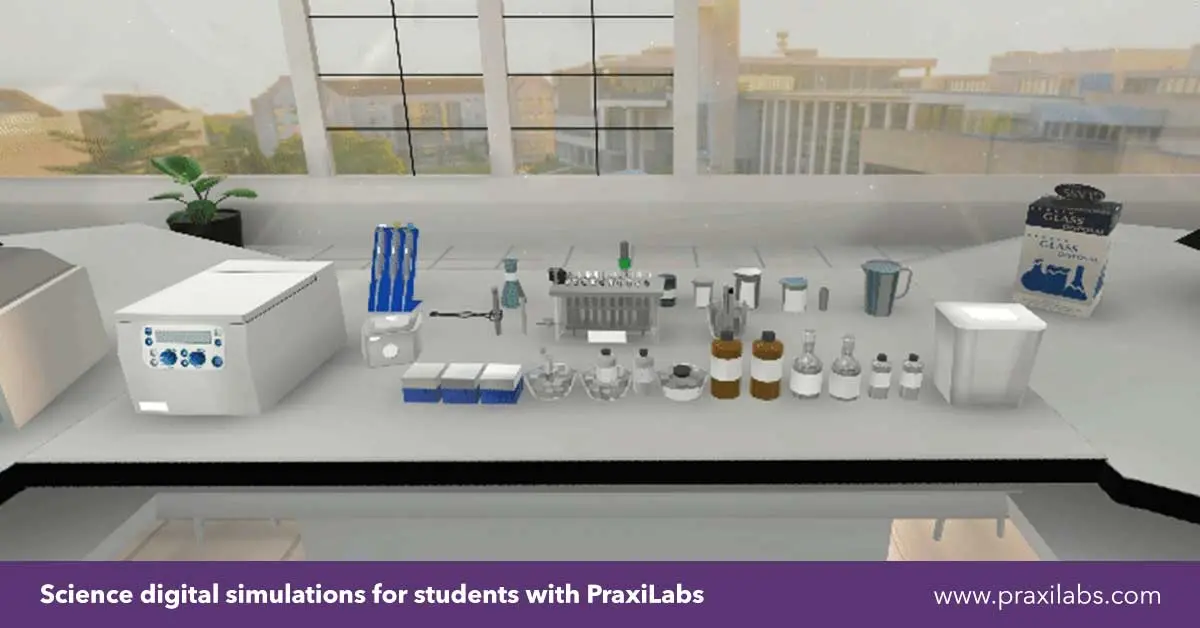
Conducting scientific experiments through simulation software for students has become an attractive and effective means for university students to explore and embody complex scientific concepts. Through interactive simulations, learners can perform experiments, adjust variables, and observe results in real-time—all within a safe and easily accessible digital environment.
Platforms like Praxilabs provide immersive 3D simulations that allow students to conduct scientific experiments as if they were in a physical laboratory. Instead of merely studying theoretical formulas, students can actively test ideas, analyze results, and better understand how physical laws work in practice.
One of the main advantages of Praxilabs is interactive learning. Students can modify experimental conditions—such as force, speed, voltage, or resistance—and observe how these changes immediately affect the outcomes. This hands-on approach enhances conceptual understanding and encourages scientific inquiry.
Frequently Asked Questions
How are simulations used in education?
Simulations can be used in education by integrating virtual laboratories, augmented reality, and more in teaching. These applications help students understand and perform their experiments safely in a virtual environment for several times and without any limitations.