 PraxiLabs A virtual world of science

Last Updated on March 8, 2026 by Muhamed Elmesery
Understanding organic reactions doesn’t have to mean memorizing complex mechanisms and hoping they make sense. With an Organic Reaction Simulator, chemistry experiments become interactive, visual, and engaging.
Instead of static equations on a board, students can observe bond formation and breaking in real time, track electron movement step by step, and explore how different conditions affect reaction outcomes.
In this blog post, we will learn more about organic reaction simulators, the impact of virtual labs on transforming chemistry education, discover a short list of PraxiLabs organic reaction simulations, and more!
Table of Contents
What is an organic reaction simulator?
Organic reaction simulation is a software-based system used to model, visualize, and predict the behavior of organic chemical reactions. This type of simulator allows students to perform their organic experiments in a safe and immersive environment without exposure to potential hazards.
An organic chemistry reaction simulator visualizes the mechanisms of organic reactions and replicates molecular interactions, reaction kinetics, and energy changes, reducing the need for costly physical experiments.
Improve students understanding of complex organic reactions:
To improve students’ understanding of complex organic reactions, educators need more than static diagrams and memorization-based teaching. Organic chemistry becomes clearer when students can visualize, experiment, and interact with reaction mechanisms step by step.
With an organic chemistry simulator platform like PraxiLabs, students can rotate molecules, zoom in on reactive sites, and fully understand why reactions proceed—not just what the product is.
Virtual labs Usage Case Study:
According to a study, virtual organic chemistry lab simulations can improve students’ learning efficiency and motivation to study abstract concepts. This work designed a VR environment for chemistry education to support computer-mediated hands-on exercises, including Self-propagating high-temperature synthesis (SHS) and Electrode sheet fabrication (ESF).
In this evaluation with 39 participants who wore heartbeat-monitoring wearables, we compared the students’ performances in hands-on chemistry tasks, either with or without score-keeping and time-sensitive conditions.
- Accordingly, we designed questionnaires reflecting sixteen qualitative aspects (e.g., content, perspicuity, and interaction) and perceived user workloads.
- The experimental results indicate participants’ preferences and attitudes in terms of efficiency and sense of safety. 94.87% of participants reported that the learning simulator could improve learning efficiency, and 92.31% of the participants indicated that it could improve their sense of safety.
- The results of the data analysis show that the different learning scenarios we simulated have a statistically significant positive impact. The findings shed light on the quality and learning performance of operational skills for chemistry education.
Conducting safe organic reactions virtually:
Real organic reactions labs face real challenges such as hazardous chemicals, expensive equipment, limited materials, and strict safety protocols, among others.
Conducting safe organic reactions virtually by using virtual labs removes these barriers while maintaining realism. Institutions can provide unlimited experimentation without risk, cost escalation, or lab scheduling conflicts.
Visualizing molecules through organic reaction simulator:
Organic reaction simulators simplify complex concepts by providing immersive and interactive virtual labs that explain these theories, allowing students to explore and visualize molecules, enhancing their learning outcomes by facilitating a deeper understanding of various organic chemistry topics.
Through an organic reaction simulator, Your students can explore the structure, properties, synthesis, and reactions of organic compounds (carbon-containing compounds).
An organic reaction simulator covers topics such as:
- Detection of Functional Groups (alcohols, aldehydes, ketones).
- Synthesis reactions.
- Saponification reactions.
- Esterification reactions.
- Identification of Carbohydrates, Fats, and Proteins.
Virtual labs’ touch in changing chemistry education:
Chemistry education is no longer confined to glassware, fumes, and time-limited lab sessions. Virtual laboratories are reshaping how students explore reactions, analyze data, and build scientific confidence—making learning more accessible, interactive, and effective.
From Passive Observation to Active Exploration:
Virtual labs, such as those offered by PraxiLabs, shift the model to active participation. Students can:
- Perform experiments independently.
- Repeat procedures without material waste.
- Make mistakes safely.
- Explore “what-if” scenarios.
Learning becomes exploratory rather than procedural.
Making Abstract Concepts Visible:
Chemistry is inherently microscopic—atoms, molecules, and electron movement. These are invisible in physical labs.
Virtual simulations allow students to:
- Visualize molecular interactions.
- Observe reaction mechanisms step-by-step.
- See bond formation and breaking dynamically.
- Connect symbolic equations to molecular behavior.
This bridges the gap between theory and practice.
Supporting Inquiry-Based & Personalized Learning:
In virtual environments, students can:
- Modify variables like temperature or concentration.
- Compare outcomes instantly.
- Learn at their own pace.
- Receive immediate feedback.
This supports differentiated instruction and strengthens critical thinking skills.
Expanding Access to Quality Lab Education:
Not all institutions have fully equipped labs. Virtual labs democratize access by:
- Supporting remote and hybrid learning.
- Providing advanced experiments to under-resourced schools.
- Standardizing lab quality across campuses.
Students gain equal opportunities regardless of location or infrastructure.
Improving Engagement & Retention:
Interactive organic reaction simulators increase:
- Student motivation.
- Concept retention.
- Academic performance.
- Confidence in scientific reasoning.
When learners interact with chemistry rather than memorize it, deeper understanding follows.
Explore Praxilabs’ Virtual Chemistry Lab Simulations
What is the website to simulate chemical reactions?
The official website where you can simulate virtual chemical reactions (and other science) experiments with PraxiLabs is:
Our platform lets you:
- Run 3D virtual laboratory simulations in chemistry (organic, inorganic, analytical), biology, and physics.
- Practice experiments safely anytime, anywhere without real chemicals or equipment.
- Access some simulations for free by creating an account.
- Explore immersive, curriculum-aligned lab environments that help build real understanding of scientific concepts.
- Empower your students with real-time, personalized guidance.
- Easily create quizzes with custom questions, types, difficulty, and timing.
- Track every student’s actions and completions in real time, and access automated performance reports to support smarter teaching decisions.
Discover a short list of PraxiLabs organic reaction simulations:
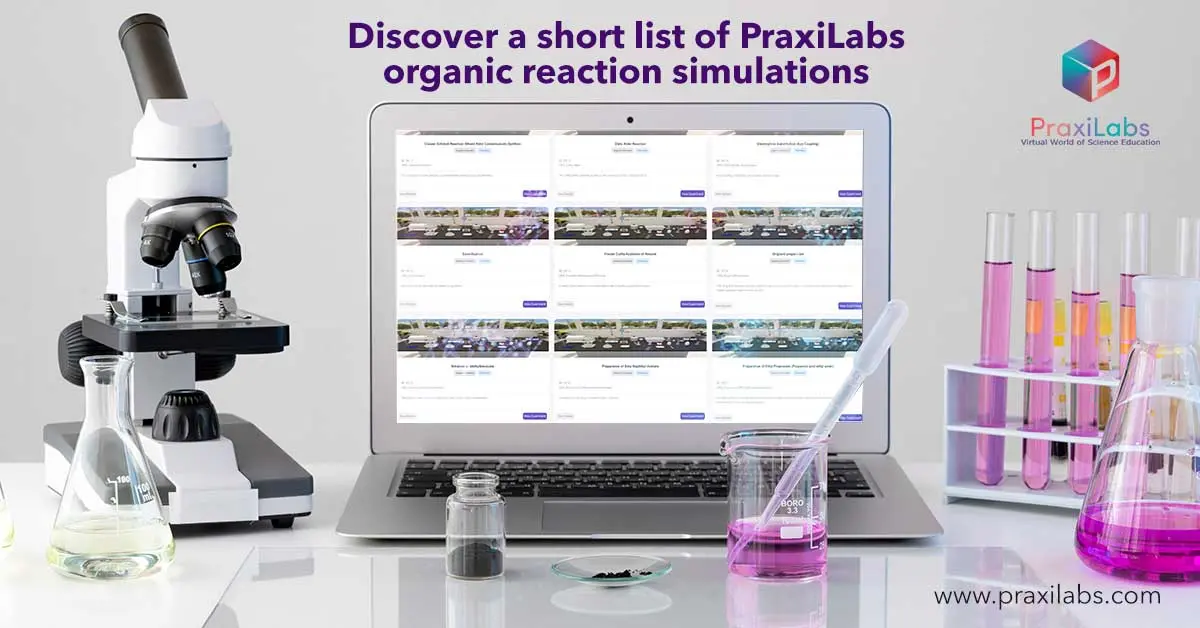
PraxiLabs provides a wide range of 3D interactive organic reaction simulators that cover critical topics in organic chemistry.
Let’s discover a short list of PraxiLabs organic reaction simulations:
- Claisen Schmidt Reaction (Mixed Aldol Condensation).
- Diels-Alder Reaction.
- Electrophilic Substitution (Azo Coupling).
- Esterification.
- Friedel-Crafts Acylation of Anisole.
- Nitration of Methyl benzoate.
- Preparation of Beta Naphthyl Acetate.
- Grignard preparation.
- Preparation of Paracetamol.
- Reaction of Alkyl Halides (Hydrolysis of Alcohols).
- Aspirin Synthesis Experiment.
- Tests for Aldehydic and Ketonic Groups.
- Test for carboxylic group.
- Tests for hydroxyl group.
- Saponification Reaction.
Frequently Asked Questions
Can I predict reaction outcomes using a simulator?
Yes, you can predict chemical reaction outcomes—including products, yields, and optimal conditions—using specialized computer simulations.
Can I track progress and results with experiments simulators?
Yes! You can do this easily. For example, PraxiLabs provides a feature called “Progress Report” that shows you any stages that have been skipped during the experiment, for example, the DNA extraction has 3 stages. The feature will capture any stages that have been skipped by the student in each attempt.