 PraxiLabs A virtual world of science

Last Updated on May 6, 2026 by Muhamed Elmesery
Virtual science experiments for high school are transforming the way students learn and experience STEM subjects. Instead of being limited by time, equipment, or lab safety concerns, students can now explore complex scientific concepts in an interactive and risk-free digital environment.
These virtual simulations allow learners to perform experiments multiple times, visualize abstract ideas, and understand scientific principles at their own pace.
By combining engagement with accessibility, virtual science experiments are making learning more flexible, inclusive, and effective—helping students build a stronger foundation in science and better preparing them for real-world applications.
Table of Contents
What are the limitations of traditional science experiments in schools?
Traditional science experiments are valuable—but they come with real constraints that often limit how much students actually learn or explore. Here are the key limitations:
- Safety and security risks.
- High operational and maintenance costs.
- Ethical challenges.
- Limited access for students.
- Lack of engagement and interest from students.
- High failure rates among students.
- Inability to accommodate the large and growing number of students.
- Excessive time constraints on teachers and professors.
- Lack of repeatability.
The use of science interactive experiments for high school aims to help students understand complex physical principles and theories that may be difficult to study experimentally or theoretically in a physical laboratory. They also address the problems faced by students and educational institutions when conducting experiments in a traditional laboratory.
Explore: The Effect of Virtual Laboratory on Student Performance
How to make science experiments for high school more effective?
Making science experiments more effective in high school isn’t about doing more experiments—it’s about making them more meaningful, interactive, and skill-focused. Here are practical ways to improve them:
- Focus on conceptual understanding, not just results.
- Make experiments inquiry-based.
- Integrate real-life applications
- Use virtual labs along side physical labs.
- Encourage collaborative learning.
- Emphasize data analysis, not just procedure.
- Allow repetition and experiment variation.
- Use formative assessment during labs.
- Bring in digital & interactive tools.
- Make reflection a core part.
Virtual science experiments for high school are considered one of the most important applications of modern technology in education. They contribute to enriching science learning as virtual educational tools by providing educational simulations and programs that accurately replicate real laboratories.
This digital environment provides students with additional advantages, such as the ability to conduct various experiments at any time and from anywhere.
Explore: Top Science Simulation Websites for Students
Why schools are adopting virtual science labs?
Virtual labs applications in teaching science experiments offer many benefits for students and educational institutions.
They enhance interaction, understanding, and critical thinking skills by providing an immersive science experience. Let us explore some of these benefits:
Enhancing Interaction and Motivation for Learning:
Virtual science labs provide immersive 3D simulations of real experiments, giving students a better learning experience through the integration of interactive learning elements that increase their engagement and interest.
Safety
Hazardous materials require careful handling and proper supervision. In the educational field, technology is constantly evolving to meet ongoing needs and requirements for advancement. Virtual science labs eliminate the risks associated with handling equipment or materials that may be dangerous.
Cost reduction
Subscription costs for virtual lab platforms are much lower than the costs of establishing a physical science lab with all its devices, equipment, and expensive resources.
Quick Access to More Experiments
Virtual science labs allow students to conduct experiments on phenomena that are usually dangerous or impossible to observe in a physical laboratory. This helps students understand more complex and abstract topics.
Accessibility
Virtual science labs work on any device connected to the internet. Whether students use a desktop computer, laptop, smartphone, or tablet, virtual labs are compatible with all popular devices and operating systems, with simple system requirements and browser capabilities.
How do interactive experiments reinforce scientific concepts?
Using online interactive experiments works on enriching the traditional experimentation process through visual means that guide students through the procedure.
They also provide guidance for analysis and help avoid incorrect choices. Moreover, students are quickly tested on the key results of their experiment to ensure an enhanced learning experience.
Explore: Virtual Interesting Biology Experiments for College
What is the future of virtual labs in education?
The future of virtual labs in education isn’t just “digital labs replacing physical ones”—it’s a full transformation of how science is taught, experienced, and assessed.
Here’s a clear, forward-looking breakdown:
-
Hybrid Learning Will Become the Standard
Virtual labs won’t replace traditional labs—they’ll work alongside them for better preparedness and deeper understanding.
- Schools are shifting toward blended models combining physical + virtual experiments.
- Around 72% of educators expect hybrid learning to dominate.
- Students will prepare virtually, then apply skills in physical labs.
-
AI-Powered Personalized Learning
This is one of the biggest game-changers, every student gets a custom learning path, not a one-size-fits-all experience:
- Virtual labs will adapt experiments based on student performance.
- AI tutors will provide real-time guidance and feedback.
- Systems can detect confusion or struggle and adjust difficulty instantly.
-
Immersive Technologies (AR/VR & XR)
The future lab will feel almost real—sometimes even better and abstract concepts will become visual, interactive, and memorable:
- Use of virtual reality (VR) and augmented reality (AR) for 3D experiments.
- Students can explore molecules, organs, or physics simulations interactively.
- New tech like haptic feedback will simulate touch and interaction.
-
Learning without Boundaries (Anytime, Anywhere)
Virtual labs remove physical limitations completely.
- Students can run experiments anytime, from any device.
- Access is no longer limited by lab availability or geography.
- Education becomes more inclusive for underserved regions.
Explore: 43 Physics Experiments for College Students to Try Virtually
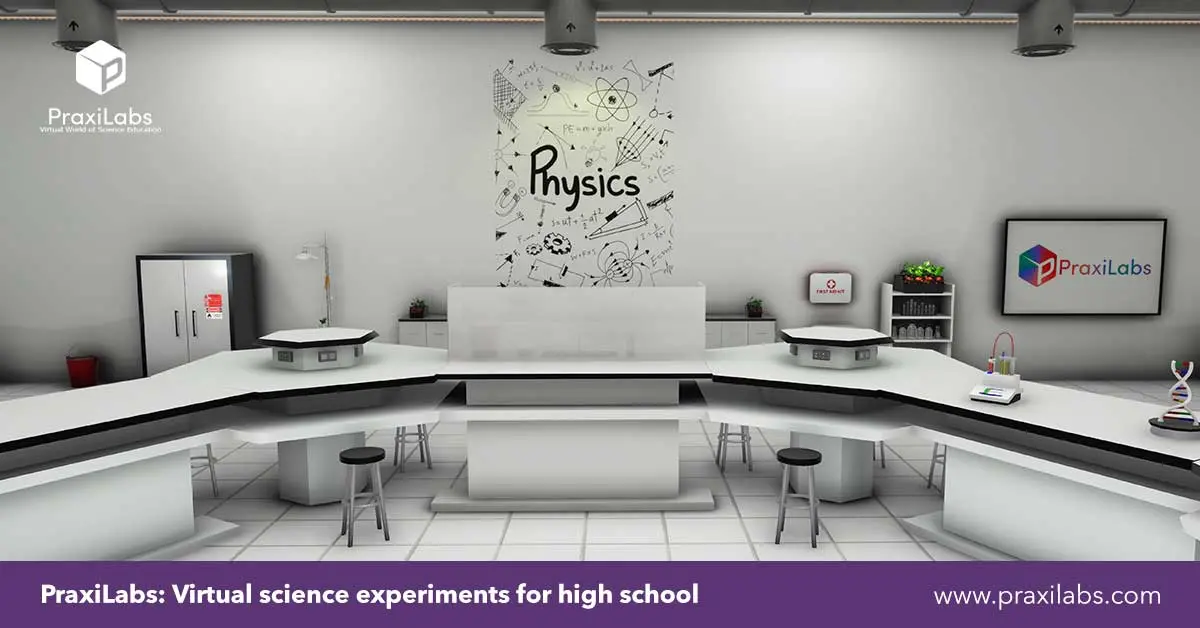
PraxiLabs: Virtual science experiments for high school
PraxiLabs science experiments for high school provides a dynamic environment where students can investigate and understand scientific concepts with a level of control and clarity that is often difficult to achieve in traditional labs.
By simulating real laboratory conditions, PraxiLabs allows students to move beyond memorization and actively perform their experiments.
We provide several virtual lab such as:
- Chemistry experiments for high school.
- Biology experiments for high school.
- Physics experiments for high school.
Explore the Virtual Physics Lab of PraxiLabs
Why use PraxiLabs for STEM experiments?
PraxiLabs has made the science learning experience in schools easier by providing interactive science labs that combine interactive technology, instructional design, and user-friendly virtual environments, helping students effectively learn fundamental scientific concepts. Here’s how this is achieved:
- Provides safe, risk-free simulations of real lab experiments.
- Enables unlimited repetition without cost or material waste.
- Covers a wide range of STEM subjects and complex experiments.
- Enhances understanding through interactive, visual learning.
- Allows students to experiment anytime, anywhere.
- Reduces dependency on physical lab availability and equipment.
- Improves concept retention through hands-on virtual practice.
- Supports self-paced and personalized learning.
- Helps teachers track and assess student performance easily.
- Prepares students for real lab work with better confidence.
- Offers consistent, accurate experimental results every time.
Frequently Asked Questions
Which skills are mainly covered in virtual labs?
Virtual labs for science experiments for high school build practical experiment skills, critical thinking, data analysis, problem-solving, and scientific observation, along with digital literacy and lab safety awareness.
What subjects benefit most from virtual labs?
Subjects like physics, chemistry, biology, and engineering benefit the most, especially those that rely heavily on experiments and simulations.
Are virtual labs used in high schools?
Yes, virtual labs for physical science experiments for high school are widely used in high schools to enhance understanding, provide safe experiment environments, and support remote or resource-limited learning.